


Attentive Interview Questions in 2026: 2 Examples

You can expect a recruiter conversation, a technical video interview, and an onsite with coding, system design, and an engineering-manager interview. The team assesses your implementation skills, system-design judgment, depth of experience, and ability to explain tradeoffs clearly during interviews.
What to Expect: Attentive Interview Process
An Attentive engineering interview guide, written by a staff engineer, says the process starts with a recruiter and continues to an onsite with coding, system design, and an engineering-manager interview. A separate recruiting presentation says the process normally takes three weeks. The exact format varies by level and specialty.
The technical interviews reflect Attentive's high-volume messaging product. Coding questions may cover parsing, logs, data structures, or business logic. Design discussions may cover throughput, reliability, event processing, customer data, and operational tradeoffs.
How to Prepare and Pass Attentive Interviews
Plan four to six weeks of preparation. Review strings, recursion, stacks, binary search, heaps, parsing, and test design. Practice designing a messaging or event-processing system with retries, idempotency, observability, and backpressure.
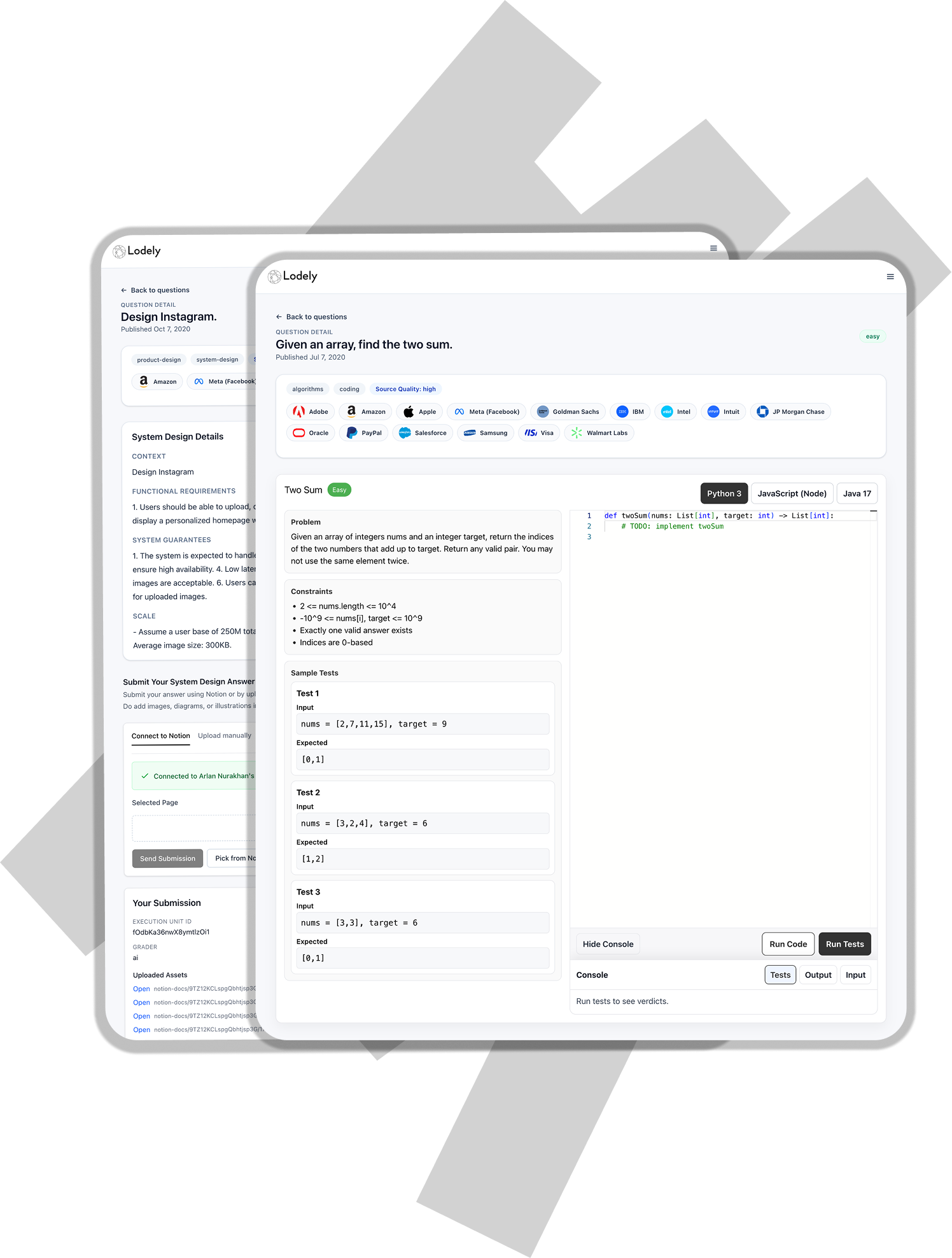
Prepare project stories about ownership, vague requirements, production issues, and delivery to other teams. Lodely lets you combine company-specific coding, system-design, and behavioral practice so your preparation covers the full onsite.

Attentive Interview Breakdown
Expression Parser
Type: Recursive parsing and scoped evaluation. The Trick: Nested expressions and variable shadowing require clean parser state and an environment that can be copied or unwound safely. What It Tests: Tokenization, grammar, variable scope, and edge-case handling.
Define a grammar for integers, variables, let, add, and multiply. Separate token advancement from evaluation. Test negative numbers, nested let expressions, reused variable names, and malformed input.
Logs
Type: Binary search over ordered records. The Trick: Find the first log at or after the start time and the first log after the end time. Repeated timestamps and inclusive bounds make off-by-one errors likely. What It Tests: Boundary handling, timestamp ordering, and output slicing.
Ask whether the input is guaranteed to be sorted, whether the interval is inclusive, and how your indexing and partitioning approach would change for a continuous stream.
Together, the two examples cover recursive parsing and high-volume log retrieval. Both reward explicit assumptions, focused tests, and complete implementations.
What Comes After The Interview
The hiring team combines feedback from the coding, design, and engineering-manager interviews before making a decision. A role can still close while interviews are underway, so keep your recruiter informed about other deadlines. If you receive an offer, compare the base salary, RSUs, and vesting schedule, including whether shares vest annually or monthly after the first year.
Candidate Experiences
One recent software-engineering candidate completed a phone screen, an assessment, and team meetings. Attentive closed the position before the process finished. The experience shows why you should keep your recruiter informed about deadlines while the role remains open.
Conclusion
Attentive rewards clean implementation, sound judgment about scalable messaging systems, and clear project stories. Rehearse both examples on Lodely, refine your reasoning, and prepare for follow-up questions in the technical screen.
✉️ Get free faang interview cheat sheet and interview tips weekly
✉️ Get free faang interview cheat sheet and interview tips weekly
