


3 Cartesia Interview Questions to Expect in 2026

Cartesia interviews vary by role. Research and applied-science candidates may use PyTorch, reason about models, and present their research. Product and systems candidates may build and debug software. Across tracks, interviewers assess how clearly you explain trade-offs and how well your experience fits low-latency voice AI.
What to Expect: Cartesia Interview Process
Candidates have described a recruiter conversation, technical screen, project deep dive with the hiring manager, and longer final loop. The final loop may include coding, PyTorch or model questions, a research discussion, and a presentation. Ask which track you're interviewing for because research and product engineering require different preparation.
Cartesia is small and growing. Interviewers may probe deeply into your past work. Explain what you did, the hardest failure you found, and whether your work changed latency, quality, or reliability.
How to Prepare and Pass Cartesia Interviews
Plan for four to six weeks if you need to refresh coding and machine-learning fundamentals. Spend the first two weeks implementing under time pressure and the next two on PyTorch, model evaluation, and concise project walkthroughs. Add two weeks if state-space models, speech systems, or production inference are new to you.
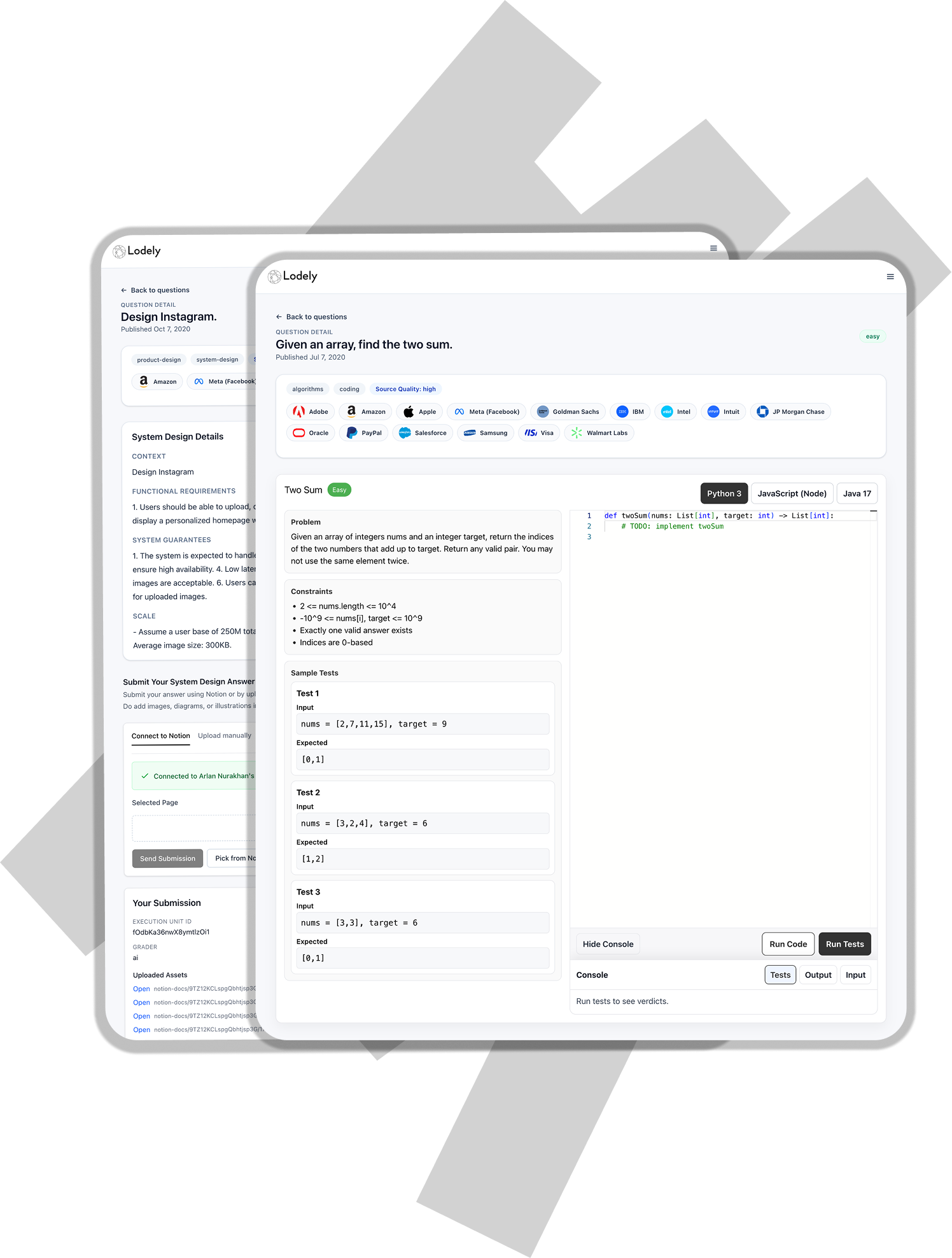
Practice company-specific backend and algorithm questions on Lodely. After each session, record the assumptions you missed and one test case that could have exposed the bug earlier.

Cartesia Interview Breakdown
Name Search
Type: String processing and search. The Trick: Define case sensitivity, punctuation handling, and partial-match rules before coding, and keep the matching logic readable. What It Tests: String normalization, matching rules, and edge-case handling.
Fraud Detection
Type: Rules, aggregation, and anomaly detection. The Trick: Decouple the data model from detection rules so new signals do not require constant rule rewrites. What It Tests: Translating ambiguous product signals into deterministic logic.
Backend Practical
Type: Production backend exercise. The Trick: Define a small functional core with explicit trade-offs that you can complete and test. What It Tests: API design, state management, testing, and engineering judgment.
What Comes After The Interview
Use the final discussion to clarify team fit and scope. Because Cartesia has limited compensation data, treat each report as one data point and ask about base salary, equity, vesting, exercise terms, and valuation. Evaluate role scope and private-company liquidity assumptions alongside total compensation.
Candidate Experiences
One candidate described four stages: a recruiter screen, PyTorch modeling, a hiring-manager review of a completed project, and a final interview series. The final interviews included algorithmic coding, a technical deep dive with the CTO, a PyTorch modeling interview, and a research talk. The candidate did not receive an offer; the sequence was specific to that role. For the research talk, prepare one presentation and be ready to defend its evaluation assumptions.
Conclusion
Cartesia evaluates implementation speed and precise technical explanations. Practice coding and technical questions on Lodely, then rehearse a concise project or research presentation.
✉️ Get free faang interview cheat sheet and interview tips weekly
✉️ Get free faang interview cheat sheet and interview tips weekly