


Chime Interview Questions in 2026: 10 Examples

Chime's software engineer interview process typically starts with a recruiter screen, followed by a one-hour coding round and then a virtual onsite with coding, system design, and behavioral interviews. You will be evaluated on algorithmic problem solving, architecture, and your ability to navigate disagreement, feedback, and tradeoff scenarios in member-facing financial systems.
What to Expect: Chime Interview Process
Recent candidates described a recruiter call, a screen on data structures and algorithms, and a multipart coding challenge. The onsite included another coding challenge, system design, a behavioral interview with the manager, and a cross-functional behavioral interview. Data-engineering roles may also include product cases and SQL.
Chime's published values emphasize members, ownership, teamwork, boldness, and respect for rules. Prepare examples that show how you protected members, worked across functions, and made decisions under regulatory and operational constraints.
How to Prepare and Pass Chime Interviews
If you code regularly, allow six weeks. Spend two weeks on arrays, strings, matrices, heaps, and graph traversal; two weeks on payment-system design; and two weeks on behavioral stories. Allow eight weeks if you need to rebuild database or distributed-systems fundamentals.
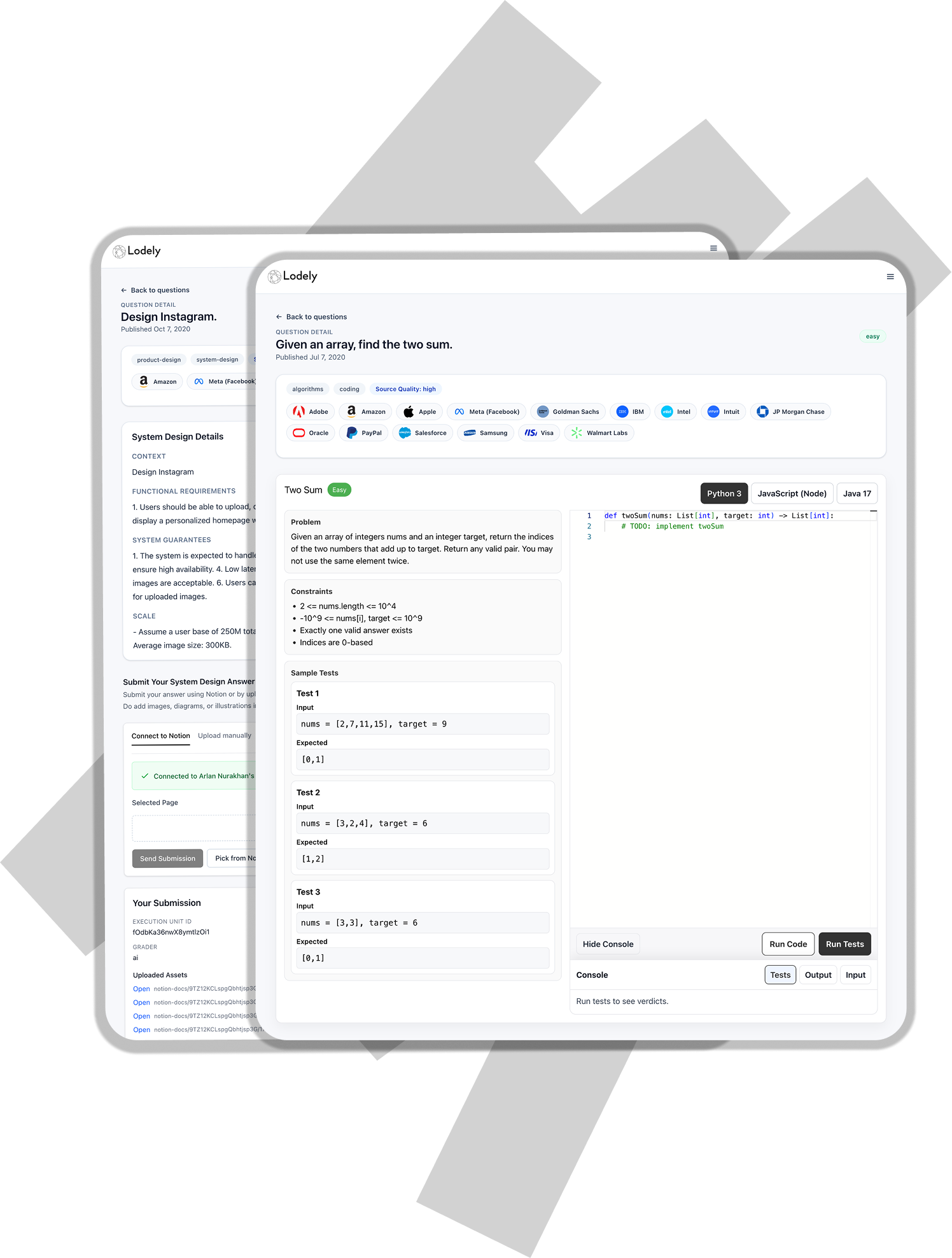
Use Lodely to practice company-specific questions and focus your time on weak areas. Work through answers aloud. Chime's loop evaluates the answer and the reasoning behind it.

Chime Interview Breakdown
Secret Guess
Type: Game logic with state tracking. What It Tests: Careful branching and use of feedback to narrow possible solutions. The Trick: State the invariant after every guess so duplicate or contradictory clues don't corrupt the solution.
Letter Combinations of a Phone Number
Type: Backtracking. What It Tests: Recursive structure, output construction, and complexity analysis. The Trick: Keep the digit-to-letter mapping separate from the search state, and handle empty input explicitly.
Spiral Matrix
Type: Matrix traversal. What It Tests: Boundary conditions and loop invariants. The Trick: After each pass, confirm that the next row or column remains within the matrix boundaries.
The remaining seven questions cover these skills. Credit Card Operation Software tests how you model credit-card payment operations. Maximum Performance of a Team tests team-performance calculation. How to Insert Into Database covers safe database writes. T9 Input Method uses dynamic search and graph reasoning. Longest Increasing Part in a Matrix also tests graph reasoning. Food Rating covers mutable data. Mine With Largest Radius of Explosion tests propagation modeling.
What Comes After The Interview
Interviewers collect feedback before making hiring and leveling decisions. U.S. software-engineer compensation varies by level, with equity and bonuses accounting for more of the package at higher levels. Compare base salary, annualized stock, bonus target, and vesting schedule when evaluating an offer.
Candidate Experiences
One recent software engineering candidate completed a recruiter screen and a one-hour data-structures-and-algorithms interview. The next stage included coding, system design, a manager behavioral interview, and a cross-functional behavioral interview. Questions covered difficult projects, disagreements, feedback, and tradeoffs. The candidate did not receive an offer. Prepare both technical and behavioral examples.
Conclusion
Chime's loop rewards strong coding, sound judgment about financial systems, and effective cross-functional work. Use Lodely to practice the full question set, then refine each answer until your assumptions and tradeoffs are clear.
✉️ Get free faang interview cheat sheet and interview tips weekly
✉️ Get free faang interview cheat sheet and interview tips weekly