




Confluent Online Assessment: Questions Breakdown and Prep Guide

Confluent's software engineering screening process varies by level and hiring path. Coding is a common early step in the documented process. One early-career candidate described a timed HackerRank round, and one senior candidate described a live technical qualifier on the platform. The exact format can also vary by team.
Prepare to solve problems involving strings, hash maps, sliding windows, caches, and time-dependent state. Senior-level candidates should also be ready to discuss trade-offs in code and distributed systems.
When to Expect the OA for Your Role
If you're applying for an early-career role, you might receive a timed coding challenge before the virtual interview loop. An early-career engineer described solving three HackerRank challenges in 75 minutes before the technical interviews. For experienced engineers, the first technical qualifier might be a live HackerRank challenge with an interviewer.
Check whether your invitation describes a live or asynchronous assessment, which languages are available, and whether you can run custom tests. These details affect how you should budget your time.
Does Your Online Assessment Matter?
The screen is part of the evaluation. Confluent does not publish an official cutoff. One recent senior applicant was asked about scalability, active state, and data structure choices. Reviewers evaluate each submission as engineering work. Confluent does not treat it as a scoring exercise.
For a live qualifier, state your assumptions before you begin coding. For a timed qualifier, leave time to test empty inputs, repeated keys, old timestamps, and large inputs.
Compiled List of Confluent OA Question Types
These problems cover parsing, caching, indexing, time-window state, and service-oriented architecture patterns.
- Number of Atoms — Stack parsing with nested counts.
- LRU Cache - Constant time lookups, updates, and evictions.
- Wildcard Matching — string matching with wildcards.
- Implement Trie - prefix index and fast lookup of functions
- Time Based Key-Value Store - storing and retrieving state by timestamp.
- Sliding Window Maximum — bounded-window aggregation with tight complexity.
- Encode and Decode TinyURL - Mapping of identifiers and service boundaries.
- Word Search II - Trie-based search across multiple candidate words
- Design In-Memory File System - hierarchical state and API contracts.
- Longest Repeating Character Replacement - Sliding-window frequency tracking.
How to Prepare and Pass the Confluent Online Assessment
Use a two-week plan. In week 1, practice strings, hash maps, tries, and windowed state. In week 2, alternate 60- to 75-minute mocks with review. Use the language in which you can debug fastest.
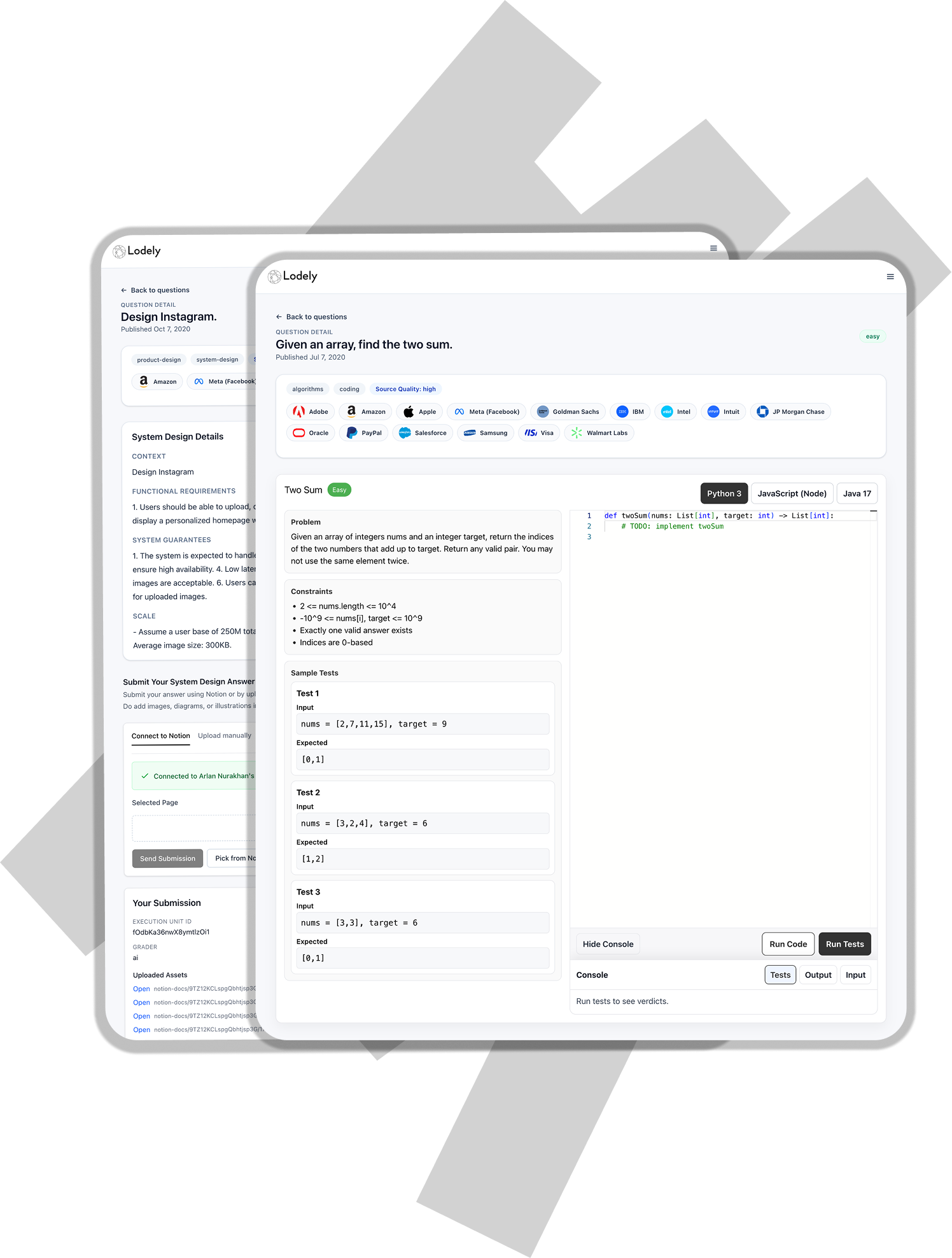
Write small tests before submitting. Cache and timestamp problems often expose bugs involving overwrites, expiration edge cases, and reordered events. After each mock, write down the invariant your solution maintains. Lodely can help you rotate through Confluent-specific coding and design prompts without repeating the same prompt.
Confluent Interview Question Breakdown
LRU Cache
Type: Data-structure design. Prompt: Store key-value pairs and remove the least recently used entry, sometimes within a time window. The Trick: Lookup, access tracking, and removal must stay coordinated. What It Tests: State modeling, complexity analysis, and edge cases.
Number of Atoms
Type: Parsing with stacks and maps. Prompt: Read a nested expression and count element occurrences. The Trick: Multipliers affect whole groups, including nested groups. What It Tests: Tokenization, stack management, and precise counting.
What Comes After the Online Assessment
One early-career candidate described data structure and concurrency rounds after the OA. One senior candidate described system design, a project deep dive, and an engineering-values conversation. The mix depends on level. In later rounds, explain the constraints and alternatives behind your OA decisions, and connect correctness to reliability.
Conclusion
Prioritize caches, time-window state, parsing, and clean testing under a fixed time limit. Use Lodely to keep company-specific questions in your daily routine.
✉️ Get free faang interview cheat sheet and interview tips weekly
✉️ Get free faang interview cheat sheet and interview tips weekly