


Decagon Interview Questions: 2 Questions to Prepare for in 2026

Decagon's software-engineering process follows a startup-style loop covering coding, practical implementation, system design, and operational judgment. The two most recent reports describe a recruiter discussion, one or two coding screens, and a multisession onsite with another coding screen, system design, a project deep dive, and a hiring-manager discussion.
What to Expect: Decagon Interview Process
You'll start by talking with a recruiter or team member about your motivation and high-impact work. Technical interviews may include algorithm questions and implementation challenges. The onsite often bases system-design and behavioral questions on AI-agent reliability, integration challenges, and customer-facing systems. Decagon's current engineering roles require fast execution, good product judgment, and high-quality production AI systems, so prepare examples that demonstrate all three.
How to Prepare and Pass Decagon Interviews
If you already work with backend systems and have applied AI experience, spend four to six weeks. Plan eight weeks when the process includes live coding or LLM-reliability design.
- Complete the implementation. Given a brief prompt, build a working interface with tests, error handling, and sound state management. Implementation gaps matter in a startup work sample.
- Design for incorrect answers. Evaluate an AI-agent system for coverage, fallback behavior, human escalation, data freshness, observability, and safe retries. Include failure paths in the design.
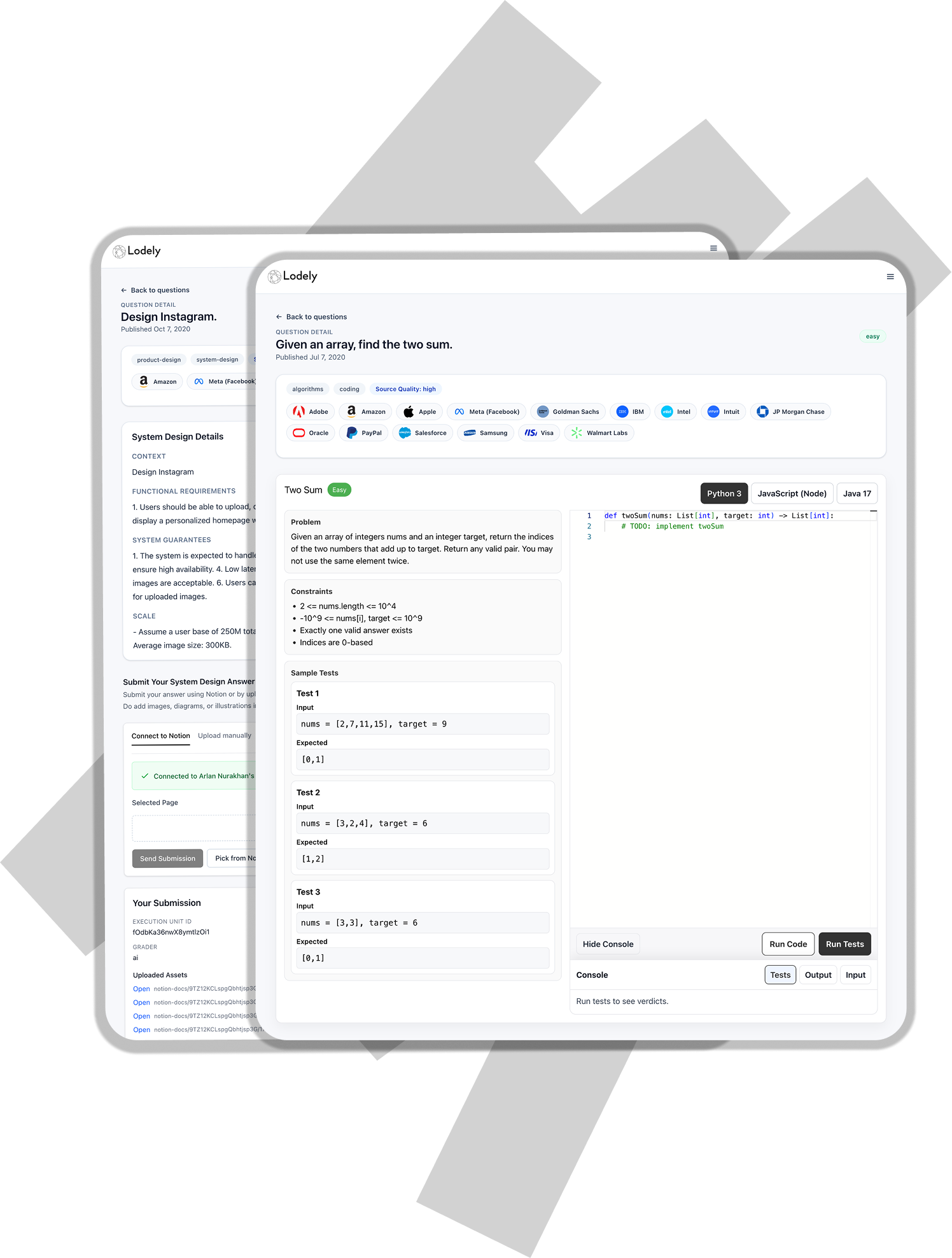
- Understand how customer-support agents use knowledge and tools and how teams evaluate their resolution quality. Use Lodely to practice coding and system-design questions alongside behavioral questions about ownership.

Decagon Interview Breakdown
Skyline Buildings
Type: Sweep-line algorithm with ordered data structures. The Trick: Multiple start and end points can share a coordinate, so handle ordering and duplicate points carefully. What It Tests: Algorithm selection, invariants, and edge-case control.
Function Time
Type: Stack-based event processing. The Trick: Time spent in nested functions does not count toward the parent call, so track the active function and elapsed time as start and end events arrive. What It Tests: State reconstruction and careful boundary calculations.
These are the only two selected questions on this page. Because the set is small, focus on depth: explain the invariant, walk through an example, show how tied events or nested calls work, and state the complexity without prompting.
What Comes After The Interview
Hiring may move quickly after the onsite, though the process may add a founder or team interview if the role's scope changes. As of September 2026, the median software-engineer package at Decagon is $510K, with reported packages up to $575K. Those figures come from a small public sample. Separate cash from annualized private-company equity, and ask about valuation and vesting assumptions.
Candidate Experiences
One recent software-engineering candidate described a live screen in which the interviewer arrived a few minutes late and gave little guidance after introducing the problem. The problem was fairly common, but the limited guidance made the correct approach difficult to identify. The candidate did not receive an offer. During a similar interview, state your assumptions, propose a plan, and confirm the approach with the interviewer before coding.
Conclusion
Decagon's loop values fast implementation, reliable AI-system design, and ownership of ambiguous work. Use Lodely to rehearse answers to these questions, then explain how your design responds when models, tools, or integrations fail.
✉️ Get free faang interview cheat sheet and interview tips weekly
✉️ Get free faang interview cheat sheet and interview tips weekly