





Google Cloud (GCP) Interview Questions: 9 Questions to Prepare for in 2026

Google Cloud interviews assess coding, system design, role-related knowledge, and Googleyness and leadership. The interview process includes an initial interview with a recruiter, coding screen, four to five interview sessions, hiring review, and team matching.
What to Expect: Google Cloud Interview Process
The technical screen generally lasts 45 minutes and uses a shared editor. The full loop may cover coding, system design for experienced candidates, Googliness, and leadership. Interviewers submit independent evidence against a rubric, and a hiring committee reviews the packet. A follow-up interview may address a weak or incomplete signal. After approval, a team-match interview connects the candidate with an open role. This process overview explains the packet and hiring committee stages.
How to Prepare and Pass Google Cloud Interviews
Allow six to eight weeks if your algorithms and distributed-systems knowledge are current. Plan for ten to twelve weeks if you need to rebuild those skills.
- Make your reasoning visible. State your invariant, compare alternatives, and test the code by hand. Give the interviewer clear evidence against the rubric.
- Design for operations. Discuss capacity, replication, failure domains, rollout, observability, access control, and cost. Explain how each choice affects production reliability.
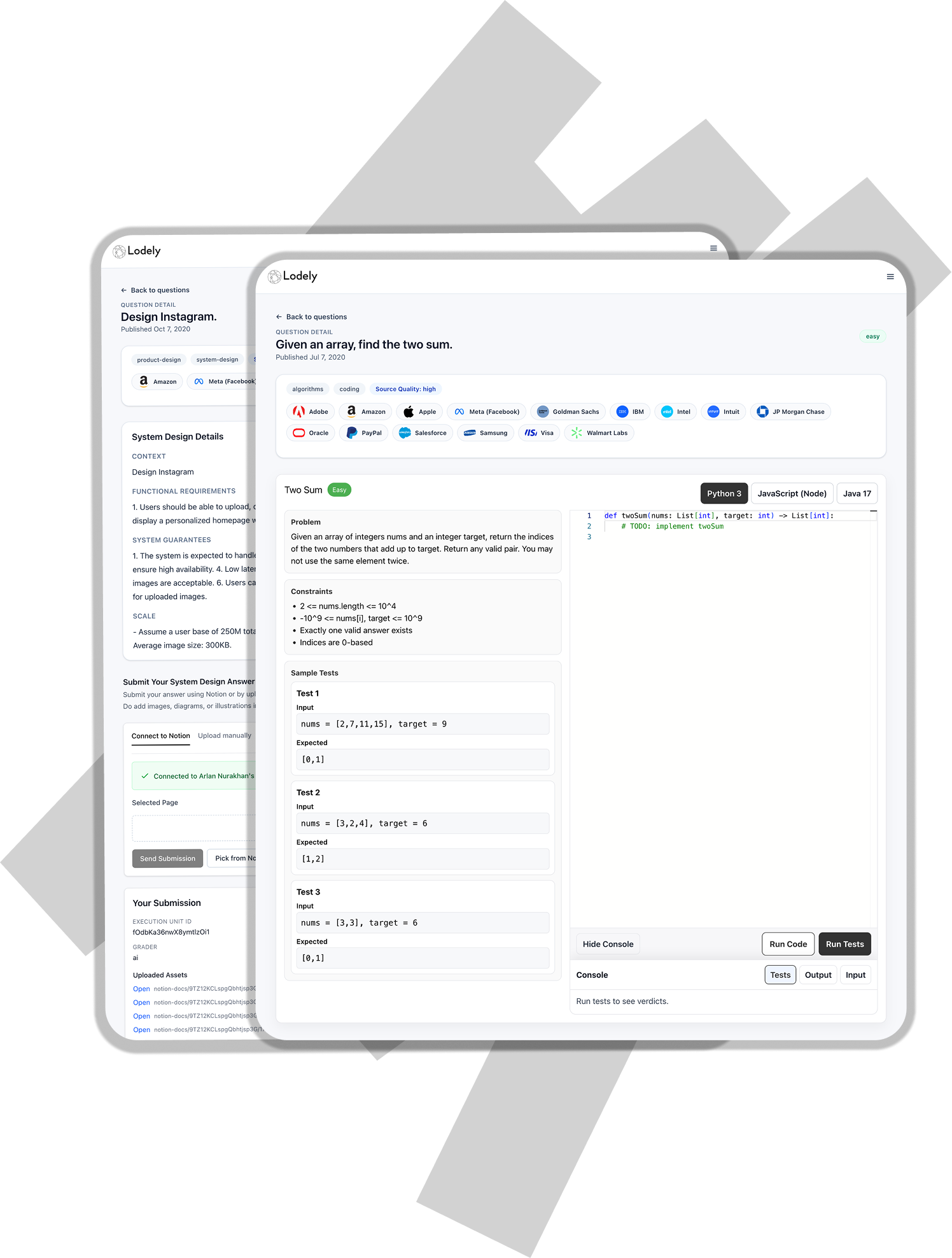
- Prepare leadership evidence. Build stories about ambiguity, missed deadlines, conflict, and influence. Use Lodely to practice coding, system-design, and behavioral questions as one Google Cloud loop.

Google Cloud (GCP) Interview Breakdown
Design a reservation and payment system for a parking garage
Type: System design. The Trick: Keep inventory and payment state consistent when concurrent users request the last available space. Explain holds, expiration, idempotency, and reconciliation. What It Tests: Transaction boundaries and system design.
Why do you think we should not hire you?
Type: Behavioral judgment. The Trick: Choose a real weakness, explain how you limit its impact, and describe the system you use to manage it. What It Measures: Self-awareness and candor.
Merge Intervals
Type: Sorting and interval processing. The Trick: Define how touching intervals should behave, sort the input once, and track one current interval. What It Tests: Algorithmic clarity.
The other six questions cover distributed systems, behavioral judgment, and algorithms. Ordered Log File and Web Crawl test distributed-systems reasoning. A question about missing a deadline tests ownership. Generate Parentheses, Subarray Sum Equals K, and Merge K Sorted Lists test backtracking, prefix sums, and heap merging, respectively.
What Comes After The Interview
Team matching and committee review can take weeks. U.S. reports from September 2026 list total compensation of $198K at level 3, $294K at level 4, $436K at level 5, and $647K at level 6. Stock and bonus grow substantially at higher levels and are important when comparing levels.
Candidate Experiences
One recent Google Cloud Developer candidate described an initial screen followed by separate leadership and coding interviews. After receiving positive feedback, the candidate met with a hiring manager, but the position closed before an offer. The recruiter reopened the packet for another team, which required an additional infrastructure interview. That path did not lead to an offer. Strong interview feedback and available headcount remain separate decisions.
Conclusion
Google Cloud interview questions test whether you can explain your reasoning, design systems for production, and lead through ambiguity. Use Lodely to practice the nine questions with the pacing and structure of the interview rubric.
✉️ Get free faang interview cheat sheet and interview tips weekly
✉️ Get free faang interview cheat sheet and interview tips weekly