

Google DeepMind Interview Questions: 5 from Real Interviews

Google DeepMind uses a four-stage interview process: first interviews, skills interviews, final interviews, and the decision and offer. The full process can take four to ten weeks, and most interviews are virtual (Google DeepMind interview guide).
The format depends on the role. A general software-engineering loop may cover coding and system design. ML and research-engineering roles examine domain knowledge, ML design, and project work in more depth. Your recruiter should explain the role-specific format once the process begins.
What to Expect: Google DeepMind Interview Process
Initial meetings cover your background, motivation, and fit with the company's mission. Skills interviews evaluate the capabilities listed in the job description. Final interviews may combine coding, design, behavioral assessment, and cross-functional collaboration before feedback moves to the decision stage.
The guide describes competency-based evaluation and recommends concise STAR examples. It asks candidates to explain their reasoning, acknowledge uncertainty, and support answers with data. It also says candidates may not use AI tools during live interviews unless told otherwise.
How to Prepare and Pass Google DeepMind Interviews
Plan for eight to ten weeks for an ML-related role. Start with coding consistency, then divide your time among scalable systems, ML fundamentals, and the team's technical domain. Prepare project examples with metrics, failed experiments, and the reasoning behind important decisions.
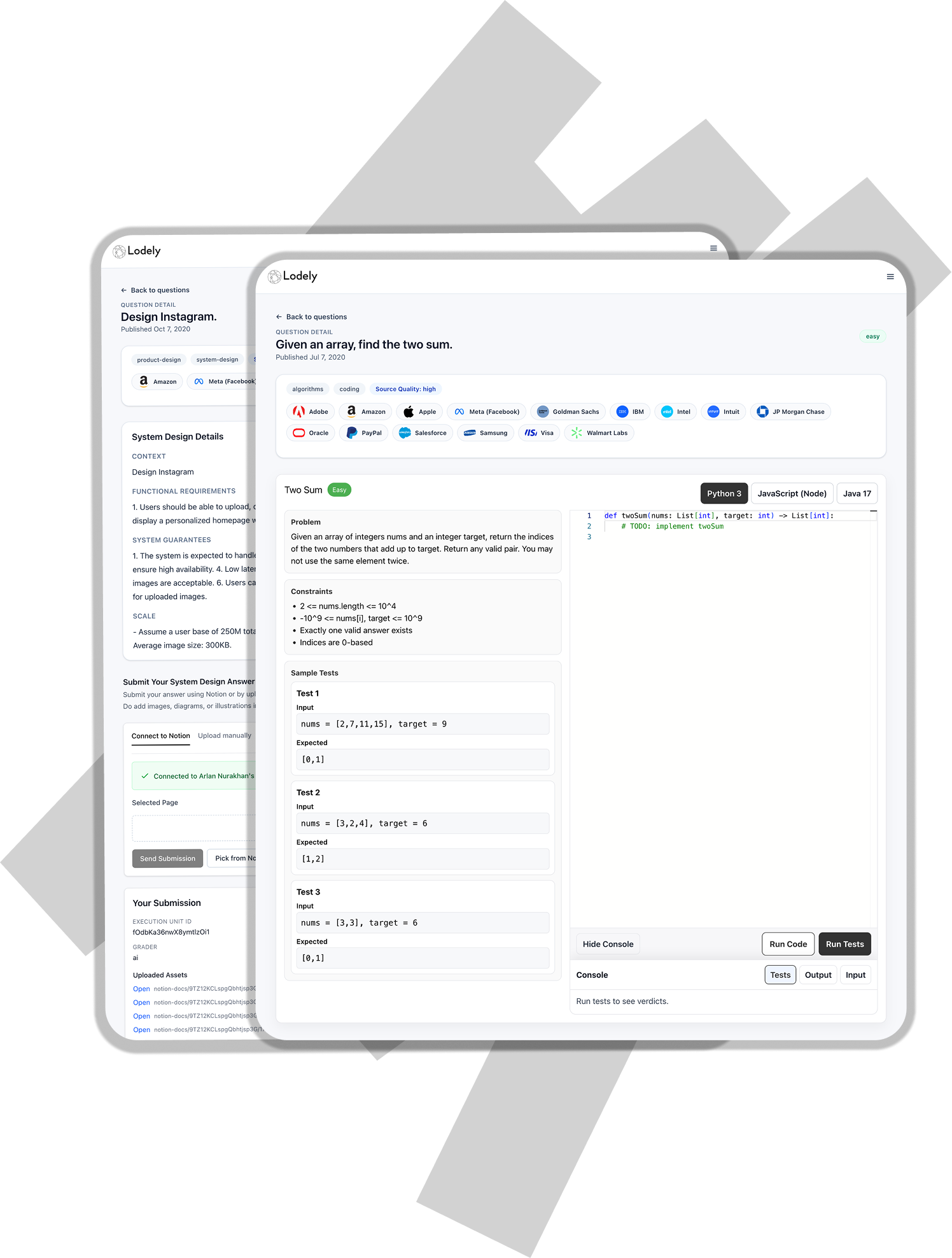
Use Lodely to practice Google DeepMind coding, design, and behavioral questions in one plan. In timed mocks, justify your assumptions and revise your answer when the interviewer adds new information.

Google DeepMind Interview Breakdown
Design a Parking Reservation and Payment System
Type: System design. The Trick: Keep space inventory, holds, payment state, expiration, and duplicate requests consistent. What It Tests: Data modeling, APIs, and failure recovery.
Why Should We Not Hire You?
Type: Behavioral self-assessment. The Trick: Choose a genuine weakness with limited impact and explain how you manage it. A disguised strength evades the question. A weakness without clear limits creates unnecessary risk. What It Tests: Intellectual honesty and evidence of improvement.
Merge Intervals
Type: Sorting and interval coding. The Trick: State the boundary conditions and merge invariant clearly. What It Tests: Algorithm choice, implementation, and verification.
The final two examples are Target Sum in an Array, which tests hash-table reasoning and edge cases, and Design a System to Log Messages in Order, which tests ordering, distributed clocks, buffering, and recovery.
What Comes After The Interview
The guide says feedback may take a few days and that delays do not imply rejection. As of 2026, reported total compensation for U.S. Google software engineers is $197,000 at level 3, $293,000 at level 4, and $442,000 at level 5. Stock accounts for most of the increase between levels.
Candidate Experiences
A recent software-engineering candidate in Bengaluru described two coding rounds, one ML system-design round, and one behavioral values round. The coding rounds required executable solutions to problems such as graph traversal and a greedy-algorithm task. The candidate found system design hardest because it required careful discussion of scalability and tradeoffs. Prepare general coding problems first, then study the team's technical domain in depth.
Conclusion
Google DeepMind looks for clear reasoning, measurable impact, and technical depth suited to the role. Use Lodely to practice the five selected questions as part of a balanced full-loop plan.
✉️ Get free faang interview cheat sheet and interview tips weekly
✉️ Get free faang interview cheat sheet and interview tips weekly