





Qualcomm Online Assessment: Questions Breakdown and Prep Guide

Qualcomm uses different online screens for software, data, and hardware roles. A publicly available HackerRank test for a senior data engineering role has four questions, including coding and database tasks, to complete in 83 minutes. Other documented software assessments include questions about C/C++, operating systems, architecture, and data structures. Use your invitation as the definitive source for format and language rules.
When to Expect the OA for Your Role
The assessment generally occurs soon after you apply and before technical interviews. Software and embedded roles may use a programming assessment or a mix of technical screening questions. Some roles may use a digital electronics assessment instead. Some experienced candidates may proceed directly to a recruiter or to technical interviews, so the process may vary by candidate.
Does Your Online Assessment Matter?
The OA helps determine who advances. It tests whether submitted code passes test cases. MCQ-heavy screens also test fundamentals across languages and systems. Some Qualcomm OAs use negative marking, so correct answers matter more than random guesses. No public source lists a universal cutoff. The hiring team and recruiter assess applicants for the role.
Compiled List of Qualcomm OA Question Types
These problems cover linked lists, graphs, strings, arrays, caches, and search patterns useful for Qualcomm software screens.
- Reverse Linked List - Pointer manipulation and edge cases.
- Number of Islands - DFS or BFS for grid traversal.
- Valid Parentheses - stack parsing.
- Merge Two Sorted Lists - pointer-based merging of sorted lists.
- Single Number - bit manipulation and invariants.
- Search in Rotated Sorted Array - binary-search partitioning.
- LRU Cache - hash maps and constant-time evictions.
- Longest Substring Without Repeating Characters - sliding-window state.

How to Prepare and Pass the Qualcomm Online Assessment
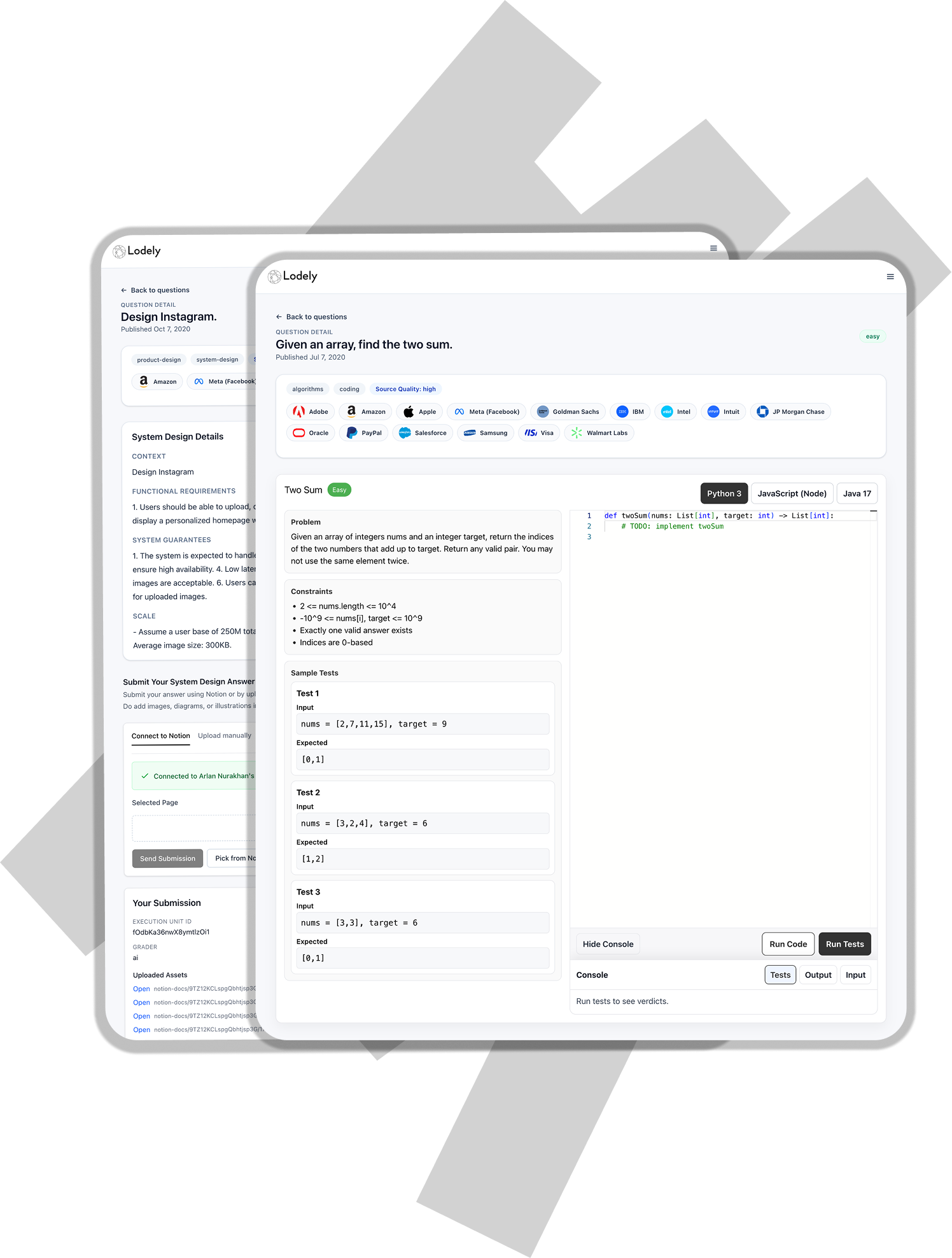
Start by reviewing the role named in your invitation. For embedded or systems roles, spend a few days reviewing pointers, memory layout, bitwise operations, C/C++ output tracing, operating systems, and computer architecture. For more general software roles, add arrays, strings, linked lists, trees, and graph traversal. Complete two timed mock assessments in the allowed language, reserving the final 10 minutes to test edge cases. Use Lodely to move from OA patterns to Qualcomm technical interview questions while keeping the same context.
Qualcomm Interview Question Breakdown
Reverse Linked List
Type: linked-list manipulation. Prompt: Reverse a singly linked list. Approach: Save the next node before changing a pointer. This tests state tracking, null handling, and clear low-level reasoning.
Number of Islands
Type: grid-graph traversal. Prompt: Count the disconnected land regions in a binary matrix. Approach: Mark visited cells and handle boundaries consistently. This tests traversal-algorithm selection, complexity analysis, and defensive indexing.
What Comes After the Online Assessment
Expect multiple technical interviews followed by a manager or HR conversation. Prepare for deeper questions about projects, C/C++ or your chosen language, operating systems, debugging, and role-specific architecture. Apply the same attention to detail you used in the OA, and practice explaining tradeoffs aloud because live rounds evaluate both reasoning and code.
Conclusion
Prepare for the role-specific mix in your invitation. Combine timed coding practice with a review of the systems fundamentals relevant to the job.
✉️ Get free faang interview cheat sheet and interview tips weekly
✉️ Get free faang interview cheat sheet and interview tips weekly