


Samsara Online Assessment: Questions Breakdown and Prep Guide

Samsara's software screens differ by role. One intern candidate described an online assessment with two easy-to-medium coding problems and multiple-choice questions in Go and Python. Candidates in senior and specialist pathways may receive a take-home task or recruiter screen. Check your invitation to confirm which assessment your role requires, then tailor your study plan.
When to Expect the OA for Your Role
Intern and new-graduate candidates often receive the assessment before the recruiter call and technical interview. Experienced candidates often speak with a recruiter first, then complete a live interview or take-home task. Language-specific multiple-choice practice is more useful when the job description mentions Go, Python, or another stack.
Does Your Online Assessment Matter?
The OA helps determine who advances. Coding sections test functionality and edge cases. Language questions check your understanding of the stack without requiring every snippet to run. Samsara does not publish a general cutoff. Solve the easier problem first, then use the remaining time to attempt the harder problem and review your work once.
Compiled List of Samsara OA Question Types
These problems cover caches, intervals, parsers, queues, and stateful services found in Samsara's coding material.
- LRU Cache - constant-time cache operations.
- Meeting Rooms II - concurrent interval counting.
- Merge Intervals - sorting and merging overlapping intervals.
- Design HashMap - keys, collisions, and mutable storage.
- Insert Interval - ordered range insertion.
- Minimum Window Substring - constrained sliding windows.
- Decode String - stack-based parsing.
- Design Circular Queue - bounded state and wraparound.

How to Prepare and Pass the Samsara Online Assessment
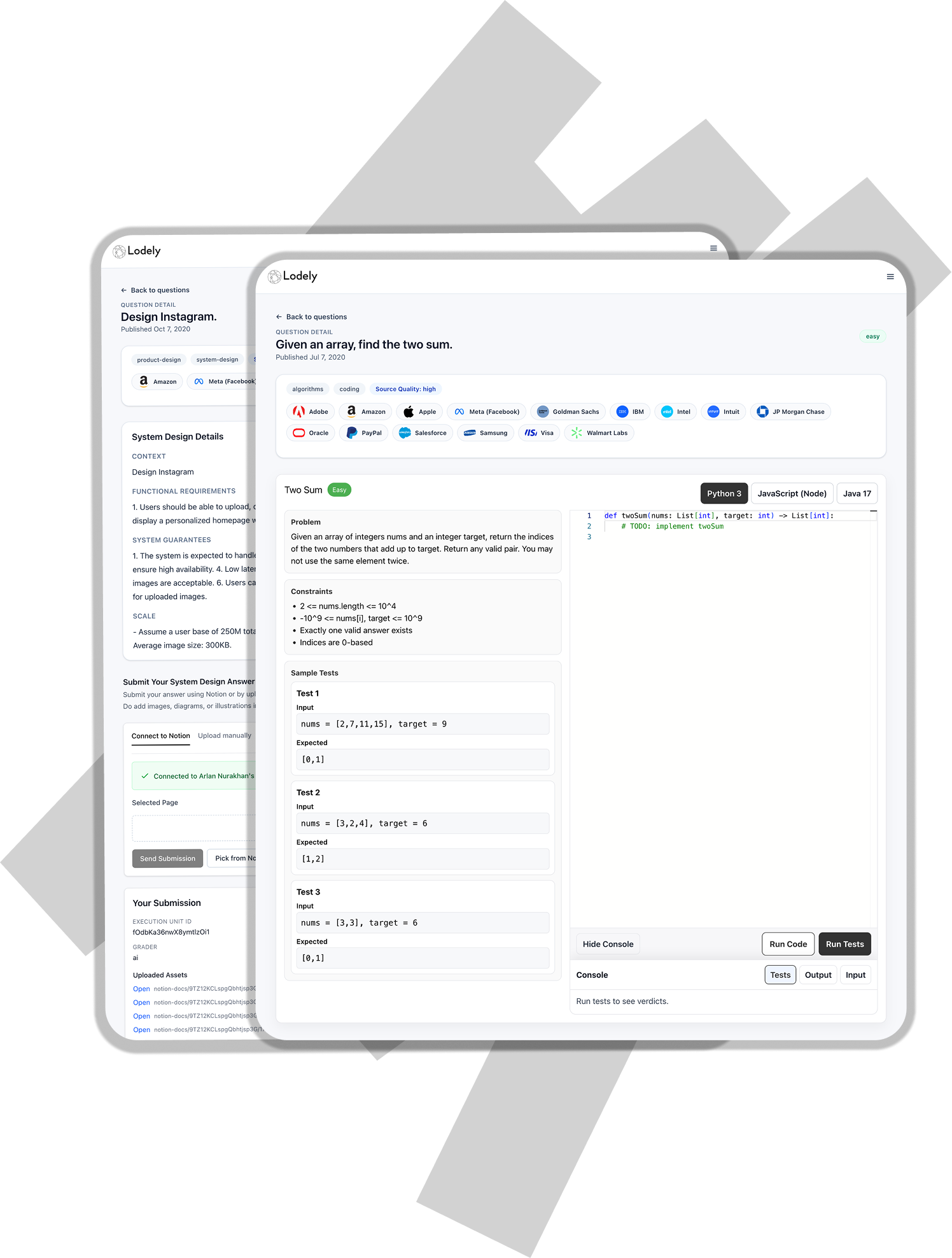
Do two timed sessions with two medium problems. Focus on arrays, strings, hash maps, intervals, parsers, and other common stateful designs. If the job description mentions Go or Python, complete short drills on language semantics, collections, concurrency primitives, and error handling. Test empty streams, overlapping ranges, duplicate keys, and capacity boundaries. Use Lodely to apply these patterns to Samsara technical interview and system design preparation.
For each mock test case, use a short checklist: parsing constraints, problem complexity, the smallest case, and inputs with no valid result.
Samsara Interview Question Breakdown
LRU Cache
Type - Stateful data structure. Prompt - Store key-value pairs with a fixed size and most recently used removal. The Trick - Maintain a lookup and recency state during every operation. What It Tests - Invariants, Mutation, Complexity
Meeting Rooms II
Type: Intervals Prompt: Find the maximum number of meetings that happen at the same time. Approach: Handle simultaneous starts and ends consistently. This tests event ordering and edge-case handling.
What Comes After the Online Assessment
Candidates who pass may move to a recruiter screen, a technical coding screen, and a live coding round. Some processes also include design and behavioral rounds. The coding rounds often emphasize data processing over puzzles. Practice solving problems with unclear requirements and turning messy input into maintainable code.
Conclusion
Prepare for a small coding test and review the programming language used by the team interviewing you. All these coding challenges require close attention to state and edge cases.
✉️ Get free faang interview cheat sheet and interview tips weekly
✉️ Get free faang interview cheat sheet and interview tips weekly