

Sierra AI Interview Questions: 8 Questions to Prepare for in 2026

Sierra changed its engineering interview in 2026 to reflect AI-assisted product work. The current loop focuses on system design, and the onsite involves planning, building, and reviewing a product with AI tools. The company is also piloting a debugging loop in an existing codebase.
What to Expect: Sierra AI Interview Process
According to its April 2026 interview update, Sierra has removed its coding and algorithms interviews. It replaced the coding interview with a system-design interview. The onsite includes three stages: plan a product with interviewers, build it independently for two hours using your preferred AI tools, and review its product flows, code, abstractions, and path to production.
The company is currently running a small-team interview centered on debugging a medium-sized codebase and a draft pull request. Sierra aims to evaluate product thinking, technical judgment, initiative, and the candidate's ability to scope work under time pressure. The interviews take place in an office because Sierra has an office-based culture.
How to Prepare and Pass Sierra AI Interviews
Give yourself six to eight weeks. Spend the first two weeks designing an AI-agent system, including tool calls, retrieval, state, evaluation, observability, and safe fallbacks. Next, run two-hour build sessions. End each session with demos, code review, and a production-readiness assessment.
Scope aggressively. Choose one user, one valuable workflow, and one success measure. A smaller, complete product is better suited for review.
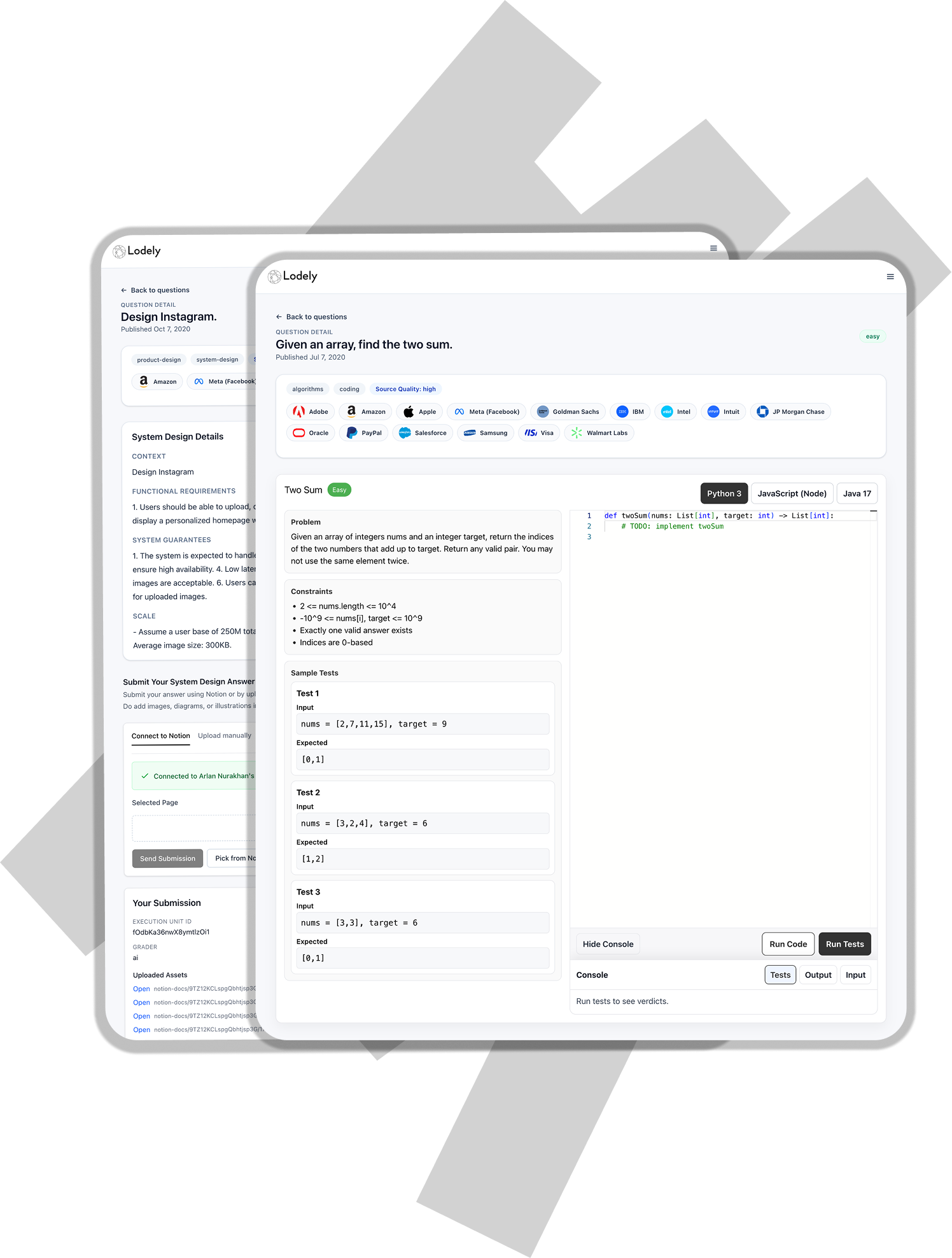
Audit the AI-generated output. Explain what it generated, what you tested, and where you overruled it. Use Lodely to practice system-design, coding, and behavioral questions with editorials before using AI tools in the interview.

Sierra AI Interview Breakdown
Build a customer service AI agent for a hypothetical outdoors company
Type: AI product build. Focus areas: Scoping, tool use, product judgment, and production thinking. The Trick: Pick a narrow workflow and decide what you want it to do, how it should fail, and how to measure it before adding features.
Implement spreadsheet dependency traversal and detect circular references
function hasCycle(n, edges)- Given a directed graph with n nodes labeled 0..n-1 and edge list edges, return true if the graph contains a cycle, otherwise false.
1 <= n <= 10^50 <= edges.length <= 2 * 10^5
n = 4, edges = [[0,1],[1,2],[2,0]]
true
n = 4, edges = [[0,1],[1,2],[2,3]]
false
Type: Directed-graph coding. What It Tests: Modeling dependencies, traversal, and cycles. The Trick: Keep track of visited nodes and the active traversal path to distinguish between shared dependencies and cycles.
Explain how retrieval-augmented generation works
Type: Technical concept and exercise. What It Tests: AI basics and concise communication. The Trick: Connect retrieval, ranking, context building, generation, and evaluation without relying on jargon.
The remaining examples cover cell validation, inventory synchronization, word search in a grid, stakeholder alignment with competing priorities, and a project you're proud of. For each example, prepare to discuss edge cases, production numbers, and your personal decisions.
What Comes After The Interview
Sierra is the next step after reference checks and offer decisions. When reviewing compensation, separate salary from any private equity. Ask which valuation the grant uses, what happens if you leave, and how refresh grants work.
Candidate Experiences
A recent Agent Engineer candidate reported a six-week process: a recruiter screen, a one-hour coding screen, a take-home agent project, and three one-hour onsite interviews. For the take-home, the candidate completed a small customer-support agent and chose the metrics and observability tools. The onsite covered debugging, a project presentation, and a hiring-manager discussion. The candidate found debugging particularly challenging because it used TypeScript and React, while Python was their strongest language. This account predates the AI-native interviews but still shows the value of practicing code review in unfamiliar languages.
Conclusion
Sierra's current process rewards product scope, system knowledge, and careful use of AI tools. Use Lodely to work through the eight questions, then rehearse the plan-build-review process within a two-hour limit.
✉️ Get free faang interview cheat sheet and interview tips weekly
✉️ Get free faang interview cheat sheet and interview tips weekly