


3 Toast Interview Questions to Expect in 2026

Toast candidates usually begin with a recruiter phone interview, followed by a hiring-manager conversation or job-related assessment, then a video panel interview and potentially a case study. The FAQ on Toast's Careers page states that interviewers ask behavioral questions based on specific examples from your work history and technical questions that require solving problems on the spot.
What to Expect: Toast Interview Process
Toast's technical interview preparation guide includes restaurant-domain exercises for coding, code review, and greenfield architecture. JavaScript, Java, Python, and Kotlin are all commonly used. Interviewers want to see that you understand edge cases, testing, scalability, and collaboration. Topics can include graphs, data structures, concurrency, data modeling, common architecture patterns, and cloud infrastructure.
The format depends on your role. Senior candidates may complete separate rounds for coding, API design, code review, system design, culture, and executive conversations. Ask your recruiter to confirm their order.
How to Prepare and Pass Toast Interviews
Create a six-week schedule focused on product-oriented exercises. First, practice strings, trees, graphs, collections, and nested data. Then build restaurant systems that remain correct when traffic is heavy, retries occur, partial failures are common, and menus change. During code review, explain what you would fix first.
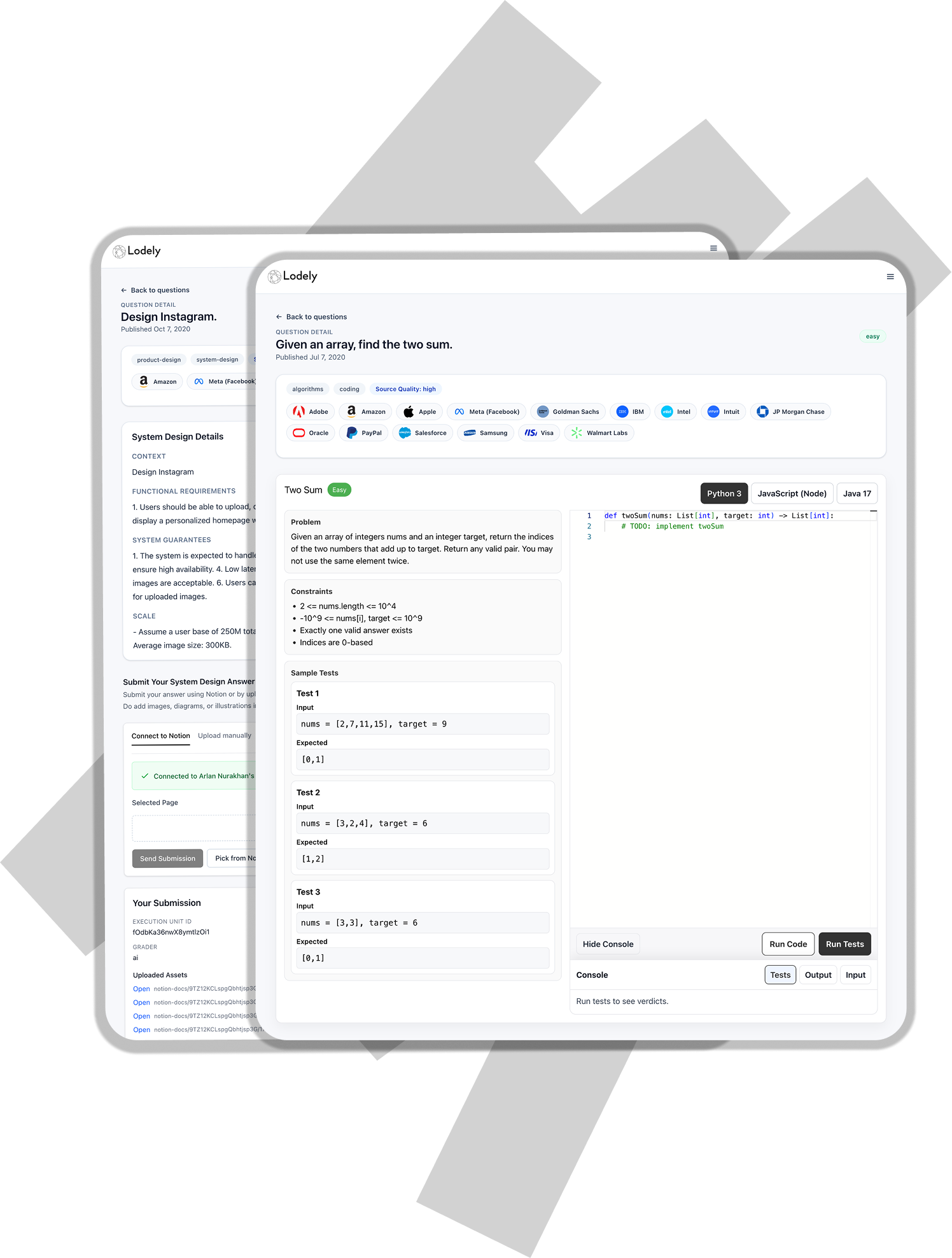
Practice the Toast coding challenge on Lodely in the language you will use during the interview. Add tests as you work. Toast's documentation stresses code correctness and maintainability, along with collaboration while solving the problem.
For system design, trace an order from the handheld to the payment, kitchen, and reporting services. Explain how the system responds if the network drops or a retry occurs. During code review, assess correctness separately from maintainability and explain your review order.

Toast Interview Breakdown
String Search
Type: Iterator coordination and document lookup. The Trick: Use the provided cursor operations correctly and return each matching document once. What It Tests: API knowledge, iteration state, and deduplication.
Palindrome with Restriction
Type: Unicode-aware two-pointer scan. The Trick: Consider only alphabetic characters, normalize case, and keep the algorithm within linear time and constant space. What It Tests: Text handling and precise reading of constraints.
Menu Price Resolution
Type: Tree traversal and inheritance. The Trick: A menu item without a price inherits the closest available price from its container group or menu. What It Tests: Recursive data modeling and correctness of business rules.
What Comes After The Interview
When a recruiter contacts you after the panel and case study, review the level and equity if you receive an offer. In the U.S., offers range from SE1 to SE5, and stock starts playing a role in compensation at SE2+.
Candidate Experiences
One recent senior software candidate with six years of experience described five rounds and did not receive an offer. The loop covered timed coding, REST API design, code review, a restaurant table-booking system design, and a behavioral conversation with the hiring manager. The tasks moved from implementation detail to product architecture while staying close to Toast's restaurant domain. Prepare to review unfamiliar code and defend API consistency as carefully as you solve the initial coding task.
Conclusion
Toast interviews reward practical code, maintainable design, and concrete examples of collaboration. Use Lodely's Toast questions to practice the restaurant-domain decisions that distinguish this loop.
✉️ Get free faang interview cheat sheet and interview tips weekly
✉️ Get free faang interview cheat sheet and interview tips weekly