




Upstart Online Assessment: Questions Breakdown and Prep Guide

Upstart's process includes coding interviews and may begin with a timed coding challenge before the live rounds. Upstart's public guidance says your recruiter will clarify whether AI tools are allowed for the challenge. The number of questions may vary by team and interview timing.
Follow the invitation's requirements. Check its expiration time, rules for the coding editor, and collaboration policy before you begin.
When to Expect the OA for Your Role
For early- to mid-career software roles, the OA may come after the application or recruiter conversation and before the technical screen. For senior roles, the process may use live coding, a project discussion, or system design. Upstart's process varies by product, so your hiring steps may differ from another candidate's.
If an assignment allows AI assistance, you must describe what the AI produced, what you changed, and why. Upstart evaluates understanding, judgment, explanation, and ownership.
Does Your Online Assessment Matter?
The assessment determines whether you advance. Upstart does not publish a cutoff. Correctness matters. Clean structure, edge-case handling, and an explanation you can defend also prepare you for later rounds. A partial solution with clear reasoning is better than rushed code you cannot explain.
Compiled List of Upstart OA Question Types
These problems cover string processing, arrays, grids, stacks, and implementation patterns useful for Upstart screens.
- Simplify Path - stack-based path simplification.
- Valid Anagram - frequency counting and string comparison.
- Decode String - parsing nested strings with stacks.
- Reverse String II - string transformation.
- Word Search - grid traversal with backtracking.
- Spiral Matrix - grid iteration with boundary tracking.
- Two Sum - hash-map lookup in an array.
- Group Anagrams - canonical keys for grouping strings.
- Minimum Remove to Make Valid Parentheses - stack or counter validation.
- Subarray Sum Equals K - prefix sums and frequency maps.

How to Prepare and Pass the Upstart Online Assessment
Complete three practice sessions on strings and arrays, then one on grids and stacks. For each problem, name the data structure, write two small examples, and reserve the final 25% of your time for testing. Before coding, practice reducing a long problem description to a small input-output specification.
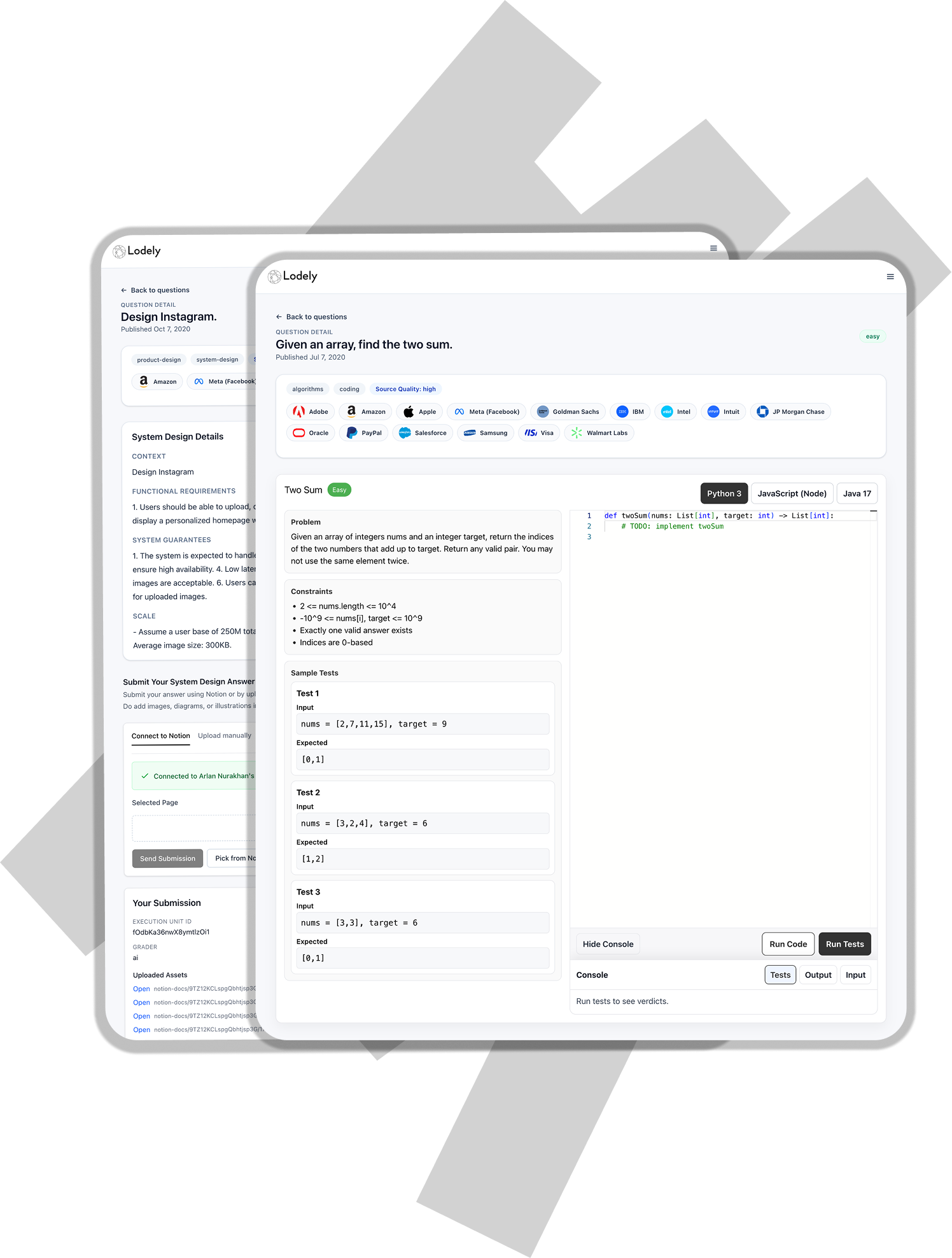
Follow the editor rules in your invitation. For company-specific coding prompts alongside this pattern practice, use Lodely to plan coding, system design, and behavioral preparation in one place.
Upstart Interview Question Breakdown
Simplify Path
Type: Stack-based string parsing.
Prompt: Normalize a path containing separators and navigation tokens.
Approach: Account for empty segments and attempts to navigate above the root.
What It Tests: Careful string parsing, invariant tracking, and construction of the minimal output.
Word Search
Type: Grid search with backtracking. Prompt: Determine whether adjacent cells can form a target word without reusing a cell. Approach: Restore visited states when backtracking. What It Tests: Recursive state management and pruning.
What Comes After the Online Assessment
If you pass the technical screen, Upstart may invite you to an all-virtual interview loop. Later discussions cover projects, system design, application design, and behavioral judgment. Record the tradeoffs from your assessment because an interviewer will likely ask you to explain or expand on your code later.
Conclusion
Focus on parsing, small tests, and code you can defend. After you submit, use Lodely for company-specific preparation.
✉️ Get free faang interview cheat sheet and interview tips weekly
✉️ Get free faang interview cheat sheet and interview tips weekly