


10 Verkada Interview Questions to Expect in 2026

Verkada's process includes a recruiter or hiring-manager screen, followed by a role-specific technical screen and in-person interviews. For software engineering roles, the process can include coding, pair programming, system design, and final interviews.
What to Expect: Verkada Interview Process
The company's interview guide lists four stages: a recruiter screen, a hiring-manager or team-member screen, a custom technical interview, and an onsite interview. The onsite may include technical interviews and a discussion of your experience and fit with the team's work.
Engineering interviews now use a practical format. You may develop in a local environment, write APIs and tested code, design a database schema, or work on device-facing code. Ask the engineer beforehand to ensure they are set up properly and save time.
How to Prepare and Pass Verkada Interviews
If your coding and design skills are up to date, plan four to six weeks. Spend two weeks on arrays, intervals, caching, APIs, and test-driven debugging. Spend another two weeks on camera and device data flow, access control, heartbeats, and error handling. Add two weeks for more pair-programming or whiteboard practice.
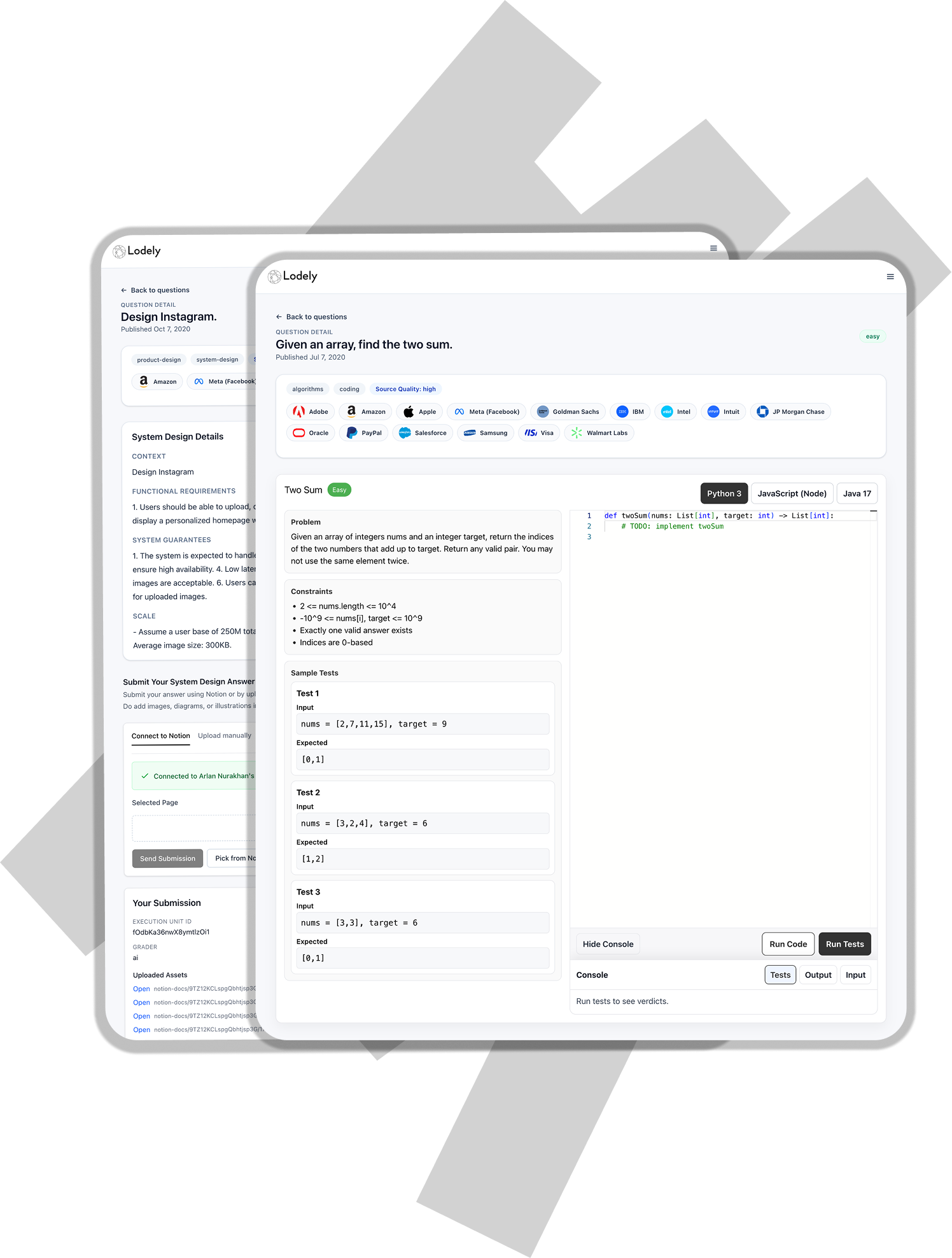
Use a local editor to work through Lodely's real interview questions and explain every decision. Verkada's practical exercises reward working code, understandable interfaces, and clear communication as requirements expand.

Verkada Interview Breakdown
Camera Intensity
Type: Coding challenge and data processing. The Trick: Model changes in intensity precisely over time and handle edge cases consistently. What It Tests: Sequence handling, clean conditional logic, and test coverage.
Widget
- Type: Implementation exercise.
- The Trick: Define the widget's state and interface before choosing a structure.
- What It Tests: Requirement discovery, maintainable code, and edge-case reasoning.
Camera States
Type: State-modeling problem. The Trick: Design valid transitions and handle repeated or out-of-order events safely. What It Tests: State machines, defensive programming, and the ability to make judgment calls.
Seven questions remain. Time-lapse Viewer Frontend: UI state and media sequencing. Filtering Alerts: Expressing filtering rules without missing events. Matrix Transposing: Matrix indexing. Cookie Collector: Traversal and counting. Wordle: Exact state and duplicate handling. LRU Cache: Constant-time lookup and eviction order. Camera Logs API: Endpoints, parsing, pagination, and error handling.
What Comes After The Interview
After the onsite, the recruiter handles the decision and final checks. The reported 2026 U.S. average salary for software engineers ranges from $186K at L2 to $474K at L6. See the level breakdown for $228K at L3, $273K at L4, and $346K at L5. The grant uses a back-weighted vesting schedule, so review its terms carefully.
Candidate Experiences
One recent software engineering candidate was asked to describe a technical screen conducted in a prepared local environment, followed by an onsite loop in San Mateo. The four onsite interviews covered implementing a cache, pair programming on a database design, whiteboard system design for access control and device heartbeats, and a behavioral interview with the hiring manager. The candidate had received no update from the company two weeks after being invited. Confirm the environment setup and follow-up timeline before the interview.
Conclusion
Verkada interviews assess how you implement code for real problems, test your solutions, choose concrete data models, and weigh tradeoffs at device scale. Use Lodely to practice this mix and keep your code and explanations clear.
✉️ Get free faang interview cheat sheet and interview tips weekly
✉️ Get free faang interview cheat sheet and interview tips weekly