





WhatsApp Interview Questions: 9 from Real Interviews

Most WhatsApp engineering interviews follow Meta's software engineering loop, which includes a recruiter conversation, a coding screen, multiple coding interviews, product/system design interviews, and a behavioral interview. Team context matters because this work affects reliability, privacy, storage, and the operation of messaging at global scale.
What to Expect: WhatsApp Interview Process
The technical screen includes two problems in about 45 minutes. The process may also include two or three coding tasks, a 45-minute design interview, and a 45-minute behavioral interview. Meta provides official guidance for its technical screen, including communication and problem-solving skills. For a WhatsApp interview, the design discussion may cover message ordering, fan-out, offline delivery, abuse prevention, and privacy.
How to Prepare and Pass WhatsApp Interviews
Budget six to eight weeks if you're already strong in algorithms. Budget ten to twelve weeks if you're also rebuilding your large-scale design knowledge.
- Practice pacing for two problems. State the approach briefly, write clean code, and test before time runs out. Explain your reasoning as you work; silence makes that reasoning difficult to assess.
- Design the messaging lifecycle. Trace a message from the sender to durable storage, then through delivery, acknowledgment, retry, and synchronization across devices.
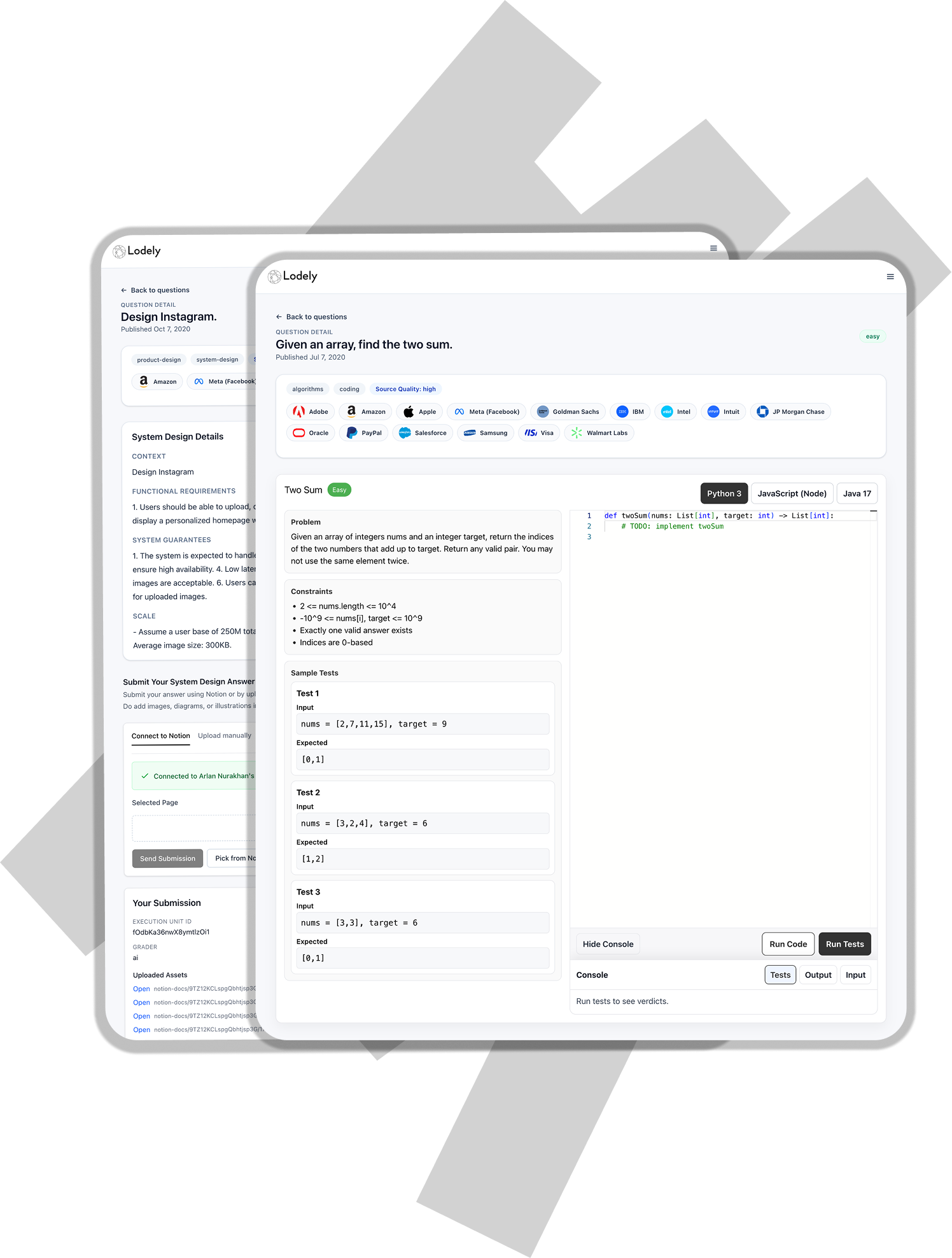
- Build impact stories. Use stories that include conflict, cross-functional collaboration, and measurable engineering decisions. Lodely lets you combine your coding, system-design, and behavioral stories into one WhatsApp-focused plan.

WhatsApp Interview Breakdown
Merge Sorted Arrays
function mergeSortedArrays(nums1, m, nums2, n)- You are given two sorted integer arrays nums1 and nums2, and integers m and n.
- Merge nums2 into nums1 as one sorted array and return nums1.
nums1.length == m + nnums2.length == n0 <= m, n <= 200-10^9 <= nums1[i], nums2[i] <= 10^9
nums1 = [1,2,3,0,0,0], m = 3, nums2 = [2,5,6], n = 3
[1,2,2,3,5,6]
nums1 = [1], m = 1, nums2 = [], n = 0
[1]
Type: Two-pointer array processing. The Trick: Let the space constraint determine whether you merge forward or backward. State the invariant before moving the pointer. What It Tests: In-place reasoning and boundary handling.
Bipartite Graph
function isBipartite(n, edges)- Given an undirected graph with n nodes (labeled 0 to n-1) and a list of edges, determine whether the graph is bipartite.
- A graph is bipartite if you can partition its nodes into two sets such that every edge connects a node in one set to a node in the other set.
- Use BFS or DFS coloring to solve this.
1 <= n <= 10^40 <= edges.length <= 10^4edges[i].length == 20 <= edges[i][0], edges[i][1] < nNo self-loops or duplicate edges
n = 4, edges = [[0,1],[1,2],[2,3]]
true
n = 3, edges = [[0,1],[1,2],[0,2]]
false
Type: Graph traversal and coloring. The Trick: Disconnected components require multiple starting points, and any later conflict invalidates the whole graph. What It Tests: Graph modeling and correctness arguments.
Design Instagram
Type: Product and system design. The Trick: Narrow the initial scope of a broad prompt. Start with feed reads, post writes, media storage, ranking, and consistency requirements, then expand. What It Tests: Requirements, architecture, and tradeoffs.
Six questions cover the full loop. The conflict question requires collaborative thinking. Validating BST, Squares of a Sorted Array, and Implement Trie cover invariants and data structures. Designing a Chat Service or Feed API covers contracts and delivery. Designing a Newsfeed covers fan-out, ranking, and freshness.
What Comes After The Interview
There may be a hiring review and team matching after you pass the loop. U.S. Meta salaries are reported at $181K for E3, $302K for E4, $435K for E5, and $669K for E6. Leveling substantially affects stock and recurring bonus, so evaluate the entire package.
Candidate Experiences
One recent E4 product-engineering candidate described an initial recruiter call, a two-problem coding screen, and an onsite covering coding, behavioral questions, and product architecture. The candidate received positive feedback within five business days, spoke with several teams, and signed the offer two months after first contact. They said the coding rounds included two problems and required an explanation of each solution. Practice pacing and communication as a single skill.
Conclusion
WhatsApp interviews ask for fast, correct code and sound system designs based on good messaging. Use Lodely to practice the selected questions and the full loop under consistent timing and communication constraints.
✉️ Get free faang interview cheat sheet and interview tips weekly
✉️ Get free faang interview cheat sheet and interview tips weekly