Interviewing.io Pricing Breakdown: Plans, Costs & What You Actually Get

Think dropping $225 on a single mock interview is the fast track to a FAANG offer? Maybe. Or maybe you're lighting money on fire when free and cheaper options exist that get you just as far.
If you're weighing whether interviewing.io is worth the investment or just another expensive prep tool with good marketing, here's the full pricing breakdown so you can decide with actual numbers.
What Is Interviewing.io?
Interviewing.io is an anonymous mock interview platform that pairs you with real engineers from companies like Google, Meta, and Amazon for live technical practice sessions. The "anonymous" part is its calling card: interviews happen over voice and a shared code editor with no video, no names, and no profile pictures. The idea is to remove bias and let your problem-solving speak for itself.
But here's the thing: interviewing.io is not a learning platform. It doesn't teach you data structures. It doesn't walk you through system design fundamentals. It doesn't give you a curriculum. It's a place to practice once you already know what you're doing — and that distinction matters a lot when you're deciding where to spend your prep budget.
What Does Interviewing.io Give You?
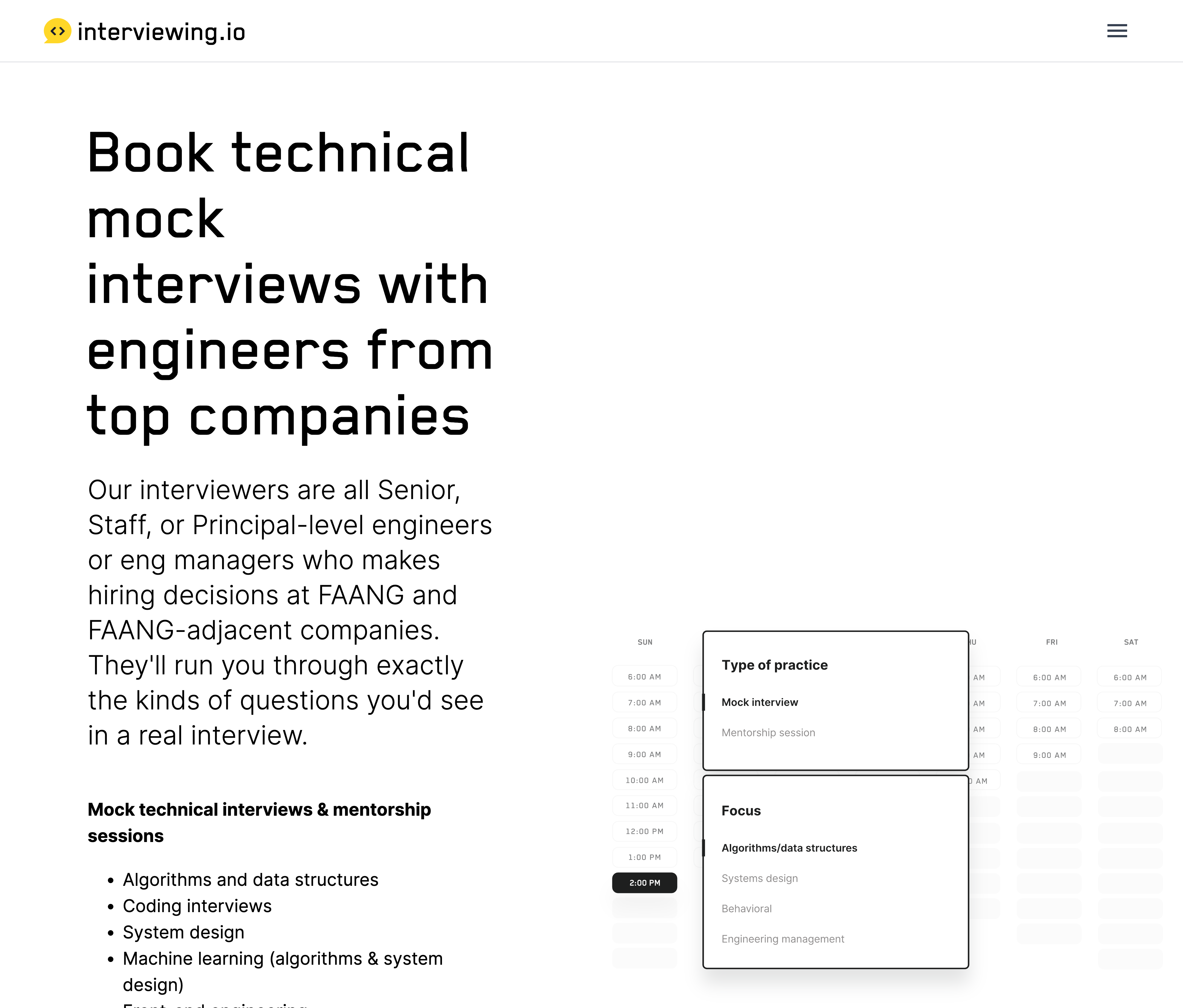
At its core, interviewing.io offers three things:
Peer mock interviews — free, peer-to-peer sessions where you and another user take turns interviewing each other. Think of it as sparring with someone at roughly your level.
Expert mock interviews — paid sessions with verified engineers from top companies. These are the flagship product. You get real-time feedback from someone who's actually sat on the other side of the table at Google or Meta.
Dedicated coaching packages — multi-session bundles (3, 5, or 10 sessions) where a mentor designs a personalized plan around your weaknesses. This is the premium tier, and the price tag reflects it.
On top of that, there's a library of recorded interview replays you can watch for free, an AI interviewer tool for solo practice, and a collection of 200+ problems from their "Beyond Cracking the Coding Interview" resource.
The Free Tier: What You Actually Get Without Paying
Let's be real about what "free" means here, because the marketing makes it sound more generous than it is.
When you sign up, you get one free peer mock interview. One. After that, you can unlock more peer sessions by conducting interviews for other users — essentially, you earn credits by volunteering your time as an interviewer.
The free tier also includes access to the AI interviewer, which simulates a FAANG-style coding or system design session. It's decent for getting reps in when you can't find a human partner, but it's not going to replace the nuanced feedback of an experienced engineer telling you exactly where your approach fell apart.
You also get access to interview replays — recorded sessions from real mock interviews with engineers at top companies. These are genuinely useful for pattern recognition. Watching someone else stumble through a graph problem and hearing the interviewer's real-time reactions teaches you things a LeetCode editorial never will.
But that's where the free ride ends. No expert interviewers. No coaching. No personalized feedback from someone who's actually hired engineers at your target company. If you want the stuff that actually moves the needle for most people, you're reaching for your wallet.
Paid Plans Breakdown
Here's where it gets interesting — and expensive.
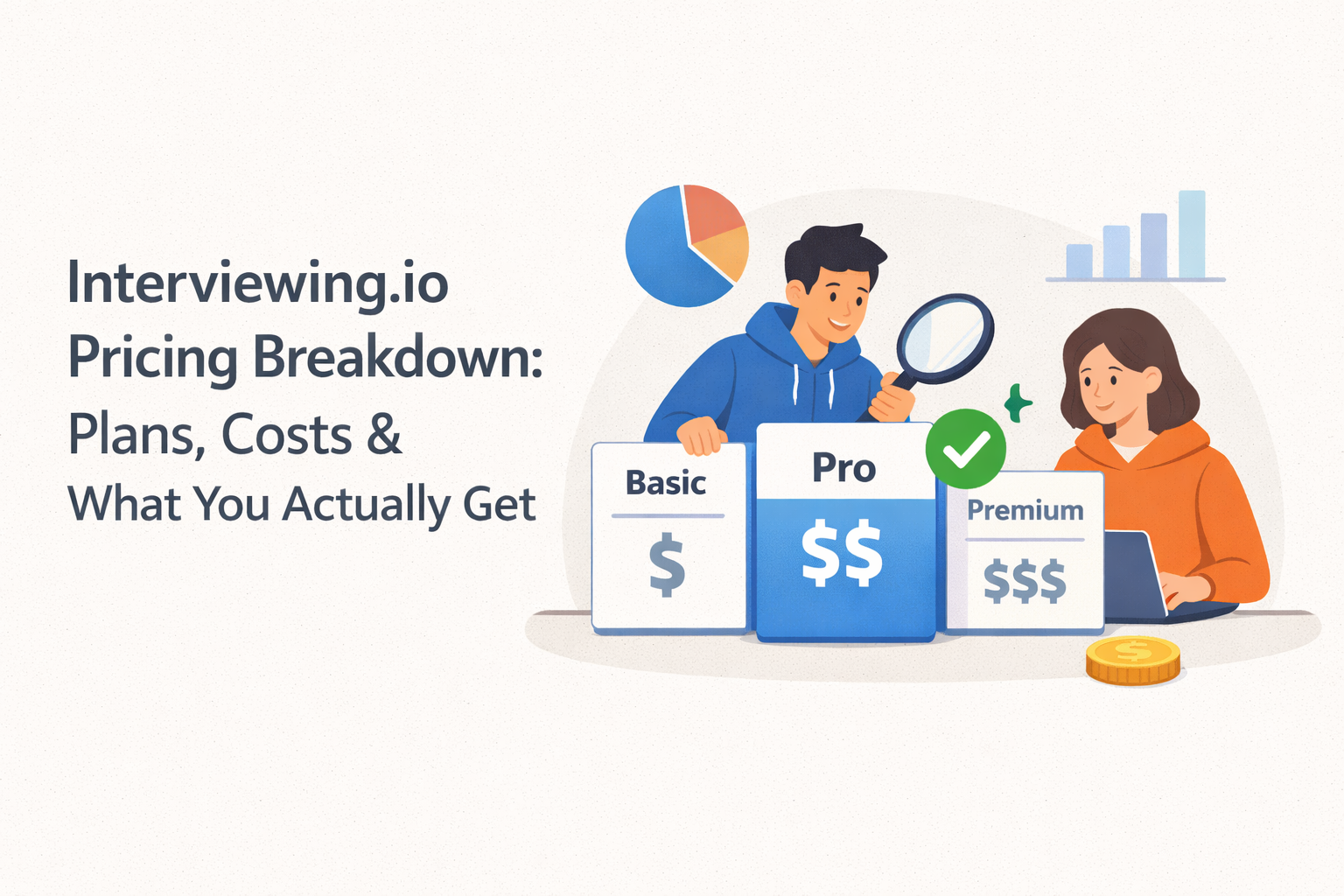
Individual expert sessions start at around $225 per session. That price fluctuates based on the interviewer's experience level and whether you want someone from a specific company. Want a current Google engineer to grill you on system design? That'll cost more. Behavioral interviews tend to start lower, around $115–$230 depending on the format.
Branded interviews — where you specifically request an interviewer from your target company — run closer to $339 per session. You're paying a premium for company-specific signal.
Dedicated coaching packages bundle multiple sessions with a single mentor who builds a plan around you:
- 3 sessions — roughly $1,500–$2,000 depending on the interviewer (we break down whether that's actually worth it in our full Interviewing.io review)
- 5 sessions — around $2,000–$2,500
- 10 sessions — originally priced at $4,000, though discounts of $200–$700 pop up periodically
Interviewing.io claims that 82% of people who complete their dedicated coaching package land the offer they wanted. That's a strong number if it holds up, but keep in mind: the people buying $4,000 coaching packages are probably already strong candidates who are close to being ready. Selection bias is real.
There's also a Pay Later Program for users authorized to work in the US, Canada, UK, or Australia. If you find a job through one of their employer partners, you don't pay anything. If you land a job through their platform but not via a partner, they refund what you spent on practice. It's a nice safety net, but it only applies in specific scenarios.
Refund policy: if you're unhappy with your sessions, they offer a full refund. No questions asked, apparently.
What Each Plan Includes
Here's the honest breakdown of what you're getting at each level:
Free tier:
- 1 peer mock interview (earn more by interviewing others)
- AI interviewer for solo coding and system design practice
- Interview replay library (hundreds of recorded sessions)
- 200+ practice problems
- Written interview guides
Individual paid sessions ($225+):
- Everything in the free tier
- Live 1-on-1 sessions with verified FAANG engineers
- Detailed verbal feedback during and after the session
- Session recordings you can rewatch
- Option to request company-specific interviewers (at higher cost)
Dedicated coaching ($1,500–$4,000):
- Everything above
- A single assigned mentor who knows your weaknesses
- Custom lesson plan designed around your target role and timeline
- 3, 5, or 10 structured sessions
- Ongoing accountability and progress tracking
The jump from free to paid is massive. The jump from individual sessions to coaching packages is more about consistency and personalization than unlocking new features. You're paying for someone to actually know your story and adapt session-to-session.
Interviewing.io vs Alternatives: How the Pricing Compares
Interviewing.io isn't the only game in town. Here's how it stacks up against other alternatives most engineers are actually considering.
Lodely
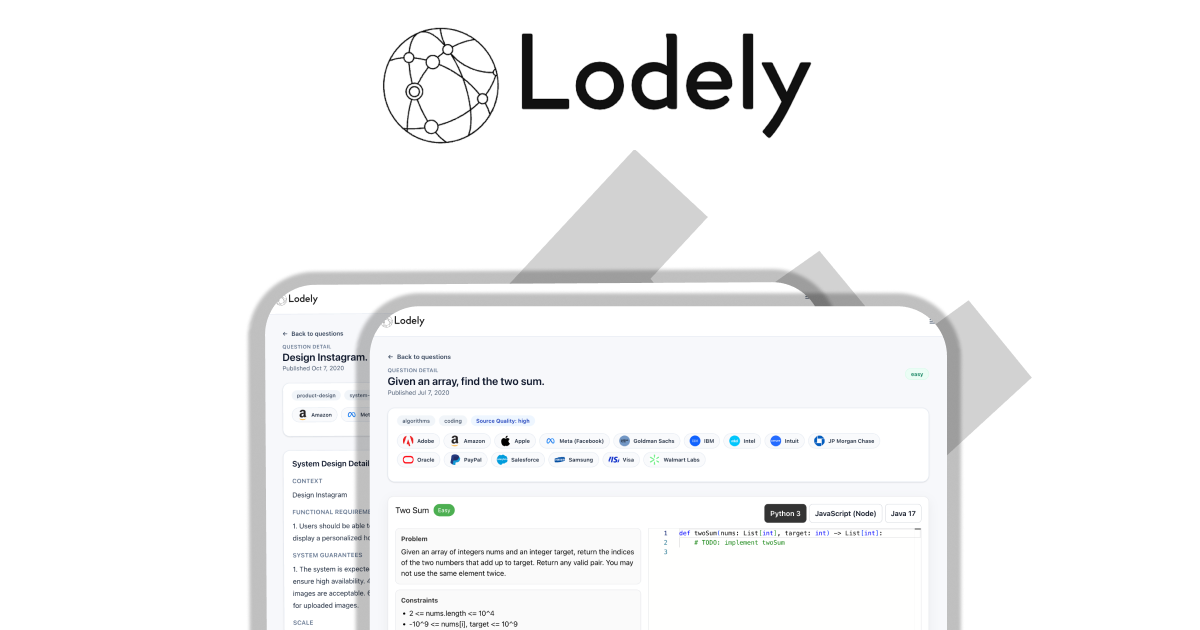
Lodely takes a fundamentally different approach. Instead of selling you individual mock interview sessions, it gives you a complete, guided interview prep program — coding, system design, behavioral, company-specific prep, and 1:1 coaching — all in one place.
The core difference: interviewing.io is a practice tool. Lodely is a full prep system that tells you exactly what to work on and when you're ready to move on. It covers 4,000+ real interview questions from 1,000+ companies, 100+ interview simulations, and includes direct coaching from engineers who's helped candidates land roles at Google, Meta, and beyond.
If you're the type who needs structure — someone to say "here's your gap, here's the plan, now execute" — Lodely will get you further per dollar than buying $225 mock sessions one at a time. Interviewing.io assumes you already know what to work on. Lodely makes sure you do.
For most engineers, the smarter play is to use a guided system like Lodely to build your foundation and close skill gaps, then layer in a few expert mock interviews (on any platform) as a final check before your real interviews.
Pramp (Now Exponent)

Pramp used to be the go-to free mock interview platform. It's now been absorbed into Exponent, but the core offering still exists: 5 free peer mock interview credits per month covering coding, system design, and behavioral questions.
The free tier is more generous than interviewing.io's. Five sessions per month versus one is a real difference when you're trying to build reps. (we go deeper on this in our Pramp vs. Interviewing.io comparison). But the quality ceiling is lower — you're practicing with other candidates, not experienced interviewers, so the feedback is hit-or-miss.
If you want unlimited sessions plus AI feedback and priority scheduling, Exponent's paid plan runs $79/month or $12/month on an annual plan. That's dramatically cheaper than interviewing.io for high-volume practice, though you're trading expert feedback for quantity.
The bottom line on Pramp/Exponent: great for free reps, but it won't replace structured prep or expert-level feedback.
Is Interviewing.io Worth It?
Here's the honest answer: it depends entirely on where you are in your prep journey.
It's worth it if you're already strong technically, you're 2–4 weeks out from real interviews, and you want a few high-signal practice sessions to calibrate your performance and identify blind spots. Two to five expert sessions can genuinely sharpen your edge when you're close to ready. The feedback from real FAANG interviewers is hard to replicate anywhere else.
It's not worth it if you're using it as your primary prep tool. At $225+ per session, you'd burn through thousands of dollars before you've even built a solid foundation. That's like hiring a batting coach before you've learned to swing. The platform itself acknowledges it's not a learning tool — it's a practice environment.
It's definitely not worth it if you don't have a clear prep plan. Showing up to an expert mock interview without knowing your weaknesses is like going to the doctor and saying "I feel bad, fix me." You'll get generic feedback and leave without a clear next step.
The smartest approach? Build your skills and close gaps with a structured prep program first. Use free peer mocks and AI tools to get comfortable with the interview format. Then invest in 2–5 expert sessions on interviewing.io as a final stress test before your real interviews.
That way, you're spending $450–$1,125 on targeted, high-value practice instead of $4,000 on a coaching package that's doing work you could've done yourself with the right system in place.
Your prep budget is finite. Spend it where it compounds.
✉️ Get free faang interview cheat sheet and interview tips weekly
✉️ Get free faang interview cheat sheet and interview tips weekly