7 Affirm Interview Questions to Expect in 2026

Affirm's software engineering process includes four to six rounds covering coding, system design, project experience, and behavioral questions. Interviewers assess code quality and how clearly you explain data integrity, experiments, and financial workflows. Because the work involves financial data, state the rules that protect integrity and explain how you verify each state change.
What to Expect: Affirm Interview Process
The exact sequence varies for new-graduate and senior roles, so confirm the expected stages with your recruiter.
Coding rounds often ask you to implement a workflow involving purchases, transactions, files, or logs. System-design discussions may cover experiments, ledgers, idempotency, and streaming. Interviewers assess how clearly you explain business rules, state representation, edge cases, and the trade-offs among them. For each prompt, name the invariants and failure cases before choosing a data structure or service boundary. Then test the failure paths.
Treat every prompt like it is production code: state your invariants, keep the interface as small as possible, and describe how you'd know if it broke in production.
How to Prepare and Pass Affirm Interviews
If you code comfortably, plan four to six weeks. Divide the schedule into three parts. First, review arrays, strings, maps, parsing, and stateful objects. Next, cover payment reliability, data modeling, experiment design, and one large-scale service. Finish with timed practice and behavioral stories about collaboration, mistakes, and product decisions.
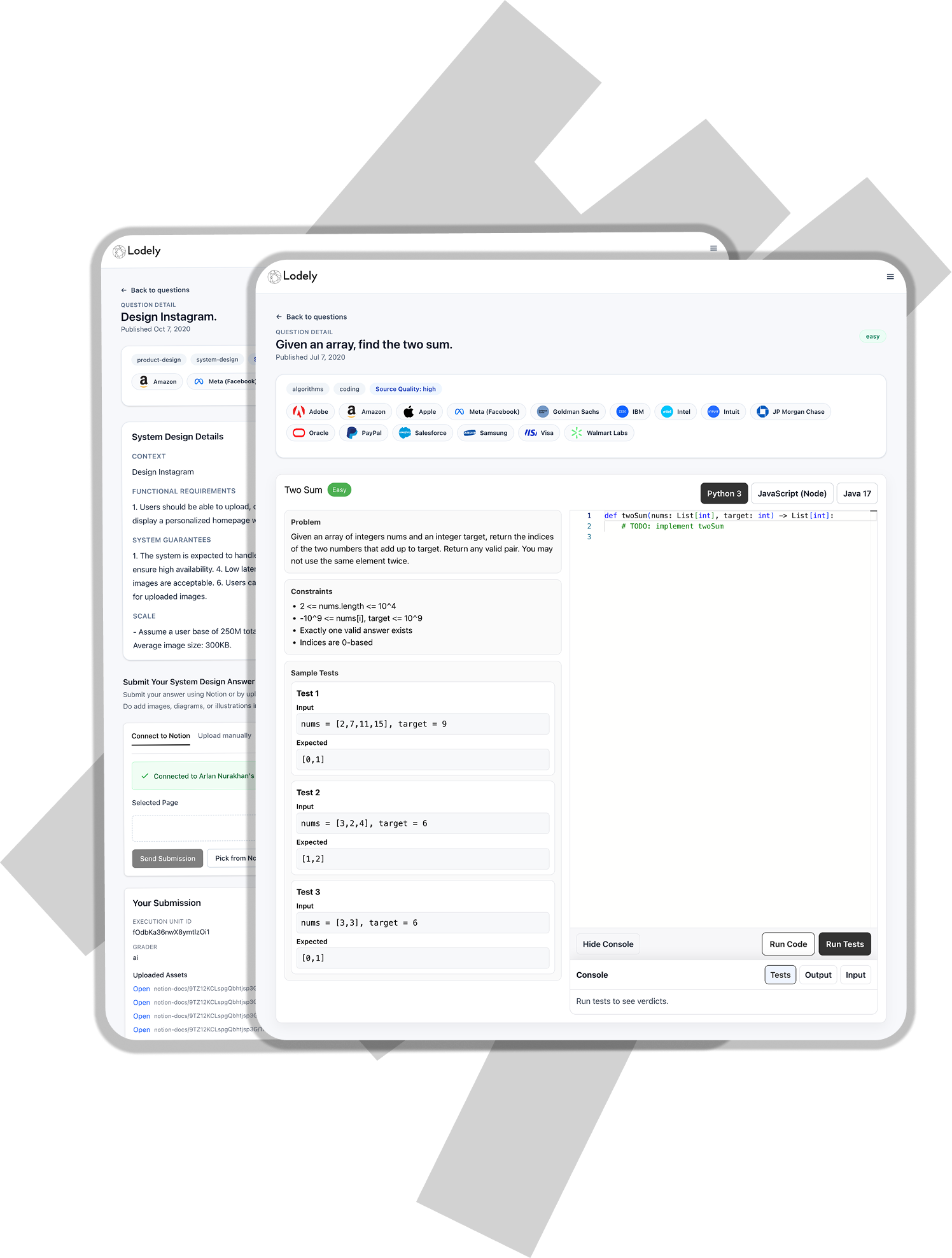
Practice prompts in a business context. Lodely provides Affirm-specific coding, system-design, and behavioral questions that match the formats used across the loop.

Affirm Interview Breakdown
Purchase Pattern
Type: Hash-map aggregation.
The Trick: Avoid counting the same merchant pair more than once within one user's history, and define tie-breaking before coding.
What It Tests: Data modeling, counting, and deterministic output.
Design an A/B Test System
Type: System design.
The Trick: Record exposure when a user sees a variant, and version the experiment configuration so results remain interpretable.
What It Tests: Assignment consistency, event tracking, metrics, and analysis.
Order Logs
Type: Practical coding.
The Trick: State how the system handles duplicate, missing, and out-of-order events, then build tests for those cases.
What It Tests: Parsing, event ordering, and state transitions.
Four more questions cover related skills. "Loan Company" and "Transaction Logging System" test reliable state changes. "File Parsing" covers validation and malformed input. "String Fingerprint" tests stable representations and collision handling. Practice these questions and explain each decision as you work.
What Comes After The Interview
Ask when feedback will be consolidated and whether a final leadership conversation remains. If an offer follows, compare the level, base salary, equity, and refresh grants.
Candidate Experiences
One recent new-grad candidate described two technical interviews followed by a behavioral conversation with a manager. Different engineers ran the technical rounds, while the recruiter stayed helpful throughout the process. Prepare to solve and explain two different coding problems under interview conditions.
Conclusion
Affirm looks for clean implementation, responsible handling of financial data, and direct communication. Practice the seven question types on Lodely and identify any remaining gaps before the interview.
✉️ Get free faang interview cheat sheet and interview tips weekly
✉️ Get free faang interview cheat sheet and interview tips weekly