AMD Interview Questions: 4 from Real Interviews

AMD software engineering interviews vary across graphics, compiler, firmware, driver, and CPU teams. One possible path begins with a technical phone screen and continues to a multi-round onsite that tests coding, operating-systems knowledge, architecture, and project depth.
What to Expect: AMD Interview Process
Each team tests depth in its own domain. A driver role may cover C/C++, memory, concurrency, Linux, and hardware interactions; a verification role may cover pipelines, clocks, coverage, and debugging.
Expect interviewers to start with your résumé and ask detailed follow-up questions. Be ready to explain the part of the system you owned, the failure modes you considered, and the measurements you used to verify your change.
Prepare a debugging story that shows how you isolated a complex failure across software and hardware.
In that story, cover the initial signal, how you narrowed the cause, the measurements you used, and the final verification. For C/C++ work, be ready to discuss memory ownership and concurrency behavior.
How to Prepare and Pass AMD Interviews
Give yourself six to eight weeks for a systems engineering role. Review C or C++, pointers, memory layout, threading, synchronization, operating systems, and computer architecture. Map the job description to the relevant AMD product area and prepare two projects that show deep debugging work.
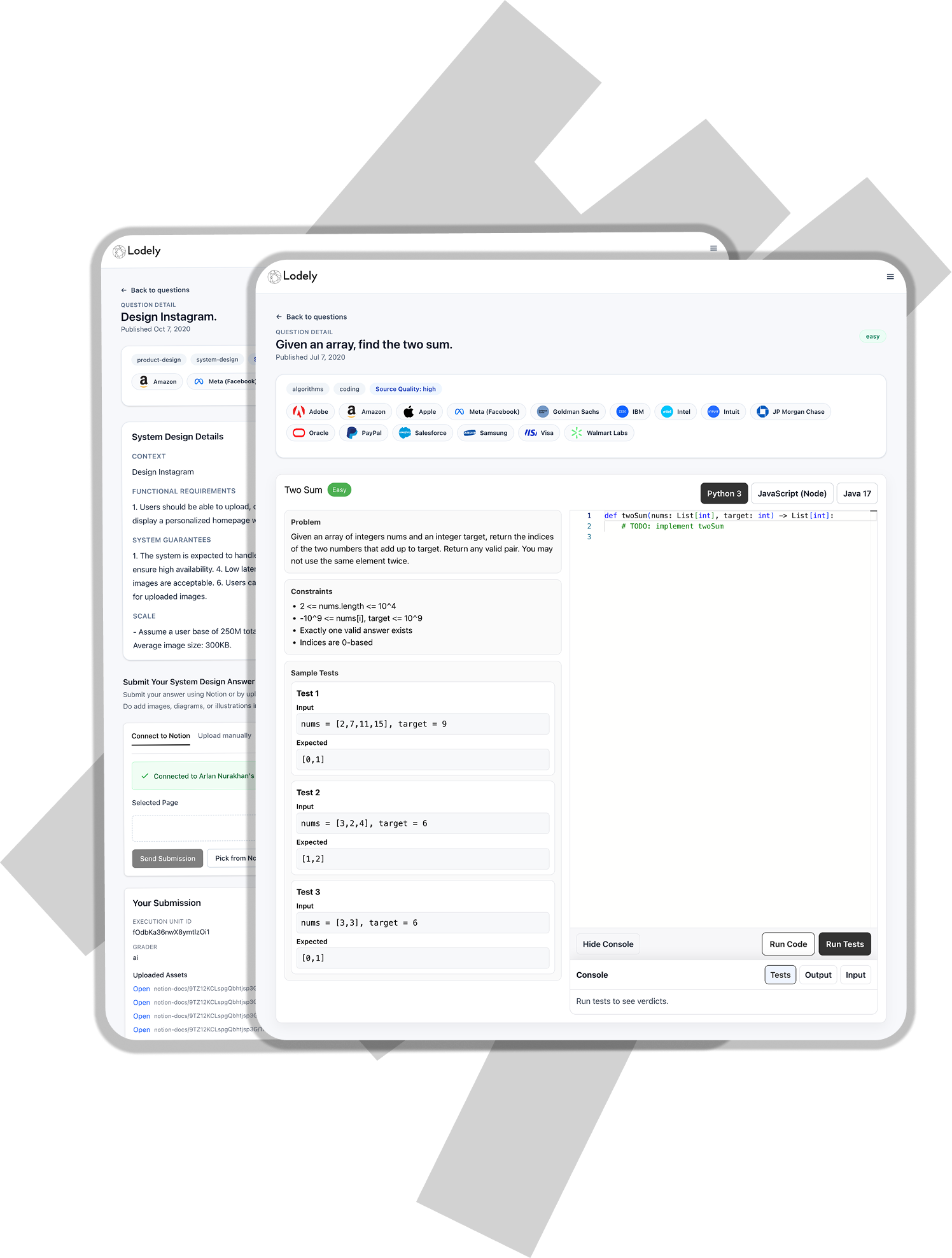
Use Lodely to alternate company-specific low-level technical prompts with the communication questions that appear later in the loop.
In each session, explain the assumption, implementation choice, and test that would expose a failure.

AMD Interview Breakdown
Design a Cache Controller
Type: Low-level system design.
The Trick: Define requests, states, cache misses, eviction, and write policy before naming components.
What It Tests: State machines, consistency, concurrency, and failure handling.
What Would Be Your Ideal AMD Team?
Type: Behavioral and role fit.
The Trick: Name the engineering layer and problems you want to own, then connect that preference to work you've done.
What It Tests: Product knowledge and self-awareness.
Count Islands in a Binary Grid
Type: Graph traversal.
The Trick: Clarify whether islands connect in four or eight directions, and avoid revisiting cells.
What It Tests: Search, visited-state tracking, and complexity analysis.
An additional release-impact prompt tests operational judgment. Give a concrete example that covers the initial signal, your immediate response, cross-team recovery, and the lasting process change.
What Comes After The Interview
Team matching and level calibration may affect the final timeline. If you receive an offer, compare base salary, annual bonus, stock, and any signing bonus. The compensation grid below shows reported U.S. medians; actual offers vary by location and specialty.
Candidate Experiences
One recent software engineering graduate described a 60-minute technical phone screen followed by a full-day onsite with four interviews. The candidate said the process focused on operating systems, C/C++, concurrency, and hardware-software interactions. Those systems topics were central to the systems-facing role.
Conclusion
AMD evaluates low-level fluency, debugging depth, and motivation for a specific product area. Practice the four examples on Lodely, then rehearse concise explanations of your systems decisions.
✉️ Get free faang interview cheat sheet and interview tips weekly
✉️ Get free faang interview cheat sheet and interview tips weekly