


Bloomberg Online Assessment: Questions Breakdown and Prep Guide

Aiming for Bloomberg and wondering what “the Bloomberg OA” actually looks like? You’re in good company. Candidates see a mix of timed coding, data-heavy scenarios, and practical design prompts that reflect Bloomberg’s world of real-time data, low-latency systems, and reliability at scale.
This guide breaks down what to expect, what to practice, and how to prepare with confidence. No fluff — just what works.
When to Expect the OA for Your Role
Bloomberg doesn’t run a one-size-fits-all assessment. The invite, format, and difficulty vary by role and level.
- New Grad & Intern (SWE) – Most candidates receive an OA shortly after recruiter outreach. For many, it’s the primary technical screen before interviews.
- Software Engineer (Backend / Systems / Full-Stack) – Standard. Expect a HackerRank- or CodeSignal-style test focused on algorithms, data structures, parsing, and correctness under time constraints.
- Data Engineering / Infrastructure – Similar to SWE, with heavier emphasis on streaming, heaps, maps, and time-series operations.
- SRE / Production Engineering – You may get algorithmic coding plus operational twists (log parsing, error handling, rate limiting).
- Senior Roles – Some candidates skip a generic OA and jump straight to live rounds, but many still see a short coding screen.
Action step: When your recruiter reaches out, ask: “Which platform, how many problems, and what’s the time limit?” You’ll usually get format guidance (e.g., HackerRank, 60–90 minutes, 2–3 problems).
What Is the Bloomberg Plum Test?
The Bloomberg Plum Test is different from the technical coding OA. Bloomberg uses it for certain entry-level positions to evaluate qualities that may be important for success in the role, rather than your knowledge of algorithms or programming languages.
The Plum Discovery Survey covers three areas:
- Personality: Choose the statements or adjectives that are most and least like you.
- Problem-solving: Complete visual pattern puzzles by identifying the missing piece.
- Social intelligence: Review workplace scenarios and select the most and least effective responses.
The assessment takes approximately 25 minutes and is not timed, so finishing quickly will not improve your result. Your answers create a Plum Profile that Bloomberg can compare with the qualities prioritized for the position.
How to Prepare for the Bloomberg Plum Assessment
You cannot prepare for Plum in the same way you would prepare for a coding test, but you can give yourself the best conditions to perform well:
- Complete it somewhere quiet and free from interruptions.
- Read every personality statement carefully and answer consistently.
- Take your time with the visual pattern questions; difficulty varies.
- Consider how each situational response would affect colleagues, customers, and the wider team.
- Avoid choosing answers solely because they sound like the “ideal Bloomberg employee.”
There is no universal perfect Plum profile. Different roles require different combinations of problem-solving ability, communication, adaptability, teamwork, and execution. The best strategy is to answer honestly while giving the cognitive and situational questions your full attention.
Pro tip: Confirm whether your invitation is for the Plum assessment, a coding OA, or both. They measure different things and require completely different preparation.
Does Your Online Assessment Matter?
Yes — and it directly influences your next steps.
- It’s the gatekeeper. OA performance is a primary filter for interview loops.
- Your code is signal. Clean, readable, tested code often gets discussed in later rounds.
- The content is realistic. Expect data streaming, aggregation, and interval-heavy problems — patterns common in market data systems.
- They’re measuring how you work. Naming, structure, complexity analysis, and tests under time pressure all count.
Pro tip: Treat the OA like a first interview. Aim for correct, clean, and efficient — and include quick sanity checks or simple tests when the platform allows.
Compiled List of Bloomberg OA Question Types
Practice these patterns and problem classes. They map closely to what Bloomberg prioritizes: parsing, hashing, heaps, graphs, intervals, and streaming.
- Minimum Window Substring — Sliding Window / Hash Maps
- Longest Substring Without Repeating Characters — Sliding Window
- Merge Intervals — Sorting / Interval Merging
- Meeting Rooms II — Intervals / Min-Heap
- Top K Frequent Elements — Hash Map / Heap
- Kth Largest Element in a Stream — Heap / Streaming
- LRU Cache — Design / Hash Map + Linked List
- Design Hit Counter — Queue / Sliding Window
- Moving Average from Data Stream — Queue / Sliding Window
- Dijkstra’s Shortest Path (e.g., Network Delay Time) — Graph / Priority Queue
- Course Schedule — Graph / Topological Sort
- Clone Graph — Graph / BFS-DFS
- Two Sum — Hashing / Arrays
- Subarray Sum Equals K — Prefix Sum / Hash Map
- Design Twitter — Design / Heaps / Hashing (good for feed/stream schemas)
- Serialize and Deserialize Binary Tree — Design / BFS-DFS

How to Prepare and Pass the Bloomberg Online Assessment
You’re building reflexes for fast, correct solutions — with code that’s readable under scrutiny.
1. Assess Your Starting Point (Week 1)
- Time yourself on 3–4 representative problems: a sliding window string, an interval merge, a heap (top-k), and a graph shortest path.
- Log where you struggle: input parsing, edge cases, complexity, or off-by-one in windows.
- Prioritize your weak topics — you’ll get outsized gains quickly.
2. Pick a Structured Learning Path (Weeks 2-6)
- Self-study on LeetCode/HackerRank
- Best for independence. Build a 40–60 problem list around strings, hashing, intervals, heaps, and graphs.
- Mock assessments / bootcamps
- Timed, proctored practice helps pacing, I/O handling, and nerves.
- Career coach or mentor
- A software engineer career coach can review code quality, challenge your approach, and simulate OA constraints.
3. Practice With Realistic Problems (Weeks 3-8)
- Focus on market-data-flavored patterns: sliding windows, rolling aggregates, top-k on a stream, dedup, and time-bucketed counts.
- After solving, refactor for clarity: function names, constants, guard clauses, and quick tests.
- Alternate languages if relevant (e.g., C++ STL vs. Python built-ins) to match the role.
4. Learn Bloomberg-Specific Patterns
Expect problems inspired by real-time data and reliability:
- Time-series sliding windows (moving averages, VWAP-like aggregates)
- Interval operations (market sessions, maintenance windows, overlapping ranges)
- Heaps for top-k or latency-sensitive selection
- Hash maps/tries for fast lookups and de-duplication across streams
- Basic design of rate limiters, caches, and counters
5. Simulate the OA Environment
- Practice on the expected platform (often HackerRank or CodeSignal).
- Use exactly the allotted time (commonly 60–90 minutes for 2–3 questions).
- Read from STDIN and print to STDOUT; handle messy input and edge cases (empty, single element, large N).
- Disable autocompletion tools if the test is proctored.
6. Get Feedback and Iterate
- Re-solve missed problems after 24–48 hours from scratch.
- Compare multiple approaches (heap vs. sort; DFS vs. BFS).
- Track recurring mistakes (off-by-one, integer overflow, tie-breaking rules) and write “gotcha” checklists before you hit Run.
Bloomberg Interview Question Breakdown
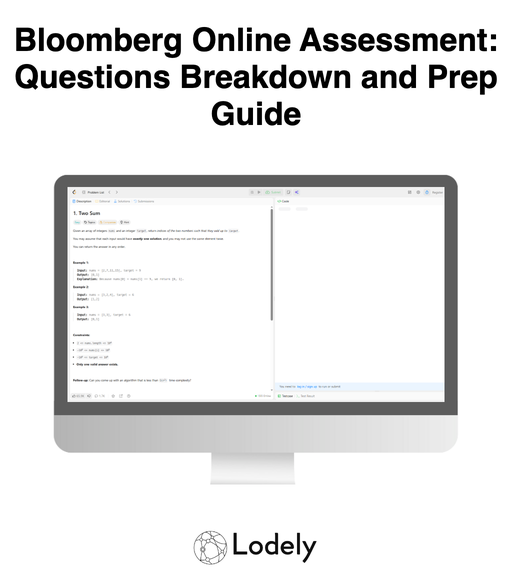
Practice these featured samples. They mirror the reasoning and patterns Bloomberg cares about.
1. Real-Time Price Window Aggregator
- Type: Sliding Window / Hash Map / Queue
- Prompt: Given a stream of trade events (ticker, timestamp, price, size), compute a per-ticker rolling average price over the last W seconds. For each new event, emit the current average.
- Trick: Maintain a queue per ticker and an O(1) rolling sum; evict stale trades by timestamp. Use a hashmap of ticker -> {queue, sum, count}.
- What It Tests: Streaming mindset, window eviction logic, time-based invariants, and clean state management under updates.
2. Merge Overlapping Trading Sessions
- Type: Intervals / Sorting
- Prompt: You receive a list of trading session intervals for multiple venues. Merge overlapping intervals and return a minimal set of non-overlapping sessions.
- Trick: Sort by start time, then greedily merge while tracking the running end. Be careful with fully contained and touching intervals.
- What It Tests: Edge-case discipline, interval reasoning, sorting complexity, and correctness-focused coding.
3. LRU Cache for Instrument Metadata
- Type: Design / Hash Map + Doubly Linked List
- Prompt: Implement an LRU cache with get/put in O(1), used to cache instrument metadata queried by ID under memory limits.
- Trick: Pair a hashmap (key -> node) with a custom doubly linked list to maintain recency ordering. Watch eviction and pointer updates.
- What It Tests: Data structure design, API clarity, class invariants, and constant-time guarantees.
4. Shortest Path with Link Latencies
- Type: Graph / Dijkstra
- Prompt: Given a directed graph of services and link latencies, compute the minimum time to reach all services from a source, or return -1 if some are unreachable.
- Trick: Use a priority queue (min-heap) and relax edges. Avoid BFS on weighted graphs; handle disconnected components cleanly.
- What It Tests: Graph fundamentals, priority queues, and careful termination conditions.
5. Top-K Tickers by Rolling Volume
- Type: Heap / Hash Map / Streaming
- Prompt: Ingest a stream of (ticker, shares). At any time, support queries for the top K tickers by cumulative volume in the last T events (or T seconds).
- Trick: Maintain per-ticker counts plus a min-heap for top K. If time-based, also maintain an eviction queue to decrement counts.
- What It Tests: Trade-offs between heap and sorting, amortized updates, and streaming data structures.
What Comes After the Online Assessment

Passing the OA unlocks the interview loop. Expect the focus to expand from coding speed to design sense, debugging, and communication.
1. Recruiter Debrief & Scheduling
You’ll get a pass/fail update and scheduling options. Ask about the interview slate (coding, debugging, design), languages allowed, and any logistics (IDE/editor, whiteboard vs. shared doc).
2. Live Technical Interviews
Expect interactive coding on a shared editor or collaborative environment. Common elements:
- Algorithm/data structure problems similar to OA, but with deeper probing
- Parsing/log-processing tasks that simulate practical constraints
- Clear communication of trade-offs and complexity
Pro tip: Keep your OA solutions handy. Interviewers may reference them or ask for alternate approaches.
3. System Design / Architecture
Mid-level and senior candidates typically get a design session. Sample prompts:
- Real-time market data ingestion and aggregation pipeline
- Publish/subscribe feed with backpressure handling
- Caching strategy for high-read, bursty workloads
They’re evaluating correctness, scalability, observability, and failure handling — not just components drawn on a diagram.
4. Debugging / Bug-Fix Round
Some loops include a “bug bash” style exercise: you’re given a broken codebase or function and asked to diagnose and fix it quickly.
- Read intentionally tricky tests
- Add asserts/logs methodically
- Communicate hypothesis → test → result
5. Behavioral & Collaboration Interviews
Expect value-centric questions around customer focus, ownership, and teamwork:
- “Tell me about a time you improved a system’s reliability.”
- “Describe a time you reduced latency or improved performance.”
Use the STAR method and quantify outcomes.
6. Final Round / Virtual Onsite
Multiple back-to-back interviews:
- Another coding round
- Design or architecture (possibly deeper)
- Cross-functional discussion (e.g., with product or a partner team)
Plan breaks, keep water nearby, and be ready to reset mentally between rounds.
7. Offer & Negotiation
Compensation typically includes base salary and an annual cash bonus. Do your market research and come prepared with a data-backed counter if needed.
Conclusion
The Bloomberg OA rewards candidates who write clean, efficient code under real constraints — especially streaming, intervals, heaps, and graphs. If you:
- Identify weak areas early and train with a timer,
- Practice Bloomberg-flavored patterns (rolling windows, top-k on streams, rate limiting, LRU),
- Refactor for clarity and test your edge cases,
you’ll convert the OA from a blocker into a momentum builder. Treat it like your first interview and you’ll show up ready for the rest of the loop.
For more practical insights and prep strategies, explore the Lodely Blog or start from Lodely’s homepage to find guides and career resources tailored to software engineers.
✉️ Get free faang interview cheat sheet and interview tips weekly
✉️ Get free faang interview cheat sheet and interview tips weekly


