Cohere Interview Questions: 6 from Real Interviews

Cohere's technical loop has five or six stages covering coding and enterprise-AI judgment. Recent applicants report recruiter and hiring-manager screens, system design, debugging, live coding, and project or research discussions. You'll need strong fundamentals and a clear understanding of how language-model systems work in production.
What to Expect: Cohere Interview Process
Forward-deployed and engineering roles may start with a call from a recruiter and a deep dive on your past work with a hiring manager. Later stages may involve AI system design, debugging, and coding, possibly with AI assistance. Research roles might involve a paper discussion or presentation instead of coding and debugging.
The format depends on the role, so confirm it with your recruiter. For coding roles, ask whether an AI assistant is available during the interview. For design roles, ask whether the discussion will cover model serving or system architecture and whether you must present published work or a system you shipped.
How to Prepare and Pass Cohere Interviews
Plan six to eight weeks: two for coding fluency and complexity; two for model evaluation, token decoding, and inference behavior; two for retrieval, guardrails, observability, and deployment; and one or two for a paper or project talk when relevant.
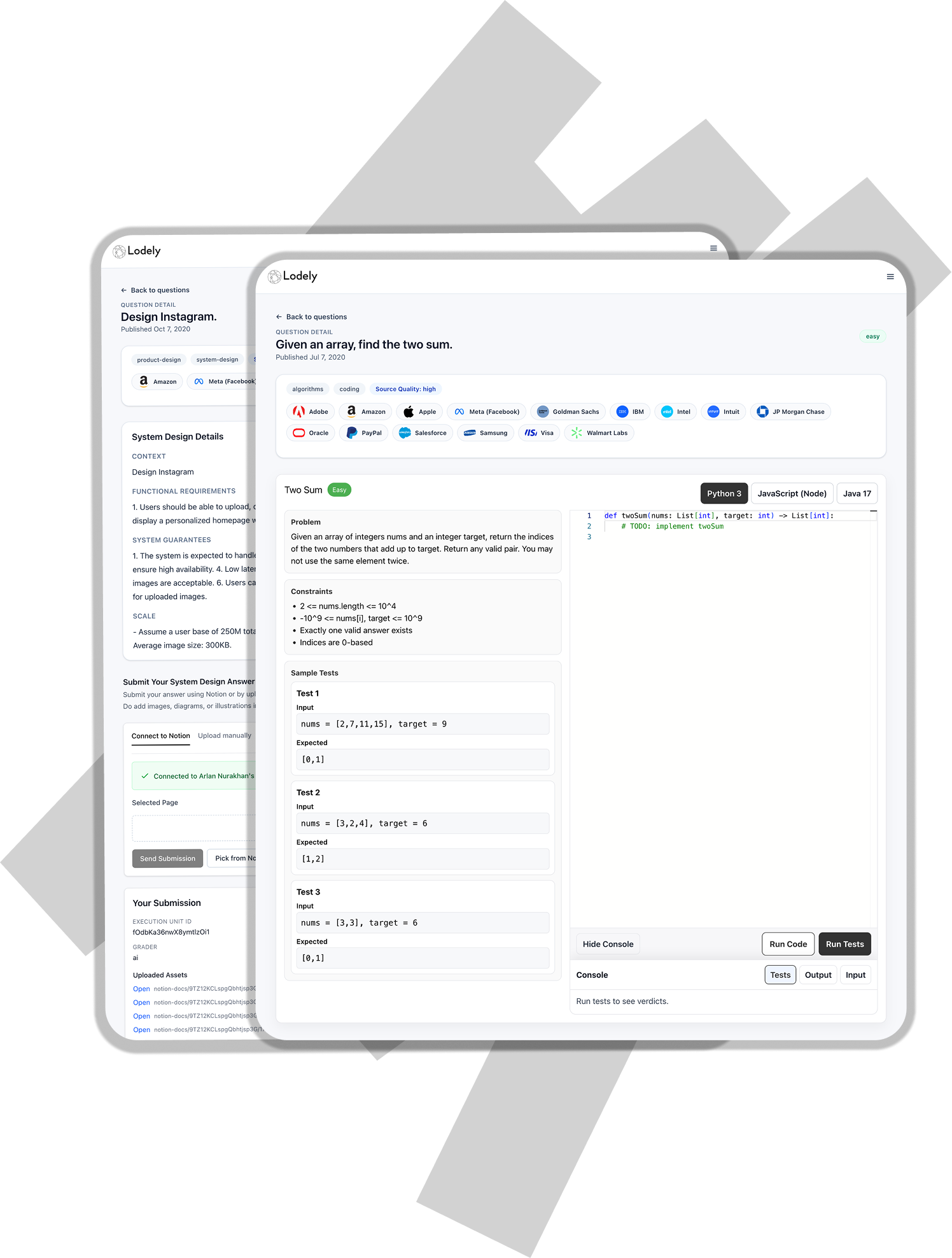
Use the Cohere set on Lodely to practice algorithms, ML implementation, reading comprehension, and AI system design. After each answer, identify the production metric you would track and the failure mode it would catch.

Cohere Interview Breakdown
Binary to Zero Operations Count
Type: Bit manipulation and counting. The Trick: Explain how each operation changes the representation, then prove the count with small edge cases. What It Tests: Whether you can identify the invariant and avoid unnecessary simulation.
Cohere Paper Deep Dive
Type: Critical research analysis. The Trick: Separate the evidence in the results from the authors' assumptions, then propose one decisive follow-up experiment. What It Tests: Your understanding of the paper's assumptions, experimental setup, and evidence.
Top-K LLM Token Decoding
Type: ML coding. The Trick: Handle logits, normalization, and sampling boundaries while explaining the tradeoff between speed and output diversity. What It Tests: Tensor manipulation, numerical stability, and decoding tradeoffs.
Removing 5 in the Maximum Number tests greedy reasoning around edge cases. ML Coding tests whether you can turn model concepts into working code. Designing a Knowledge Cutoff Guardrail for an LLM tests retrieval, policy, uncertainty handling, and monitoring decisions.
What Comes After The Interview
The panel assesses your technical execution, research, and collaboration. Reported U.S. packages include base salary, private-company equity, and occasionally a bonus, usually with four-year vesting. Ask about the stated equity value, how often grants are refreshed, and which liquidity assumptions are built into that number.
Candidate Experiences
A recent forward-deployed AI candidate described a recruiter screen, a hiring-manager project deep dive, AI-specific system design, debugging, and coding with AI assistance. The design prompt focused on an LLM code-review system, and the debugging round used practical troubleshooting questions requiring applied reasoning. The candidate did not mention the outcome. Prepare to connect product requirements to model behavior and operational controls in one conversation.
Conclusion
Cohere looks for people who can combine strong implementation with secure, observable enterprise AI. Practice the six highlighted examples on Lodely, then prepare one project or paper talk with evidence for every claim.
✉️ Get free faang interview cheat sheet and interview tips weekly
✉️ Get free faang interview cheat sheet and interview tips weekly