





Gusto Interview Questions: 9 from Real Interviews

Gusto's software-engineering process includes implementation challenges, domain-driven coding questions, system design, and values conversations. You'll explain how you interpret and implement payroll rules and how you handle changing requirements while building a feature. Your interviewer may be someone you'll work with.
What to Expect: Gusto Interview Process
Recent candidates describe a recruiter screen followed by a coding exercise. Skills exercises often use coding challenges, extensions to earlier work, system design, or a values-based interview. Live coding may use payroll, tax, scheduling, or other business-data contexts. Because each challenge uses a specific domain, you need to understand that domain even when you know the underlying data structures.
Gusto's engineering jobs currently list "AI fluency can be assessed when it matters to the role" as a qualification. Read the job description carefully and prepare one concrete example of responsible AI use.
Prepare a short project walkthrough covering the customer problem, your data model, the hardest production constraint, and one decision you would change. Because Gusto handles sensitive financial and employee data, discuss privacy, correctness, and auditability when relevant.
How to Prepare and Pass Gusto Interviews
Spend the first two weeks on hashing, arrays, time, and test design. Use the next two for data models and service boundaries. Spend the final two extending small programs and documenting how each new rule changes the design.
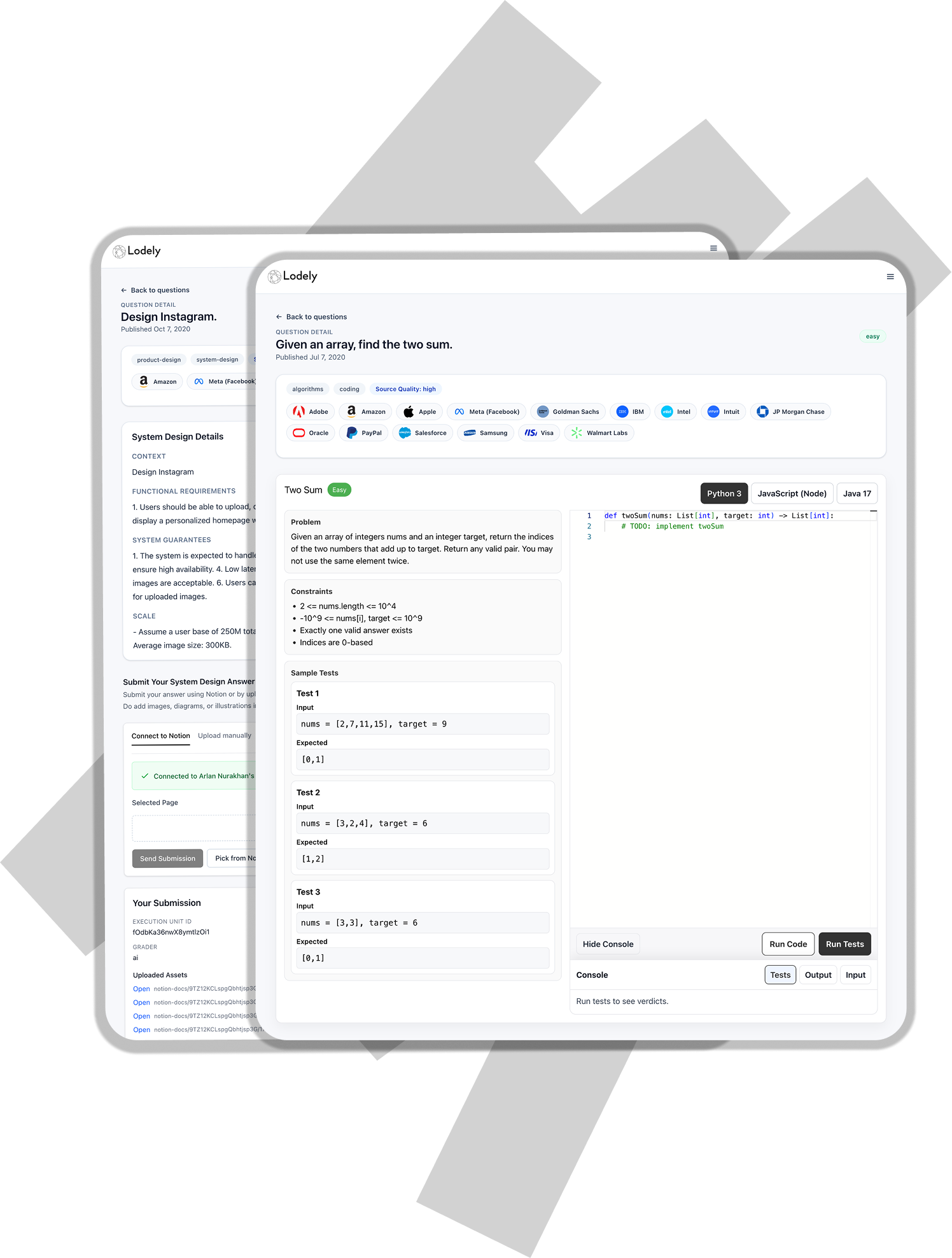
Practice Gusto-specific tax, logging, formatting, and behavioral prompts together on Lodely. Review questions about rounding, missing values, time zones, ordering, and effective dates.

Gusto Interview Breakdown
Tax Calculation
Type: Rule-based implementation. The Trick: Clarify tax-bracket boundaries and rounding before beginning the calculation. What It Tests: How your code handles boundaries and how clearly it is written.
Time Based Key Value Store
function timeBasedKV(operations, args)- Implement a time-based key-value store.
- Given a list of operations ('set' or 'get') and their arguments: 'set' stores a key-value pair with a timestamp; 'get' retrieves the value for a key with the largest timestamp less than or equal to the given timestamp.
- If no such value exists, return an empty string.
- Return the list of results for all 'get' operations.
- Timestamps for 'set' operations on the same key are strictly increasing.
1 <= operations.length <= 10^4All timestamps are positive integersFor the same key, set timestamps are strictly increasing
['set', 'get', 'get', 'set', 'get'], [['foo', 'bar', '1'], ['foo', '1'], ['foo', '3'], ['foo', 'bar2', '4'], ['foo', '5']]
['bar', 'bar', 'bar2']
['set', 'set', 'get', 'get', 'get'], [['a', 'v1', '1'], ['a', 'v2', '3'], ['a', '2'], ['a', '3'], ['a', '0']]
['v1', 'v2', '']
Type: Ordered data structure. The Trick: Maintain timestamp order and define behavior before the first recorded value. What It Tests: Retrieval complexity and API behavior.
What are your strengths and weaknesses?
Type: Behavioral. The Trick: Link one strength to one outcome and one development area to a specific recent action. What It Tests: Self-awareness and growth.
Six additional examples complete the set. JSON Difference and Log Analysis test structured comparison and event processing. Bold Tags and Integer to English test careful string output. Tax Problem explores domain rules again, while Paying Bonuses tests allocation logic and edge cases.
What Comes After The Interview
Gusto's public postings provide location-specific cash bands, while 2026 reported packages range from about $177K at L1 to $332K at L4 in the United States. Ask how base, bonus, and private-company equity are valued.
Candidate Experiences
One recent senior candidate described three skills exercises involving payouts, tax deductions, and a basic key-value store with a time parameter. The candidate advanced after the first exercise despite not solving every part because the explanation was strong. A later system-design exercise asked for a restaurant-scheduling data model, with the interviewer working through the trade-offs. Ask domain questions and explain your reasoning even if you don't finish the code.
Conclusion
Gusto's process tests real coding, rule interpretation, and collaborative design. Before your loop, use Lodely to solve all nine examples under different requirements.
✉️ Get free faang interview cheat sheet and interview tips weekly
✉️ Get free faang interview cheat sheet and interview tips weekly

