


SIG Interview Questions: 9 from Real Interviews

SIG's software-engineering interviews include timed coding, code optimization, object-oriented design, and quantitative reasoning based on the role. Interviewers evaluate your ability to write correct code, optimize it, explain it clearly, and improve it when they introduce new constraints.
What to Expect: SIG Interview Process
Candidates with relevant industry experience describe recruiter or HR conversations followed by a 75- to 90-minute technical coding test. The final interview may last two and a half hours and include coding or low-level object design. Early-career candidates may instead begin with an online test.
SIG employs teams that use different languages and work across different parts of the trading stack. Candidates interviewing for C++, C#, Python, systems-performance, research-tooling, or infrastructure roles may therefore have different experiences. Roles also vary in the depth of probability knowledge required.
When discussing optimization, begin with measurements. Know your constant factors, memory layout, allocation behavior, and asymptotic cost. Predictability matters in trading systems, so describe both worst-case and average-case behavior.
How to Prepare and Pass SIG Interviews
Plan eight weeks: three for implementation, data structures, and complexity; two for object design and memory-aware choices; two for probability and expected value if the recruiter gives you that scope; and one for time-pressured mocks followed by optimization.
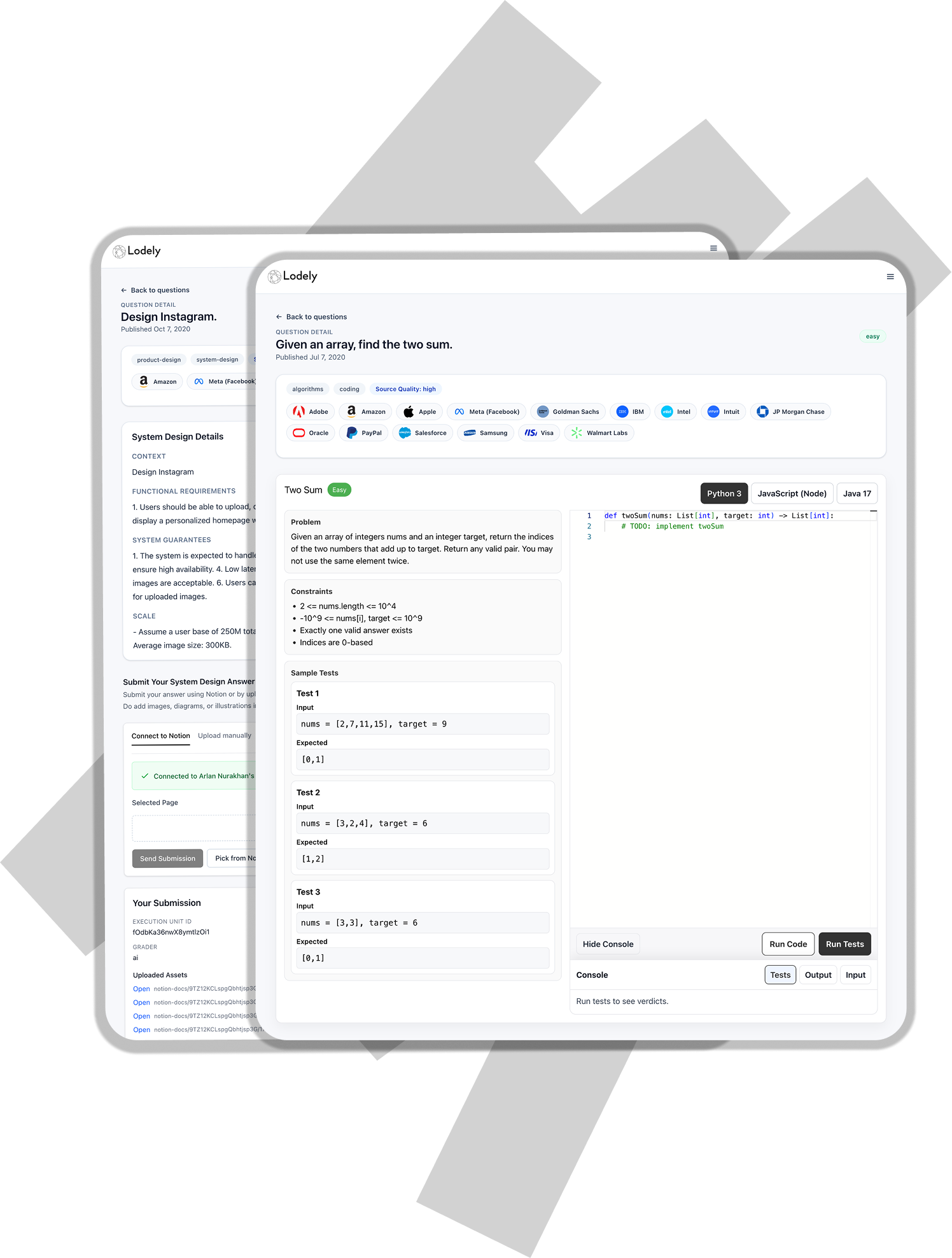
Use Lodely to practice coding and quantitative problems. As you write working code, explain each assumption and bottleneck, choose your test cases, and describe how the code would change under tighter latency and memory constraints.

SIG Interview Breakdown
Sea Battle Game
function seaBattle(grid, shots)- Implement a Sea Battle game.
- Given a grid where '.' is water and uppercase letters represent ships (same letter = same ship), process shots [row, col] and return results: 'Missed' if no ship, 'Attacked ship X' if hit ship X but not sunk, 'Ship X sunk' if last cell of ship X, 'Already attacked' if cell with ship was already hit.
- Water cells always return 'Missed' even if shot again.
1 <= rows, cols <= 101 <= shots.length <= 100
grid = [['.','.','A','.','B'],['.','.','A','.','B'],['.','.','.','.','.'],['D','D','.','.','.'],['.','.','.','.','E']], shots = [[0,2],[1,2],[0,4],[1,4],[3,0],[3,1],[4,4],[0,0],[0,2]]
["Attacked ship A","Ship A sunk","Attacked ship B","Ship B sunk","Attacked ship D","Ship D sunk","Ship E sunk","Missed","Already attacked"]
Type: Grid simulation and state tracking. The Trick: Distinguish a repeat hit on a ship from a repeat shot at water, while tracking when the final cell of each ship is hit. What It Tests: Grid modeling, mutable state, edge-case handling, and clean branching.
Age Logic Puzzle with Truth/Lie Conditions
Type: Constraint reasoning. Model the problem with logical constraints. What It Tests: Logical consistency and control of the search space. The Trick: Encode each constraint correctly and eliminate contradictory possibilities as early as possible.
Bayesian Probability with Biased Coins
Type: Conditional probability. What It Tests: Bayes' theorem and the underlying calculations. The Trick: Define the prior and the observation before substituting numbers.
The quantitative-research assessment record provides pacing context, although it combines several tasks rather than one standalone question. Divisible Rolls and Expected Turns for Consecutive Black Tiles test expected value and stochastic processes. Meeting Probability tests geometric probability. Picnic Table Grid Placement tests discrete modeling, while Hashmap for a New Programming Language tests implementation and object boundaries.
What Comes After The Interview
Offers include a base salary and bonus. Reported 2026 U.S. packages are $148K for associate software engineers, $230K for software engineers, $237K for senior engineers, and $290K for technical leads.
Candidate Experiences
One recent senior candidate described a recruiter introduction, an HR interview, a 90-minute coding interview, and a two-and-a-half-hour final round. The final combined an object-oriented design question with implementation questions, including a grocery-checkout problem and a ticker problem involving extraction from headlines. The candidate did not receive an offer but was satisfied with the interviewers. Be ready to code, explain, and optimize across a long sequence.
Conclusion
SIG values code written with its consequences in mind, explicit complexity analysis, and disciplined quantitative reasoning. Work through these nine examples using Lodely, then tailor the final week to your specific desk and programming language.
✉️ Get free faang interview cheat sheet and interview tips weekly
✉️ Get free faang interview cheat sheet and interview tips weekly