


9 Instacart Interview Questions to Expect in 2026

If you're applying for a software engineering role at Instacart, the process will probably start with an online assessment and a recruiter interview. You'll likely then complete a four-part technical loop: two coding interviews, one system-design interview, and one behavioral discussion. You'll need a basic understanding of coding and the ability to make sound design trade-offs backed by evidence from your past work.
These questions focus more heavily on product data and delivery operations. They reward well-designed solutions, so avoid shortcuts. Prepare for data structures, APIs, state, testing, and communication under time pressure.
What to Expect: Instacart Interview Process
One recent Toronto software engineer described an assessment, a recruiter call, two coding sessions, system design, and a behavioral interview. The questions covered sales, profit, travel time, shopper capacity, categories, products, APIs, pagination, and response size. Loops vary by role, so confirm the format with your recruiter.
Instacart's current candidate AI guidance says AI is encouraged only in the Karat Next Gen portion of its senior software engineer process. Other interview responses must reflect your own judgment. Ask where that policy applies before your first technical round.
How to Prepare and Pass Instacart Interviews
Give yourself four to six weeks if your fundamentals are current, or eight to twelve if you're rebuilding them. Alternate timed coding with product-centric design. For coding, practice parsing, aggregation, versioned state, dependency graphs, and edge-case testing. For design, cover catalog data, order flow, inventory freshness, delivery events, and failure recovery.
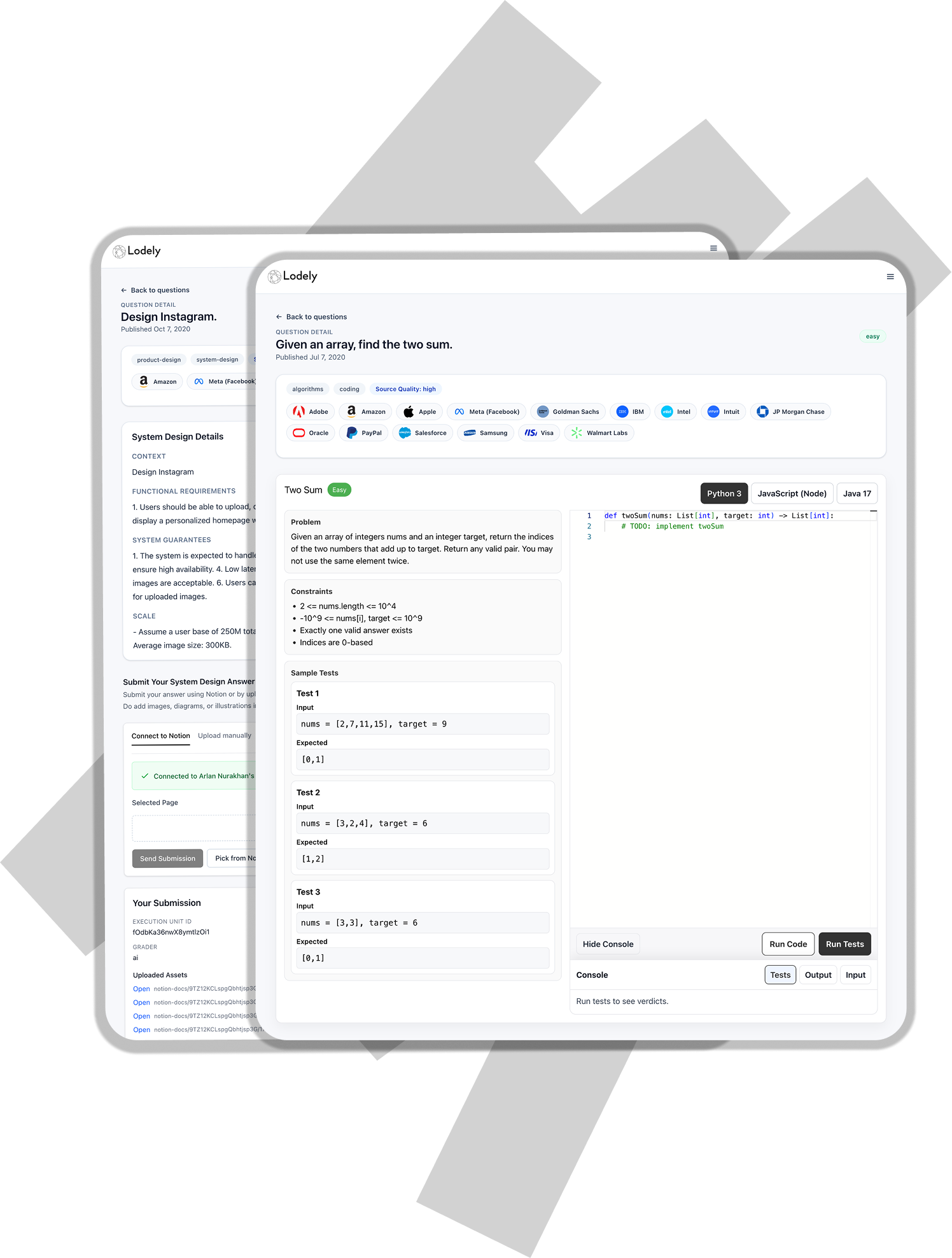
Prepare six behavioral stories about ownership, disagreement, ambiguous requirements, production failure, customer impact, and a decision you changed. Use Lodely to rehearse a company-specific mix of coding, system-design, and behavioral questions in one training path.

Instacart Interview Breakdown
Encoded Matrix
Type: Ordered deduplication and matrix construction.
The Trick: Preserve first-occurrence order, normalize case, and place I/J in the same slot without shifting the rest of the alphabet.
What It Tests: This question tests your ability to read a specification, choose an appropriate data structure, and test boundary conditions.
A Hand of Three Cards
Type: Combinatorial search problem with three categorical properties.
The Trick: Each property must be the same across all three cards or different on every card. Implement the rule once for all possibilities instead of writing separate logic for each combination.
What It Tests: Clean modeling, search complexity, and your ability to prove that the validation logic is complete.
Average Travel Time
Type: Event correlation and running aggregation.
The Trick: Match pickup and delivery events for each shopper, then track route totals and counts without mixing data from different trips.
What It Tests: State ownership, malformed-sequence handling, and efficient updates and queries.
The next six questions expand on the same practical scope. Timestamped key-value store adds historical reads. Pattern finding supports wildcards. Formula evaluation involves dependencies and cycle detection. Data pivot table aggregates sales and profit by a selected column. Decode password checks parsing of a structured file across chunks. Create a mobile app for grocery delivery shifts focus to requirements, API boundaries, and customer-facing trade-offs.
What You’re Playing For: Instacart Compensation
US software engineer packages reported by public data in September 2026 range from about $221,000 at L3 to $453,000 at L6 among the levels shown here. Stock is an important component of senior packages, so compare annualized equity, vesting, base salary, and refresh policy separately.
What Comes After The Interview
Ask when the debrief will happen and whether a hiring committee will review the loop. Write one short thank-you note that refers to a technical discussion. If you receive an offer, confirm the level, team, base salary, equity schedule, and any location change before comparing the numbers.
Candidate Experiences
One recent Toronto software engineer described two coding rounds built around product sales and shopper travel time, followed by API-and-database system design and a project-focused behavioral conversation. The candidate found the interviewers supportive, and the second coding solution led into a production-scaling discussion. The final rejection cited a need for a stronger coding signal despite positive moments elsewhere. Practice finishing the core solution while leaving time to test and discuss scale.
Conclusion
Instacart's loop emphasizes accurate implementation, product modeling, and concise discussion of trade-offs. Practice these nine interview questions on Lodely as full spoken interviews.
✉️ Get free faang interview cheat sheet and interview tips weekly
✉️ Get free faang interview cheat sheet and interview tips weekly