


Karat Interview Questions in 2026: 7 Examples

Karat usually conducts a 60-minute live technical interview as part of another company's hiring process. The session generally includes a brief introduction, about 10 minutes of discussion questions, and roughly 40 minutes of programming. The employer receives the recording and a performance report, then uses them to make its hiring decision.
What to Expect: Karat Interview Process
According to Karat's candidate guide, your interview uses a browser IDE with full tooling and a professional Interview Engineer. You schedule the interview, check your setup, complete the live session, and then wait for the recruiter at the requesting company to follow up. Some programs also include a qualifying test or a redo, so check those details in your invitation.
The interview is timed. Discussion questions may cover past work, debugging, systems concepts, and design. Programming questions arrive in parts, with a new requirement added after you complete each part. Interviewers assess correctness, communication, testing, and your ability to extend code without breaking existing behavior.
How to Prepare and Pass Karat Interviews
Plan three to four weeks if you are comfortable with programming fundamentals. In week one, review arrays, strings, maps, graphs, and standard parsing. In week two, solve multi-part problems in a shared editor while explaining your work. In the remaining weeks, run full 60-minute simulations with a short discussion followed by coding.
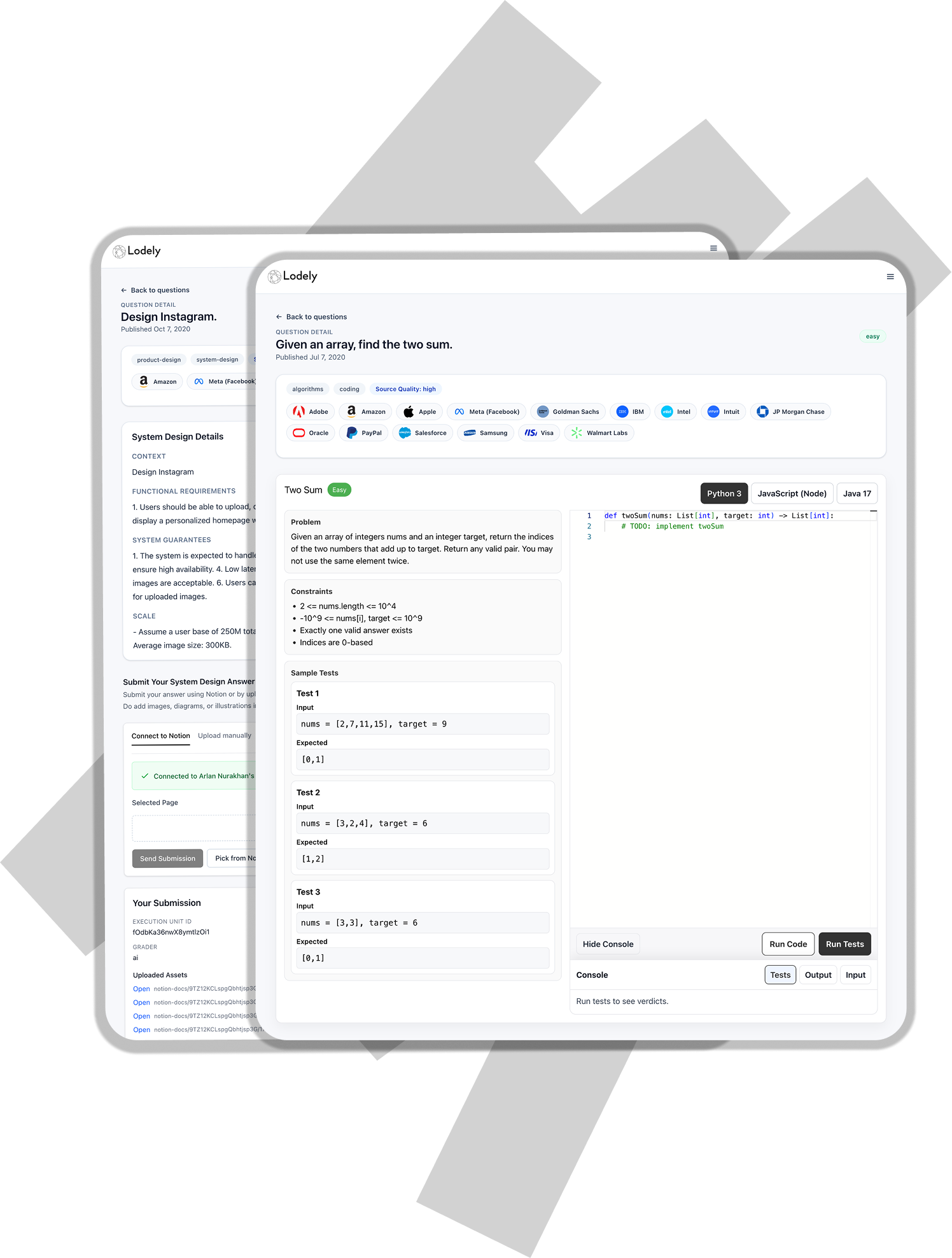
Use the language you debug fastest. Write a small test, then implement the solution. Preserve existing behavior as requirements change. Use Lodely to practice Karat questions with editorials and company context so your timed sessions more closely match the real interview.

Karat Interview Breakdown
Writing Application
Problem Type: Multi-part string formatting. The Trap: Building the initial "word wrap" step too narrowly can force a complete rewrite when justification is added. Skills Tested: Greedy grouping, careful length counting, incremental construction, and regression testing. Build lines separately from spacing so future requirements remain manageable.
Catch Cheaters
Type: Frequency counting and grid search. The Trick: Track whether characters can be reused, as in "string" and "stringer," and when movement is allowed once the board becomes two-dimensional. What It Tests: Maps, search-state modeling, constraint reading, and complexity analysis. Define a valid occurrence before writing traversal code.
Most Powerful Card
Type: Simulation and rule modeling. The Trap: Encoding each rule as a separate condition makes the solution hard to extend. What It Tests: Modeling, data ordering, tie-breaking, and test coverage. Turn the rules into explicit ranks and compare those ranks case by case.
The other four questions are Domain Analysis, which groups visits by domain and parent domain; Generation Graph, which covers parent-child relationships and traversal; Domain Knowledge Questions List, which covers engineering concepts such as when to use recursion; and Camping, which asks you to model resources and constraints under time pressure.
What Comes After The Interview
After reviewing the recording and summary, the employer decides whether and when to move forward. If you are interviewing for a role at Karat itself, its internal hiring process and compensation are separate from the client interview described here. Limited public salary information is available for Karat, so the role and equity in each offer are specific to that offer.
Candidate Experiences
One recent software-engineering candidate had a short multiple-choice qualifier followed by a one-hour live video interview. They chose between backend, general coding logic, and algorithms topics, then went through a discussion, system-design analysis, and live coding. Although rescheduling and a redo were available, the pace left little time to understand the first coding task and limited progress on later work. The candidate was not selected. Their experience highlights the need to manage time and clarify the first task early.
Conclusion
Karat evaluates code correctness, clear communication, and designs that accommodate future requirements. Practice these seven examples on Lodely under a strict 60-minute limit before your session.
✉️ Get free faang interview cheat sheet and interview tips weekly
✉️ Get free faang interview cheat sheet and interview tips weekly