


MongoDB Interview Questions in 2026: 8 Examples

MongoDB software-engineering interviews usually begin with a recruiter call and an initial technical screen. Depending on the team and role, later stages may include coding, system design, behavioral evaluation, or a senior-leader interview. Prepare to discuss concurrency, storage, reliability, and code quality in practical terms.
What to Expect: MongoDB Interview Process
MongoDB's official careers website lists a recruiter conversation, an initial technical interview, a technical interview covering coding and system design, a director or vice-president interview, and an offer. The process varies by role and region. A Database Engineering role may require knowledge of concurrency and internals, while a developer-productivity role may emphasize code review, tooling, and operational judgment.
Interviewers assess the answer, its time complexity and memory use, missed test cases, thread safety, and the alternatives you rejected. In system-design interviews, expect follow-up questions about data structures, read and write paths, consistency, and failure recovery.
How to Prepare and Pass MongoDB Interviews
Plan four to six weeks if your foundations are current, or eight to twelve if you need serious review of distributed systems and concurrency.
- Learn to build concurrent code. Review locks, work queues, termination, shared-state ownership, race detection, and nondeterministic failures.
- Connect algorithms to storage. Review indexes, caching, eviction, batching, replication, partitioning, and backpressure.
- Prepare a deep project story. Defend one architectural decision, describe an incident or migration, and explain how you influenced a decision without having final authority.
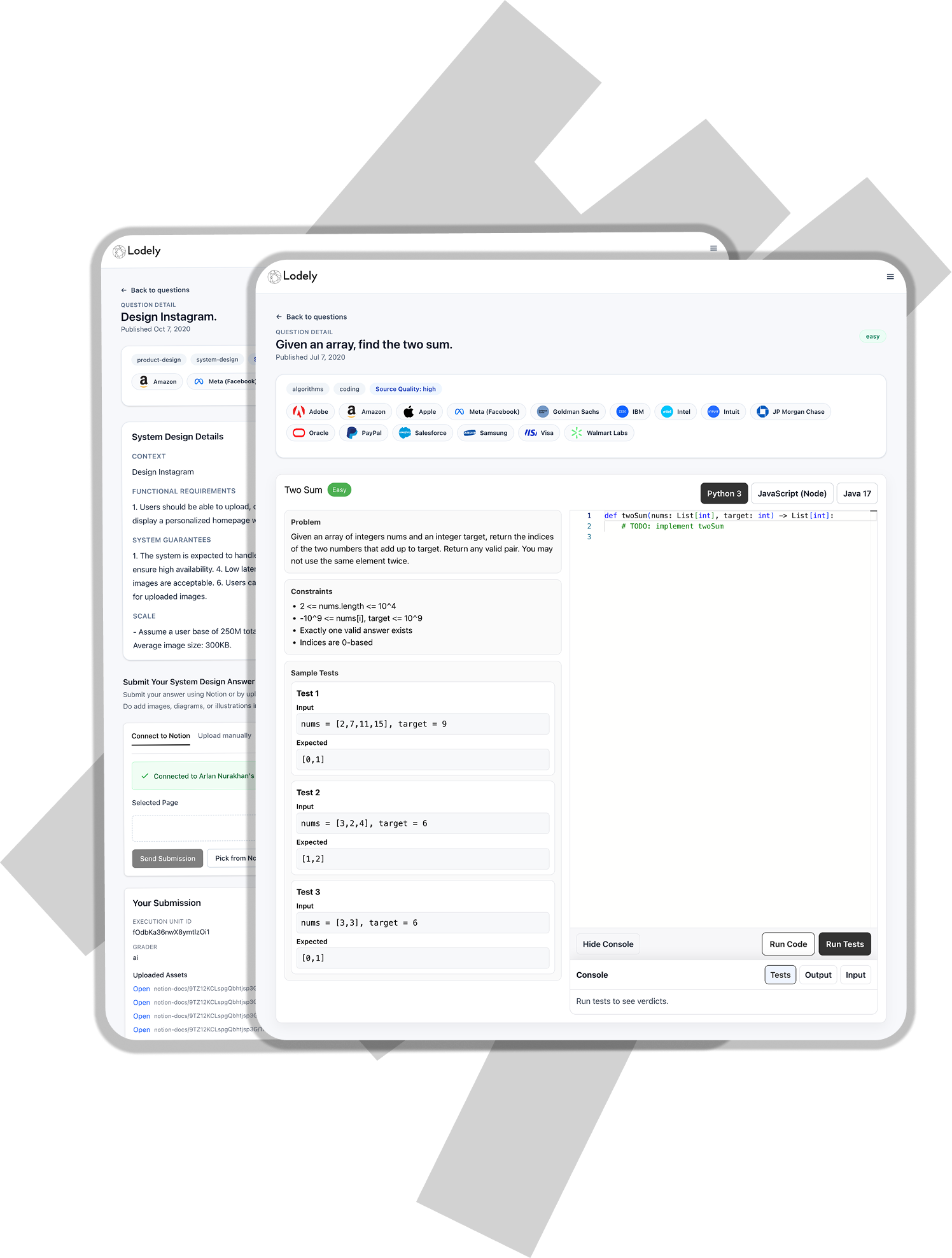
Use Lodely for MongoDB-specific coding, system-design, and behavioral practice. Detailed editorials explain the reasoning behind each answer and help you become familiar with the interview loop.

MongoDB Interview Breakdown
Inverted Index
function advancedSearch(sentences, words, mode)- Given a list of sentences, query words, and a mode ('AND' or 'OR'), return sentences matching the query.
- AND: sentence must contain all query words.
- OR: sentence must contain at least one query word.
- Matching is case-insensitive.
- Return results in original order.
1 <= sentences.length <= 10^41 <= words.length <= 100
sentences = ["Coffee is good","I am at a coffee shop","Tea is also good"], words = ["coffee","good"], mode = "AND"
["Coffee is good"]
Type: Search indexing with AND and OR queries.
The Trick: Normalize terms consistently, preserve the original result order, and combine posting sets. Clarify duplicate handling and case sensitivity before coding.
What It Tests: Hash-based indexing, set operations, input normalization, and query-time complexity.
Iterators
function mergeKSorted(arrays)- Given a list of K sorted arrays (each sorted in ascending order), merge them into a single sorted array.
- Use a min-heap (priority queue) approach for efficient merging.
- Track which array each element comes from and the current index within that array.
1 <= arrays.length <= 1000 <= arrays[i].length <= 1000-10^6 <= arrays[i][j] <= 10^6Each arrays[i] is sorted in non-decreasing order
arrays = [[1,4,7],[2,5,8],[3,6,9]]
[1,2,3,4,5,6,7,8,9]
arrays = [[1,2],[3,4]]
[1,2,3,4]
Type: Merging multiple sorted sequences.
The Trick: Use a min-heap to track the current item from each iterator. Store both the source sequence and current position so you can advance the correct iterator after emitting a value.
What It Tests: Iterators, priority queues, empty inputs, duplicates, and clear complexity analysis.
Connection Pool
Type: Stateful coding with concurrency constraints.
The Trick: Define the lifecycle for checkout, timeout, failure, and return before implementing synchronization. Leaked or double-returned connections reduce pool capacity.
What It Tests: Resource ownership, thread safety, failure handling, and testable interfaces.
Five more examples complete the set. Random Dice Roll tests randomness, distribution, and testing strategy. Design a distributed key-value store covers replication, partitioning, consistency, and failure recovery. Design a time series storage layout for sensor data covers write throughput, retention, compression, and range queries. Tell me about a database migration, upgrade, or conflict requires a specific risk, mitigation, and outcome. Tell me about influencing an architecture decision without final authority tests trade-off communication, disagreement, and evidence-based alignment.
What Comes After The Interview
Ask whether the remaining process includes a director conversation or team-level review. If you receive an offer, compare the level before the total compensation. As of September 2026, San Francisco Bay Area submissions on public data show $162K for SE2, $227K for SE3, $412K for Senior, and $611K for Staff. Equity rises sharply at Senior and above, and the RSU schedule spans four years.
Candidate Experiences
One recent senior software-engineering candidate described five final interviews: a multithreaded code review, system design, concurrency coding, a hiring-manager project deep dive, and a director conversation. The design interview began with architecture questions and moved into concrete data structures and read scalability. The coding task involved a finite concurrent web crawler, while the hiring-manager and director sessions focused on past projects and team fit. Practice switching between low-level concurrency and high-level design while keeping your assumptions explicit.
Conclusion
MongoDB interviews assess code correctness, concurrency discipline, database-aware design, and sound technical judgment. Practice the eight selected questions on Lodely as a loop covering coding, design, and behavioral skills.
✉️ Get free faang interview cheat sheet and interview tips weekly
✉️ Get free faang interview cheat sheet and interview tips weekly


