


Nextdoor Interview Questions: 10 from Real Interviews

Nextdoor interviews cover algorithmic coding and large-scale systems. You may face questions about data structures, in-memory components, or system design for feeds, relevance, identity, and neighborhood reliability.
Nextdoor describes its product transformation in the company's 2025 annual filing. In the fourth quarter, the company had 21 million weekly active users. That scale supports questions about correctness and product tradeoffs.
What to Expect: Nextdoor Interview Process
A typical process starts with a recruiter interview, followed by one or two technical interviews. The final virtual loop includes a coding interview, system design, a hiring manager interview, and behavioral questions. Senior-level engineers must shift between implementation details and high-level architecture.
During coding challenges, interviewers evaluate your tests, complexity analysis, and responses to follow-up questions. Before designing the service, define the target behavior, privacy and freshness requirements, and failure cases.
How to Prepare and Pass Nextdoor Interviews
Review arrays, nested structures, graph traversal, backtracking, maps, intervals, and transactional state. Build a small API, then extend it without breaking existing code. For feeds and neighborhoods, discuss ranking, caching, moderation, identity, and observability.
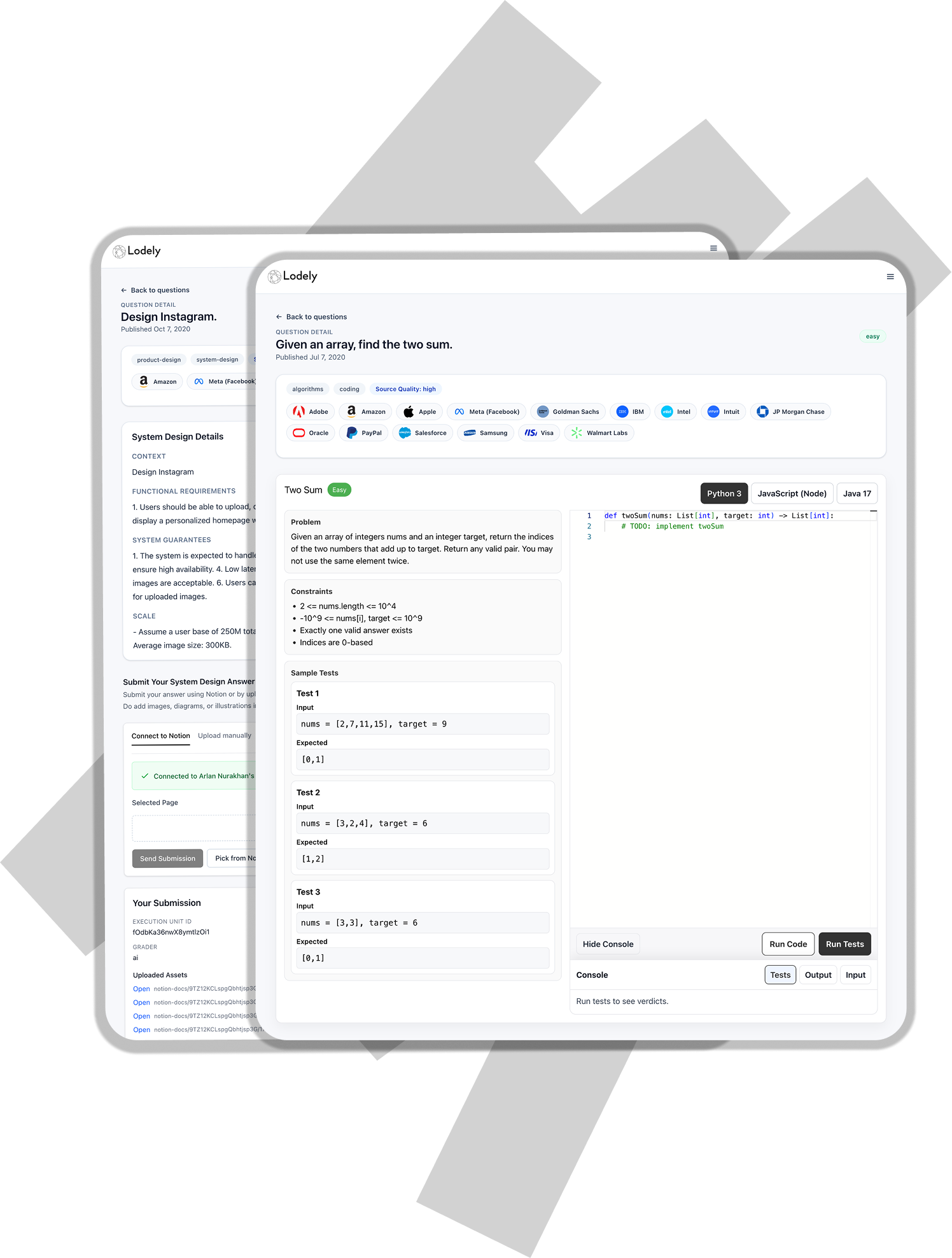
Prepare stories about projects that demonstrate ownership and constructive disagreement. Use Lodely to combine company-specific coding, system design, and behavioral practice in a timed full-loop rehearsal.

Nextdoor Interview Breakdown
Depth Weighted Sum
Type: Coding
What It Tests: Recursion, traversal, nested data, and complexity.
The Trick: Track depth as part of the traversal state and define how to handle an empty list.
Integer Split
Type: Coding
What It Tests: Array scanning, array bounds, and planning ahead.
The Trick: Treat the segments as ranges so you only need to track the index.
Max Island Area
Type: Coding
What It Tests: Grid traversal, visited state, and connected components.
The Trick: Mark each cell when you enter it during the search.
The seven additional tasks are Letter Combinations of a Phone Number (backtracking), Find View By ID (breadth-first versus depth-first), Feed List (group and sort picture objects), Semantic Versions (compare version strings by the given rules), In-memory Database (add transaction commands to a key-value store), Hashmap Difference (find the first mismatched value in a nested hashmap), and Intervals Merging (merge boundaries between two interval series).
What Comes After The Interview
After the loop, the hiring team reviews evidence from your coding, design, and collaboration interviews. Ask how the team evaluates neighborhood relevance and trust, which systems you would own, and what changed with the product transformation. Reported median engineering salaries range from $176k at L1 to $412k at L5, with equity and grant schedules contributing to wide variation.
Candidate Experiences
A recent senior-level candidate described two phone screens that included an interval-merging question and an in-memory database with transactions and savepoints. He completed the solutions, reran his tests, and believed his answers were correct, but felt that he worked too slowly. He received a standard rejection a few days later. Practice explaining and implementing solutions under strict time limits.
Conclusion
Prepare for Nextdoor by combining algorithms, product constraints, and behavioral evidence. Finish the verified Nextdoor set at Lodely, then complete another timed full loop and explain your tests clearly.
✉️ Get free faang interview cheat sheet and interview tips weekly
✉️ Get free faang interview cheat sheet and interview tips weekly