


5 Nuro Interview Questions to Expect in 2026

Nuro's interviews reflect the company's blend of software, AI, and automotive systems. Software roles cover coding and design, but the specific topics depend on the team. Infrastructure interviews may focus on C++ memory and scheduling, while autonomy interviews may go deeper into data, models, and safety.
Nuro was founded in 2016 and develops the Nuro Driver, an autonomy platform for robotaxis, personal vehicles, and commercial fleets. Nuro increasingly looks for practical AI fluency when hiring engineers.
What to Expect: Nuro Interview Process
The process usually begins with a recruiter screen. Next, you'll speak with a hiring manager or engineer on a video call. You may have a half-day interview that includes coding, system-level or low-level design, and a project discussion. Leadership interviews vary by role. Nuro's 2026 candidate guide says CEO Jiajun Zhu personally interviews candidates, and teams evaluate AI understanding across all functions.
An interviewer may ask you to solve a problem in code and then discuss complexity, memory use, and edge cases. Follow-up questions can be demanding because you must explain how the code would need to change for a real system.
How to Prepare and Pass Nuro Interviews
Review graphs, queues, linked lists, geometry problems, topological sorting, and frequency counting. Check whether the role uses C++, then review ownership, memory allocation, caching, and scheduling. Define safety and reliability requirements before designing a component.
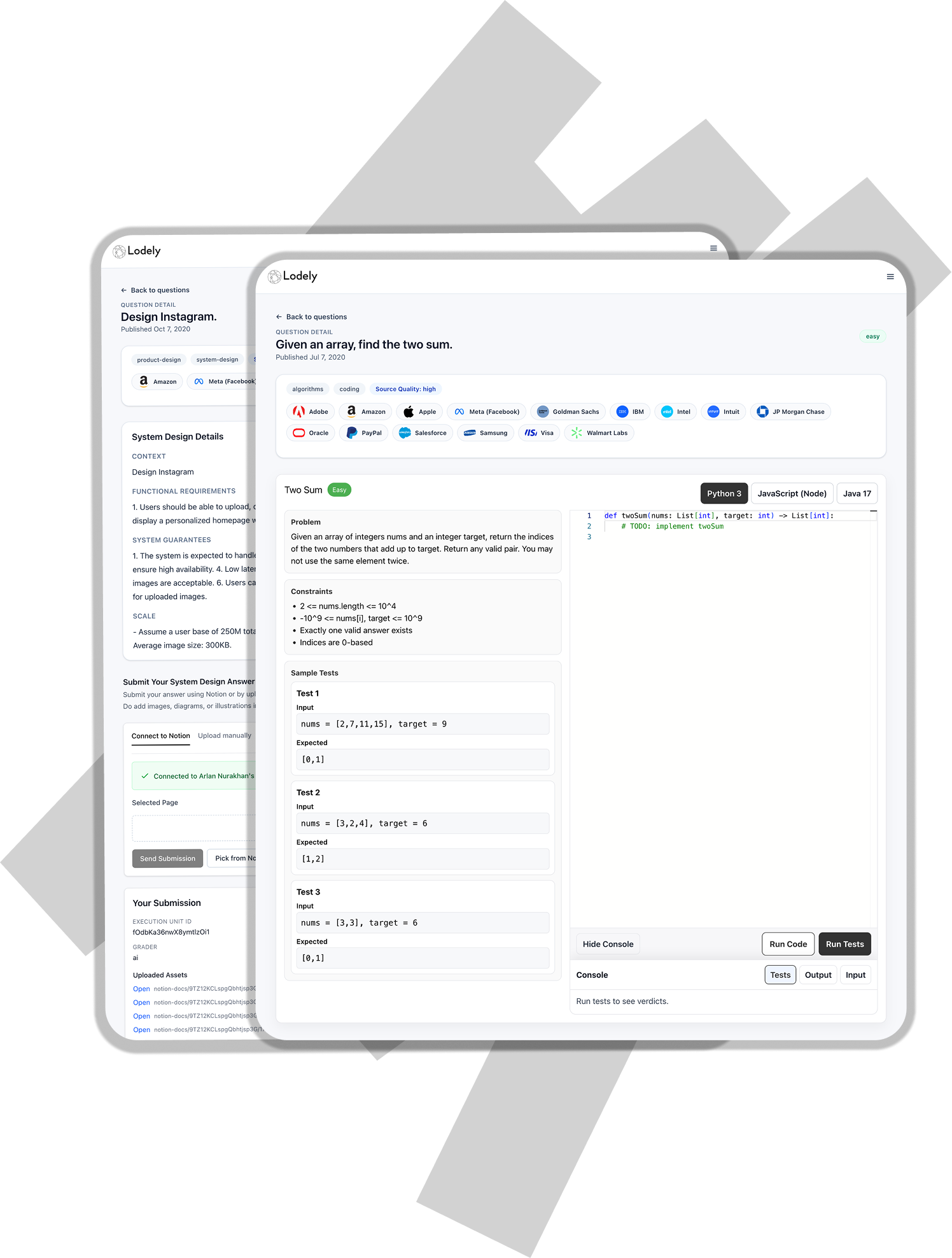
When discussing past work, explain the problem, the decisions you made, what changed your mind, and how you verified the fix. Use Lodely to practice coding, system design, and behavioral questions in one full loop with company-specific prompts.

Nuro Interview Breakdown
Breakdown Point
Type: Coding
What It Tests: Geometry, cumulative distance, edge cases, and numeric precision.
The Trick: Find the segment containing the target distance, then interpolate within that segment.
Triple Pointer
Type: Coding
What It Tests: Linked-list invariants and careful mutation.
The Trick: Write the pointer invariant, then modify each affected node after a prepend or removal.
Frequency Tracker
Type: Coding
What It Tests: Sliding windows, counts, and deterministic tie-breaking.
The Trick: Track each number's frequency and recency so that, when frequencies tie, you return the most recent number.
The remaining questions require similar skills. Stop Sequence asks you to order stops by priority while respecting dependencies and detecting cycles. Points Clustering asks you to group 3D points connected within a given distance threshold and discuss how the approach scales.
What Comes After The Interview
After the loop, interviewers gather evidence from the technical and collaboration rounds before making a hiring decision. Closing interviews let you ask which vehicle platforms the team owns, how it handles data flows and simulations, how it evaluates road data, and which operational metrics define success. Reported median U.S. software engineering salaries range from $235,000 at L3 to $613,000 at L6, with wide variation in equity-based compensation.
Candidate Experiences
A recent software engineering candidate first had a recruiter interview, then a video call with a hiring manager and an engineer. The process included a half-day onsite with coding and design questions about C++, memory, and scheduling. He described the interview as extremely difficult but still positive. He did not receive an offer. Practice implementation details and design tradeoffs in the same session.
Conclusion
For Nuro, connect strong fundamentals to the requirements of trusted autonomy systems. Answer the verified Nuro questions on Lodely.com, then clearly explain your decisions about memory, performance, safety, and ownership.
✉️ Get free faang interview cheat sheet and interview tips weekly
✉️ Get free faang interview cheat sheet and interview tips weekly