





Waymo Interview Questions: 9 from Real Interviews

Waymo's hiring process begins with an initial phone screen and up to one or two interviews with a peer or manager. A virtual onsite follows with up to five 45-minute interviews. The official hiring process includes behavioral questions, hypotheticals, case studies, coding, and system design, depending on the role. Required skills include explaining an algorithm and defending a safety-critical system design.
What to Expect: Waymo Interview Process
First, you'll have a call to assess your fit for the role and discuss the team's timeline. There will be 1-2 technical behavioral screens. During the virtual onsite, you'll meet your team and potential collaborators. Interviewers evaluate coding, design explanations, and collaboration stories separately, so strong coding cannot compensate for vague design explanations or weak collaboration stories.
Backend candidates may need to focus more on distributed systems and reliability. Planning or autonomy candidates may encounter graphs, geometry, simulation, machine learning, or C++. Ask the recruiter which formats your loop uses before building your practice plan.
How to Prepare and Pass Waymo Interviews
Use a six-week plan. Spend the first two weeks on graph traversal, matrices, trees, heaps, and interval problems. Spend the next two on system design, including data ingestion, latency, failure recovery, and safety. Use the final two weeks for timed mixed loops and behavioral stories about cross-functional decisions.
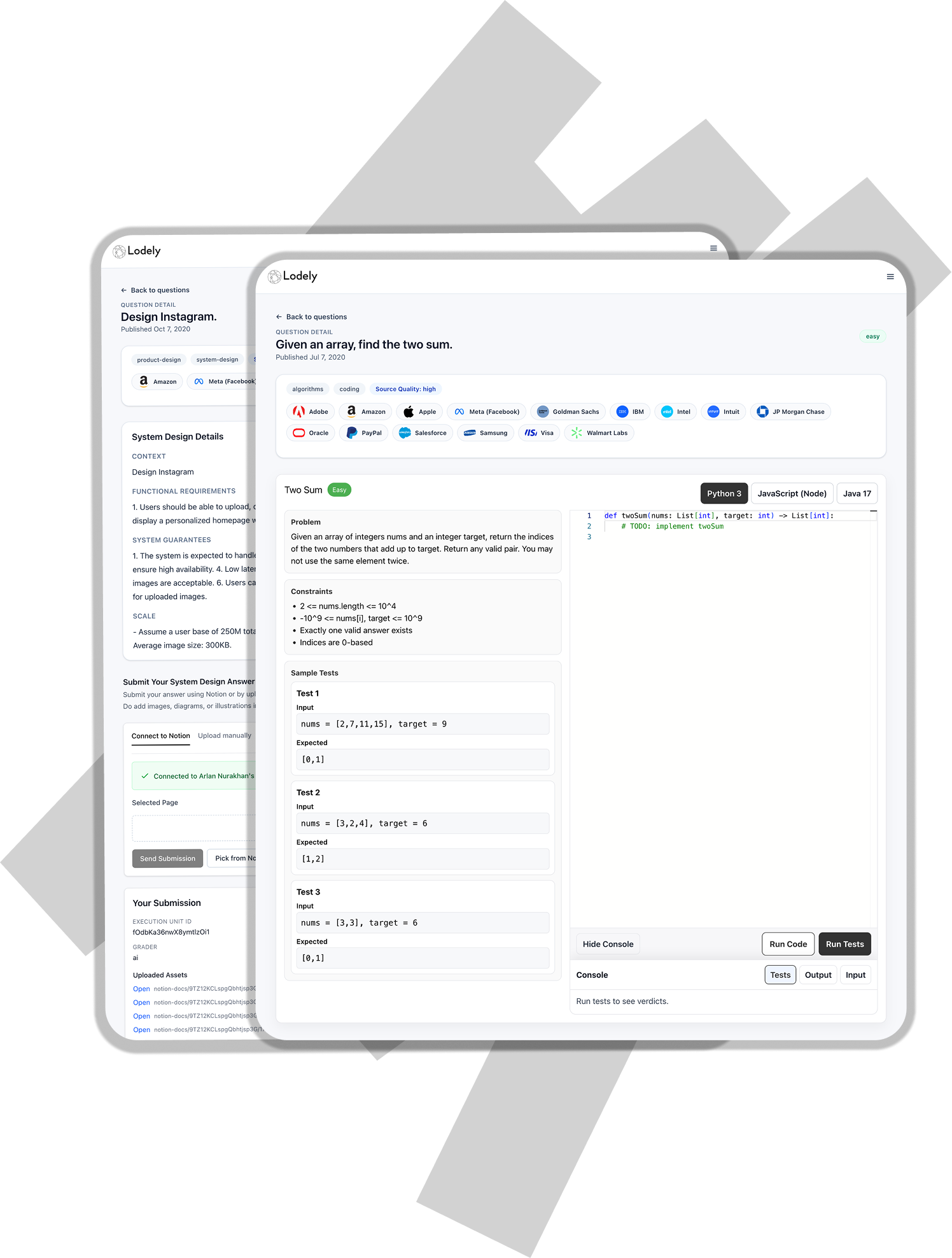
Practice with Lodely by verbalizing invariants and edge cases before writing code. At Waymo, that habit helps when a familiar structure appears inside a navigation, fleet, or sensor-data scenario.

Waymo Interview Breakdown
Words Filling
Type: Grid and constraints. The Trick: Must check boundaries, blocked cells, direction, and prefilled letters, without filling the slot at all. What it tests: Translation of physical layout into code.
Toeplitz Matrix
Type: Matrix scanning. The Trick: Compare each cell with its upper-left neighbor, then explain how the algorithm would change if memory could hold only one row or part of a row. What It Tests: Simple invariants and space efficiency.
Rabbit Inbreeding
Type: Graph ancestry and lowest common ancestor (LCA). The Trick: The graph allows two parents in a lineage, so tree assumptions can fail. What It Tests: Graph modeling, distances between ancestors, and disconnected graphs.
Six questions remain. Election Winner asks whether partial district orderings can determine an election winner. Array Compression preserves an array's relative order as it is compressed into a matrix. Next Right Nodes links tree nodes on the same level to the right. Largest Rectangle in Histogram uses a monotonic stack to handle boundaries. Implement LRU Cache maintains relative order with O(1) access. Merge Schedule merges two partial event orders without duplicates.
What Comes After The Interview
Feedback is collected across the loop, and your recruiter handles any team-specific next steps. If you receive an offer, compare the proposed level and pay mix carefully. Reported Waymo packages become much more equity-heavy at senior levels; the compensation grid below shows current samples.
Candidate Experiences
One recent senior software candidate described a coding phone screen followed by three onsite rounds. The onsite combined system design with two additional algorithmic sessions, and several prompts used navigation or autonomous-vehicle scenarios. The account shows that domain-specific constraints can frame general engineering questions. Clarify the vehicle or mapping assumptions before you start coding.
Conclusion
Waymo rewards clean code, deep role knowledge, and calm tradeoff decisions. Tailor your full-loop coding, design, and behavioral practice to the role you're applying for with Lodely's company questions.
✉️ Get free faang interview cheat sheet and interview tips weekly
✉️ Get free faang interview cheat sheet and interview tips weekly
