


Optiver Interview Questions: 7 Questions to Prepare for in 2026

Optiver's software engineering process typically includes an HR screen, an online assessment, a coding screen, and two interviews. The interviews may include a coding challenge, system design for a performance-critical problem, or both.
The firm's technical interviews cover object-oriented programming languages, data structures and algorithms, computer architecture, networking, concurrency, and memory management. Interviewers also ask about trade-offs and how physical constraints affect a design (Optiver's interview tips for software engineers).
What to Expect: Optiver Interview Process
The first screening usually assesses implementation speed and logical reasoning. A recruiter or behavioral screen asks why you want to be a software engineer, why you want to apply software engineering to market making, and what examples of collaborative work you can discuss. The technical screen tests your coding fundamentals, and the final screen covers system design and low-level technical decisions.
Expect follow-up questions after presenting your first solution. They may cover memory layout, complexity, contention, and how the design behaves as latency and throughput requirements change. Optiver suggests clarifying the load, edge cases, and latency requirements before choosing an architecture.
How to Prepare and Pass Optiver Interviews
If your fundamentals are current, plan four to six weeks. During the first half, practice C++, Java, or Python; data structures and algorithms; runtime analysis; memory usage; and implementation with limited tooling. Spend the second half on networking, concurrency, operating systems, memory management, and performance-oriented design.
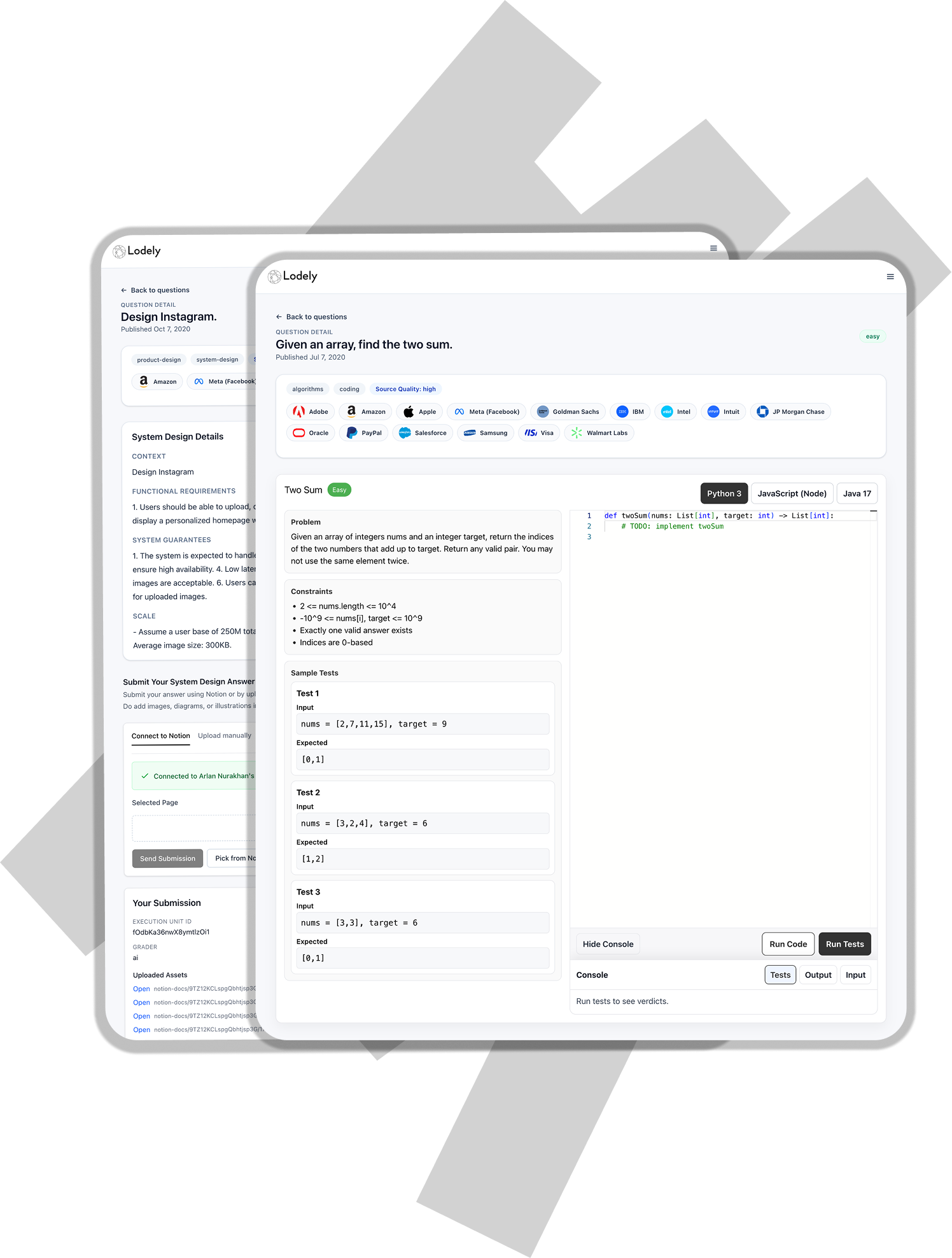
Use Lodely to practice the full Optiver loop, including coding, system design, and behavioral questions. State your decisions, test edge cases aloud, and justify the simplest design that meets the requirements.

Optiver Interview Breakdown
Array Reconstruction
Type: Array reasoning and constructive coding. The Trick: Convert the local constraints into a global constraint while tracking indices. What It Tests: Invariants, data-structure choice, and clean coding.
Favorite Songs
Type: Pair selection coding. The Trick: Handle duplicates, preserve distinct indices, and support fast lookup. What It Tests: Hashing, edge cases, and complexity analysis.
Orders Leaderboard
Type: Ranked-state coding. The Trick: Apply repeated order updates without rebuilding the entire ranking, while defining tie behavior clearly. What It Tests: Ordered data structures, invariants, update complexity, and boundary cases.
The remaining examples cover related signals. The two Optiver Graduate Software Engineer 2025 OA questions test multi-step coding under time constraints. Circular Queue tests fixed-capacity indexing, wraparound, and edge cases. The CS fundamentals collection covers follow-up questions about memory, networking, concurrency, and language behavior.
What Comes After The Interview
The recruiter normally coordinates the decision after the final technical interview. Performance strongly affects compensation: 2026 U.S. salary reports list total compensation of $334K for L3, $483K for L4, and $447K for L5. Performance-based pay therefore makes up a substantial part of the package.
Candidate Experiences
A recent employee on a New York software engineering team described an HR interview, an online assessment, a phone coding screen, and two final interviews. The final stage included one technical interview and one system design interview focused on a trading system server. They described the assessment as tedious and the final interview as challenging, but received an offer. Prepare to apply algorithms to real systems with performance constraints.
Conclusion
Optiver evaluates coding accuracy, systems knowledge, and reasoning that holds up under follow-up questions. Practice the complete company-specific loop on Lodely.
✉️ Get free faang interview cheat sheet and interview tips weekly
✉️ Get free faang interview cheat sheet and interview tips weekly