





Oracle Interview Questions: 9 from Real Interviews

Oracle's software engineering process varies by business unit, but most reported loops include a background screen, technical depth interviews, coding, system design, and project discussions. OCI roles focus on distributed systems and reliability, while database and application teams focus more on Java, SQL, or product fundamentals.
What to Expect: Oracle Interview Process
Most candidates report a talent advisor call, a manager or technical screen, and either a panel or a multi-session loop. Oracle's candidate guide notes that multiple business representatives may be present. Recent experienced hires report coding, backend or system design, language fundamentals, project deep dives, and behavioral questions. The combination of stages varies by team and hiring level. Ask your recruiter to confirm the format.
How to Prepare and Pass Oracle Interviews
Plan four to six weeks if your fundamentals are current. Plan eight weeks if you need to review distributed systems or timed coding.
- Tell one technical story about a system you worked on. Explain the problem, trade-offs, and result. Prepare for follow-up questions about each detail you mention.
- Practice clean coding out loud. State your assumptions, pick a data structure, test edge cases, and give your runtime and memory usage.
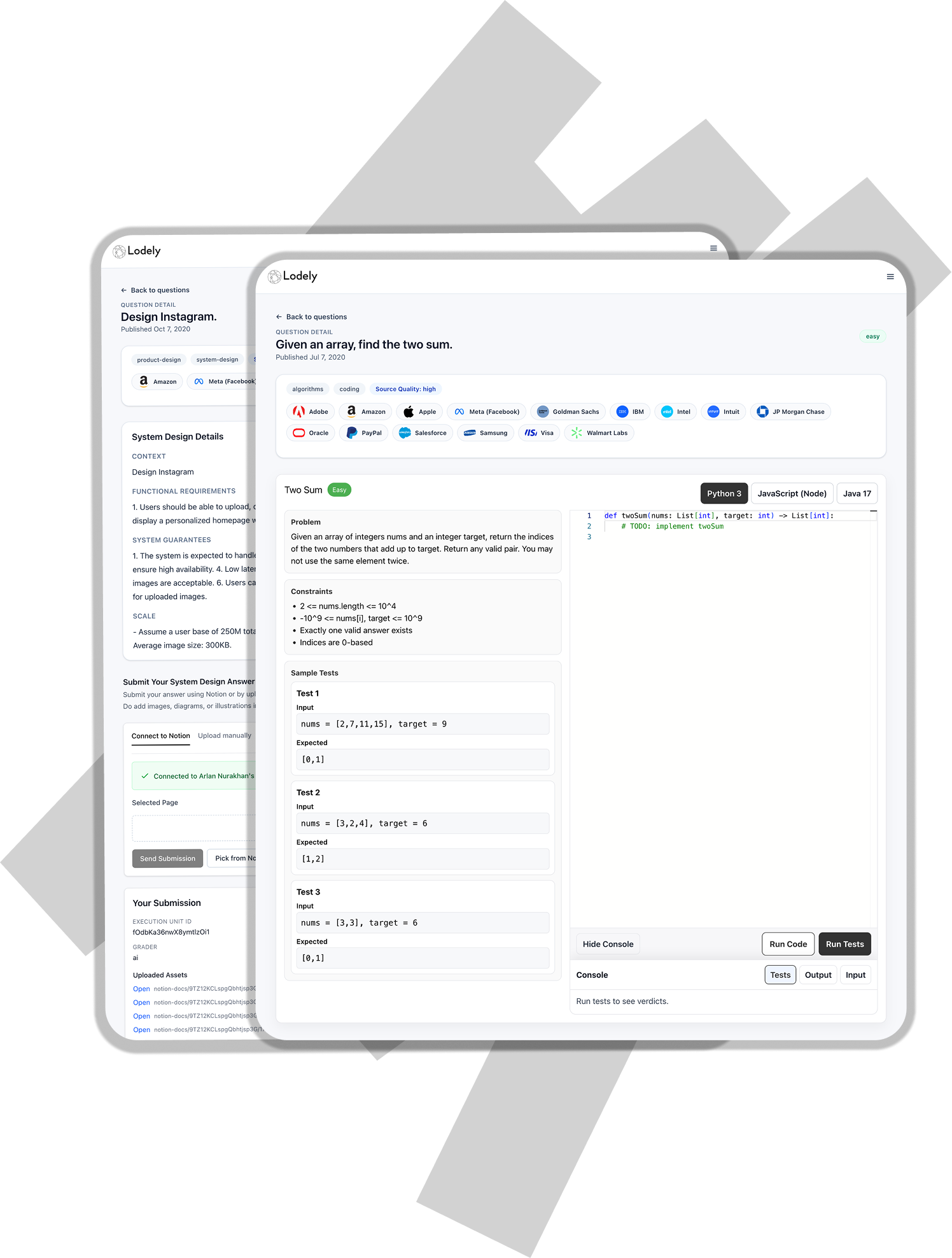
- Review consistency, replication, failure recovery, caching, and observability in Oracle products. Use Lodely to rehearse coding, system design, and behavioral questions together.

Oracle Interview Breakdown
Tell me about yourself
Type: Behavioral. The Trick: Build a two-minute answer around your current scope, two relevant achievements, and why this Oracle team is the next fit. What It Tests: Communication, prioritization, and role fit.
Design a key-value store
Type: System design. The Trick: Define consistency, scale, and durability requirements before designing components. Then cover the API, access patterns, partitioning, replication, failure management, and monitoring. What It Tests: Distributed systems judgment.
Tell me about a time you made a mistake
Type: Behavioral ownership. The Trick: Use a meaningful mistake that directly answers the question. Explain the impact, how you fixed the error, and what you changed to prevent it from happening again. What It Tests: Accountability and learning.
The final six questions cover additional skills. Valid Parentheses tests stack use and malformed input. Two Sum tests lookup-based problem solving. Merge Two Sorted Linked Lists tests pointer use. The complex problem story covers how you solved a difficult problem. Linked List Cycle tests invariant-based traversal. Implement Trie tests tree-based data modeling and operations.
What Comes After The Interview
If your packet requires written approval, you may need manager and business approval. As of September 2026, reported U.S. Oracle software engineer salaries ranged from $162K (IC-1) to $299K (IC-4), with much higher packages at upper levels. Compare the headline number with the base salary, annualized equity, bonus, and actual leveling decision.
Candidate Experiences
One experienced candidate interviewed a couple of months earlier and described a talent advisor call, a semi-technical manager screen, and a 90-minute panel with four interviewers. The panel then asked increasingly detailed technical follow-up questions. Interviewers gave constructive guidance when one answer was incomplete. The candidate received a verbal offer about three weeks after the panel, with written approval later that month. Document your project details thoroughly enough to answer several layers of follow-up questions.
Conclusion
Oracle evaluates strong fundamentals, clear project ownership, and design choices that handle failure. Practice company-specific questions across the full loop under realistic time pressure on Lodely.
✉️ Get free faang interview cheat sheet and interview tips weekly
✉️ Get free faang interview cheat sheet and interview tips weekly