Otter.ai Interview Questions in 2026: 9 Examples

Otter.ai software engineering interviews begin with a recruiter screen and live coding, followed by a multi-round loop that may include system design, machine learning, and behavioral interviews. The official process guide says the post-screen loop has three to five rounds, with the mix depending on whether you are targeting backend, frontend, or machine learning roles.
What to Expect: Otter.ai Interview Process
The first technical interview tests whether you can write technically correct code, manage complexity, and handle edge cases under time pressure. Later interviews may cover graphs and grids, strings and intervals, system design for a senior engineer, or frontend and machine learning topics for specialized teams. The leadership interview may cover how your technical decisions affect users. Expect follow-up questions about the clear limitations of your solution.
How to Prepare and Pass Otter.ai Interviews
Plan five to seven weeks. Practice graphs, trees, strings, and streaming state. Write every implementation in full, test edge cases, and explain why the complexity is O(n) for an input of size n. Add role-specific depth: distributed components for backend, rendering and state for frontend, or modeling and GPU basics for machine learning.
Otter.ai's question mix makes incremental state especially useful to practice. Convert a batch solution into an iterator or stream without saving the entire result again. Test gaps, duplicate timestamps, empty input, and an interrupted producer. This prepares you for follow-up questions that change the delivery model while preserving the core result.
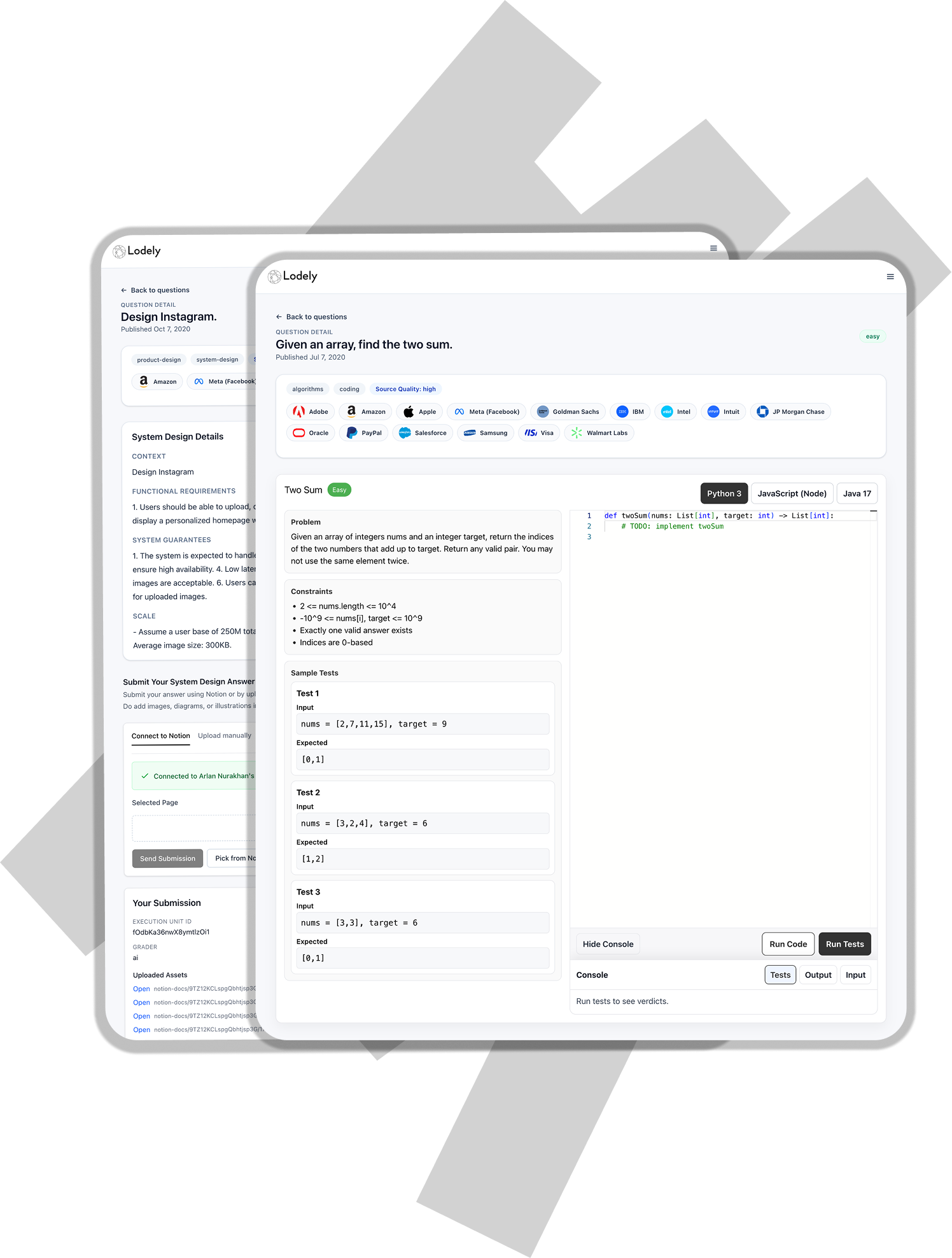
For one design, practice identifying the bottleneck and recovery behavior of a specific requirement. Lodely provides Otter.ai questions, editorials, and daily paths across algorithms, architecture, and technical discussion.

Otter.ai Interview Breakdown
Design a web crawler.
Type: Distributed system design. The Trick: Control overlapping work and per-host politeness as the frontier grows through many workers. What It Tests: Requirements, partitioning, reliability, and operational trade-offs.
Time Interval String Matching (Stream)
Type: Streaming interval processing. The Trick: Keep enough state to process each time period as data arrives without rebuilding the full result. What It Tests: Edge cases, iterators, and incremental processing.
Password Validation System (Multiple Rules)
Type: Rule-based implementation. The Trick: Run independent checks without rescanning the input, and return useful failure messages. What It Tests: Clean problem decomposition, edge cases, and code quality.
The other six problems broaden the scope. ML Basics: Overfitting, LSTM vs Transformer, GPU tests technical explanation. Array Element Ranking tests sorting. Frog Jump tests graph traversal. Binary Tree Root to Leaf Maximum Path Sum with Path tests tree reasoning. Flatten Deeply Nested Array tests iteration. Two Sum Variant: Array Format and List Sum tests hash-table use.
What Comes After The Interview
The panel evaluates coding, role depth, and communication before a final decision. A September 2026 U.S. report lists a $207K L3 package, including $187K in base salary and a $20K bonus, though sample sizes for small companies are limited and compensation terms can change quickly.
Candidate Experiences
One senior candidate described a two-week process that began with a 30-minute screen. A week later, the candidate completed a 45-minute live coding exercise and found the interviewers friendly, but didn't reach an optimal solution and received no offer. Interviewers assess communication and optimization together. Explain your reasoning as you code.
Conclusion
Otter.ai evaluates fast, correct implementation and depth in the team's domain. Use Lodely to practice these nine questions and review the reasoning behind each pattern before the live screen.
✉️ Get free faang interview cheat sheet and interview tips weekly
✉️ Get free faang interview cheat sheet and interview tips weekly