Samsara Interview Questions: 10 from Real Interviews

Samsara software engineering interviews usually include an online test, a recruiter screen, a technical interview, and a hiring manager interview. Senior or full-time roles include system design or another coding round. Because Samsara builds connected-operations products, the work will likely involve practical data handling, building objects or APIs, and working with systems that process device or fleet data.
What to Expect: Samsara Interview Process
Samsara's engineering internship description says the team discusses your past experience, what you want to learn, and your fit across engineering groups. Recent intern loops have included an hour-long assessment, a 30-minute recruiter screen, and a one-hour technical interview before the hiring manager conversation. Experienced candidates should also prepare for architecture and production trade-offs.
The technical interview may require you to start with the product or parser. The interviewer may ask for clarification on ambiguous requirements, selection of data structures, development in increments, and strict time boxing for testing. It may ask about your previous projects and how you followed through on an idea to get a product to market.
How to Prepare and Pass Samsara Interviews
Follow a six-week plan:
- Two weeks: Arrays, strings, intervals, caching, and graph traversal
- Two weeks: Object modeling, HTTP flow design, and fleet data design
- Two weeks: Timed coding, project stories, and end-to-end mocks
- Add two weeks if concurrency and system design are new to you
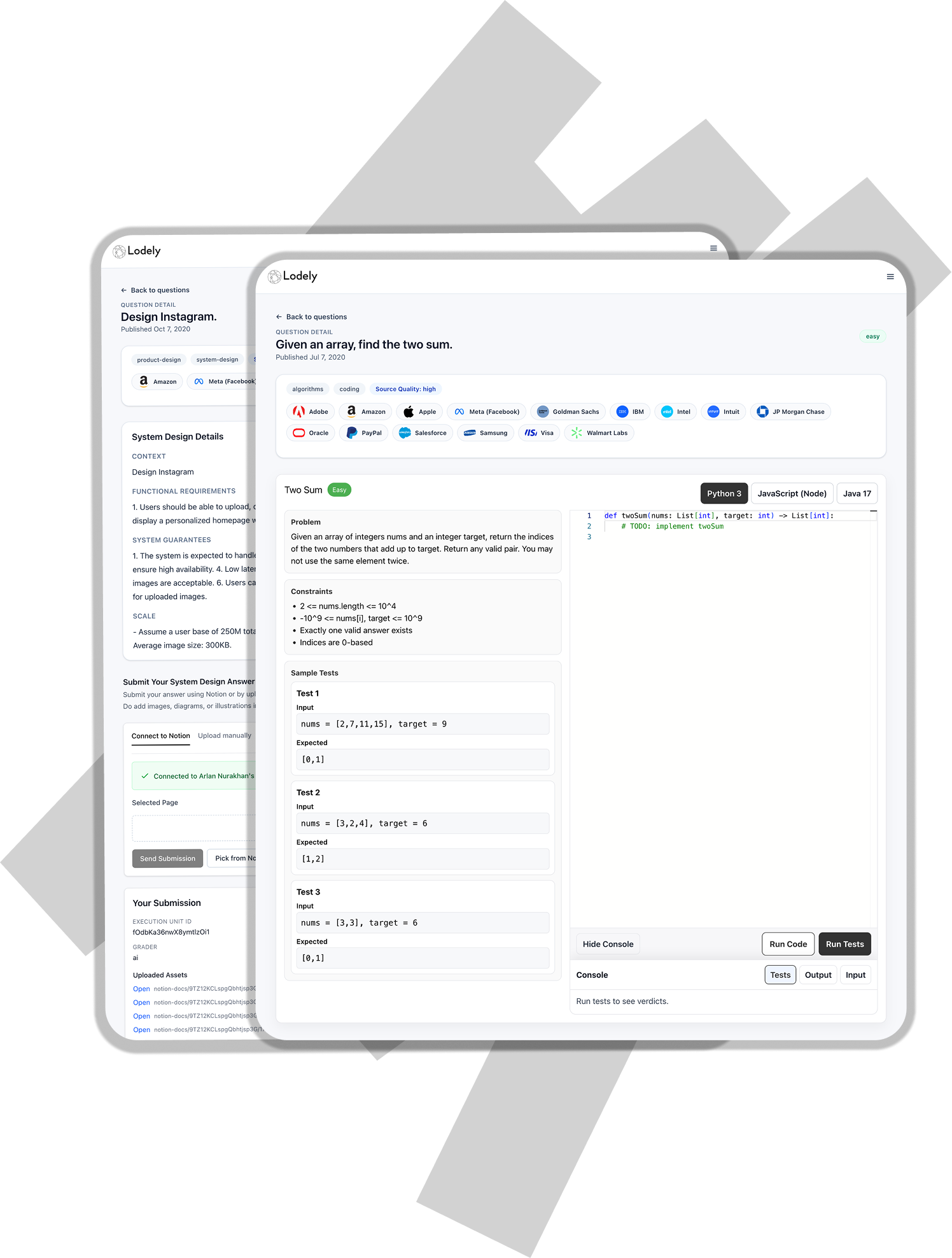
Use Lodely to practice Samsara questions in the same mixed order as the interview loop. State invariants before coding, test boundary cases aloud, and explain how design choices affect failure recovery. Prepare one project story that shows how you took an idea through rollout.

Samsara Interview Breakdown
Markup Processor
function processMarkup(lines)- Convert simplified markdown to HTML.
- Input is an array of lines.
- Empty strings represent paragraph breaks (wrapped in <p></p>).
- Non-empty consecutive lines in the same paragraph are separated by <br/>.
- Lines starting with '> ' are blockquotes (strip prefix), wrapped in <blockquote></blockquote>.
- Consecutive blockquote lines merge with <br/> between them.
- Text between ~~ pairs becomes <del></del>.
0 <= lines.length <= 10^4
lines = ["Hello ~~world~~","","New paragraph"]
"<p>Hello <del>world</del></p><p>New paragraph</p>"
Type: Stateful string parsing. The Trick: Flush each paragraph or blockquote before starting a different block, while applying inline strikethrough without breaking line grouping. What It Tests: Boundary handling, parser state, and careful transformation of structured text.
Implement an LRU Cache
function lruCacheOperations(operations, arguments)- Design a data structure that follows the constraints of a Least Recently Used (LRU) cache.
- Implement the LRUCache class: LRUCache(int capacity) initializes the cache with positive size capacity. int get(int key) returns the value of the key if it exists, otherwise returns -1. void put(int key, int value) updates the value if the key exists, otherwise adds the key-value pair.
- If the number of keys exceeds the capacity, evict the least recently used key.
- The get and put operations must each run in O(1) average time complexity.
1 <= capacity <= 30000 <= key <= 10^40 <= value <= 10^5At most 2 * 10^5 calls will be made to get and put
['LRUCache', 'put', 'put', 'get', 'put', 'get'], [[2], [1,1], [2,2], [1], [3,3], [2]]
[null, null, null, 1, null, -1]
['LRUCache', 'put', 'get', 'put', 'get', 'get'], [[1], [1,10], [1], [2,20], [1], [2]]
[null, null, 10, null, -1, 20]
Type: Data structures and object design. What It Tests: Constant-time lookup, recency updates, and eviction at capacity. The Trick: Adjust recency after reads and updates, and preserve the ordering invariant during replacement.
Valuable Management System
Type: Incremental object-oriented coding. What It Tests: Class design, collection updates, capacity rules, and changing requirements. The Trick: Track the total size and current maximum value correctly as items are added and removed.
The other seven questions broaden the coverage. Set Game tests class modeling and combination generation. Intervals Merging and Concurrent Meetings test overlap logic. Trailer and Temperature Detecting apply algorithms to operational data. Command Parser combines parsing with stateful design. The System Design Question List collects fleet, fueling, CSV-import, and API design prompts.
What Comes After The Interview
The recruiting and hiring teams debrief after the final round. Reported 2026 U.S. median total compensation is about $214,000 at P20, $230,000 at P30, $358,000 at P40, and $417,000 at P50. Stock makes up a growing share at senior levels, so verify the grant value, vesting schedule, and base salary.
Candidate Experiences
One recent software engineering intern candidate described a short algorithm assessment followed by questions on Python and Go fundamentals. The live technical interview asked the candidate to build a Markdown-to-HTML parser. The interviewer was encouraging, and the candidate still had a hiring manager conversation after the technical stage. Practice timed parser work and language-specific concepts alongside general algorithms.
Conclusion
Samsara evaluates how well engineers turn operational requirements into thoughtful code and robust designs. Practice company-specific questions on Lodely under the same time pressure you'll face in the interview.
✉️ Get free faang interview cheat sheet and interview tips weekly
✉️ Get free faang interview cheat sheet and interview tips weekly