


Twilio Interview Questions: 6 Questions to Prepare for in 2026

Twilio currently uses a six-step hiring process: application review, recruiter interview, hiring-manager interview, a mini project or technical evaluation, meetings with three to five team members, and a final decision. Its candidate resources state that individual interviews last between 45 and 60 minutes and identify coding, system design, and architecture as technical focus areas.
What to Expect: Twilio Interview Process
The recruiter discusses the role and logistics. The hiring manager discusses the team and your background in more depth. You may complete a technical evaluation, such as a mini project, a coding interview, or another evaluation format, followed by several interviews with Twilio team members that may span a few days.
Twilio's 2026 guidance asks you to connect behavioral examples to Twilio’s values and use a detailed situation, task, action, result structure. Expect direct follow-up questions when an answer remains at the big-picture level.
How to Prepare and Pass Twilio Interviews
Plan for four to six weeks if you're ready to practice coding and design. Allow eight weeks if you want to practice turning architectural concepts into operational details.
- Write production code. State assumptions, test boundaries, and discuss readability and failure handling. A correct algorithm is still maintainable.
- Design communication systems end-to-end. Cover APIs, queues, rate limits, retries, idempotency, observability, regional failure, and what users see when a dependency slows.
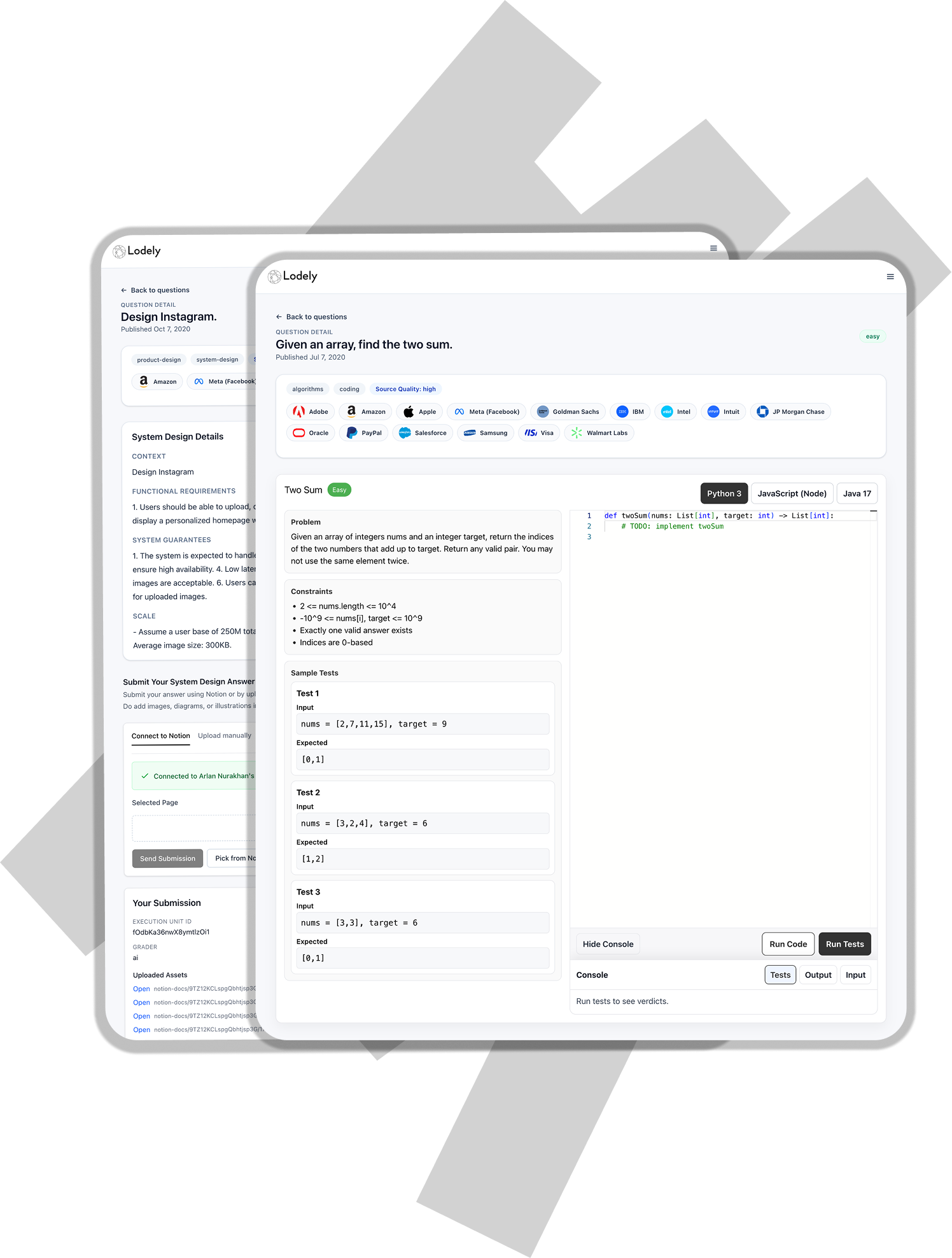
- Build a small story bank. Prepare stories about customer impact, ownership, change, feedback, and team success. Lodely pairs behavioral practice with Twilio's coding and system-design questions, giving your preparation a clear structure.

Twilio Interview Breakdown
Implement an LRU Cache
function lruCacheOperations(operations, arguments)- Design a data structure that follows the constraints of a Least Recently Used (LRU) cache.
- Implement the LRUCache class: LRUCache(int capacity) initializes the cache with positive size capacity. int get(int key) returns the value of the key if it exists, otherwise returns -1. void put(int key, int value) updates the value if the key exists, otherwise adds the key-value pair.
- If the number of keys exceeds the capacity, evict the least recently used key.
- The get and put operations must each run in O(1) average time complexity.
1 <= capacity <= 30000 <= key <= 10^40 <= value <= 10^5At most 2 * 10^5 calls will be made to get and put
['LRUCache', 'put', 'put', 'get', 'put', 'get'], [[2], [1,1], [2,2], [1], [3,3], [2]]
[null, null, null, 1, null, -1]
['LRUCache', 'put', 'get', 'put', 'get', 'get'], [[1], [1,10], [1], [2,20], [1], [2]]
[null, null, 10, null, -1, 20]
Type: Hash map with recency tracking.
The Trick: Every successful read or update changes the recency order, while eviction must remain constant time.
What It Tests: Data structure composition, invariants, and implementation.
Maximum Path Sum in a Binary Tree
// Node has fields: val (number), left (Node or null), right (Node or null)
function maxPathSum(root)- A path in a binary tree is a sequence of nodes where each pair of adjacent nodes in the sequence has an edge connecting them.
- A node can only appear in the sequence at most once.
- Note that the path does not need to pass through the root.
- The path sum of a path is the sum of the node's values in the path.
- Given the root of a binary tree, return the maximum path sum of any non-empty path.
The number of nodes in the tree is in the range [1, 3 * 10^4]-1000 <= Node.val <= 1000
root = [1,2,3]
6
root = [-10,9,20,null,null,15,7]
42
Type: Depth-first search with a global best path.
The Trick: A parent can return only one branch, but the best path may include both branches.
What It Tests: Recursion, negative values, and correctness reasoning.
Course Schedule
Type: Directed graph cycle detection or topological sorting.
The Trick: Track nodes currently being explored separately from nodes already known to be safe.
What It Tests: Graph modeling, cycle detection, and complexity analysis.
The final three interview questions are: Continuous Subarray Sum: Uses prefix remainders and first-occurrence indices. Group Anagrams: Uses a stable signature for each word. What Are You Most Proud of in Your Career?: Relate ownership, impact, and reflection to a concrete story.
What Comes After The Interview
Reported 2026 U.S. total compensation for software engineers runs from about $148,000 at IC1 to $744,000 at IC6. Equity drives much of the senior-level increase, and reported restricted stock follows a four-year vesting schedule.
Candidate Experiences
One recent L2 candidate described a recruiter screen, a coding round, a combined low-level and high-level design session, and a values conversation. The loop also included a short debugging and on-call scenario. That mix rewards candidates who can move from algorithmic code to operational diagnosis without losing clarity.
Conclusion
Twilio rewards good code, architectural decisions, and stories that have a tangible impact on customers or the team. Practice answering these six questions on Lodely and moving between code, design, debugging, and values.
✉️ Get free faang interview cheat sheet and interview tips weekly
✉️ Get free faang interview cheat sheet and interview tips weekly