





Visa Interview Questions in 2026: 6 Examples

Visa software engineering interviews include a recruiter screen, a technical assessment, a hiring-manager conversation, and multiple technical sessions. Recent full-stack loops have tested backend coding, frontend coding, system knowledge, and behavioral judgment before team matching. Interviewers evaluate your code, the tradeoffs behind your decisions, and your ability to build reliable systems that support payment processing.
The format varies by location, level, and team. Ask whether your loop includes an assessment, pair programming, system design, frontend/backend interviews, or another format.
What to Expect: Visa Interview Process
The process starts by confirming role fit and required languages. It may include a coding test or live coding screen. Technical interviews often precede a manager interview and team matching. For U.S. roles, team matching may follow a panel interview.
Current Visa engineering postings highlight Java, C++, web applications, microservices, scalability, security, and cross-functional delivery. Connect those themes to payment systems, including idempotency, auditability, authentication, failure recovery, and safe rollouts.
How to Prepare and Pass Visa Interviews
If your coding fundamentals need review, plan four to six weeks. If you're rebuilding system-design or full-stack knowledge, plan eight to twelve weeks.
- Use visible checkpoints. Restate the contract, work through an example, choose a data structure, and test before optimizing.
- Design for financial correctness. Cover duplicate requests, durable state, reconciliation, access control, and regional failure.
- Prepare targeted stories. Cover collaboration, a hard delivery, a mistake, security judgment, and why Visa's network scale interests you.
Use Lodely to practice Visa coding, system-design, and behavioral questions in sequence.

Visa Interview Breakdown
Tell Me About Yourself
Type: Behavioral introduction.
The Trick: Keep your answer relevant. Describe your work, the experiences most useful to the role, and the work or platform you want to pursue.
What It Tests: Communication, prioritization, and credible motivation.
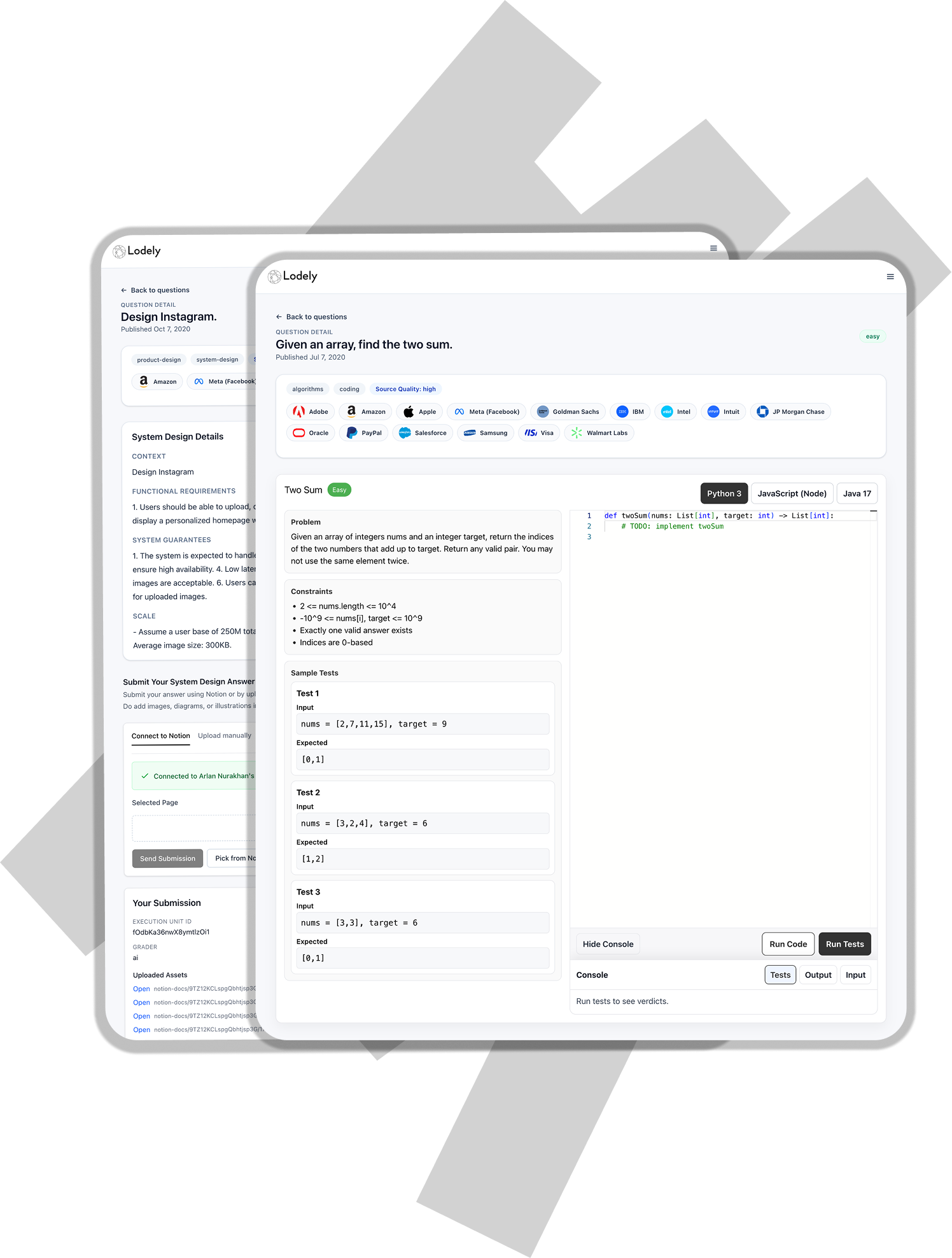
Find Two Numbers That Sum to a Target
function twoSum(nums, target)- Given an array of integers nums and an integer target, return the indices of the two numbers that add up to target.
- Return any valid pair.
- You may not use the same element twice.
2 <= nums.length <= 10^4-10^9 <= nums[i], target <= 10^9Exactly one valid answer existsIndices are 0-based
nums = [2,7,11,15], target = 9
[0,1]
Type: Array and hash-map coding.
The Trick: Store the value only after checking for its complement. Explain why you can only use one element. Test duplicates and negative numbers.
What It Tests: Data-structure choice, correctness, and complexity analysis.
Design a Payment Gateway and Experiment Service
Type: Payment system design.
The Trick: Isolate authorization and durable transaction state from experiment assignment. Define idempotency, audit logs, rollout controls, and failure recovery before addressing scale.
What It Tests: System limits, consistency, security, experimentation, and judgment.
Three coding questions remain. Count Triple Substrings is a more difficult problem that requires you to identify a rule and avoid repeated work. Linked List Cycle tests pointer manipulation and constant-space cycle detection. Sawtooth Subarray Count requires tracking the parity of changes and resetting state when the pattern breaks.
What Comes After The Interview
Ask whether the panel decision is final or starts team matching. U.S. compensation reports updated in September 2026 list roughly $127,000 at L3, $121,000 at L4, $155,000 at L5, and $202,000 at L6. Base salary remains the largest component at these levels, with stock and bonus adding to total compensation.
Candidate Experiences
One recent U.S. full-stack candidate with about one year of experience described a recruiter call and assessment, a hiring-manager round that lasted roughly 20 to 25 minutes, and separate backend and frontend technical interviews. The backend session used a word-processing coding problem, while the frontend session involved building a task list and answering questions about application behavior and data fetching. After an initial rejection, the company moved the candidate into team matching. The candidate completed that conversation and received an offer.
Conclusion
The Visa team rewards disciplined code and designs that ensure correctness at scale. Use Lodely to rehearse the six selected questions and practice explaining each failure path.
✉️ Get free faang interview cheat sheet and interview tips weekly
✉️ Get free faang interview cheat sheet and interview tips weekly