


Perplexity Online Assessment: Questions Breakdown and Prep Guide

Thinking about cracking Perplexity’s OA but not sure what to train for? You’re not alone. Engineers see a mix of search, systems, and algorithmic questions with an AI twist: retrieval pipelines, token budgets, caching, and concurrency. The hardest part is knowing which patterns Perplexity actually cares about.
If you want to walk into the Perplexity Online Assessment confident and ready, this is your playbook. No fluff. Real breakdowns. Strategic prep.
When to Expect the OA for Your Role
Perplexity tunes the OA by role and track. The timing, platform, and question mix vary.
- New Grad & Intern Roles – Expect an OA invite soon after recruiter contact. For many interns, this is the only technical gate before the final loop.
- Software Engineer (Backend / Full-Stack) – Standard practice. Look for a HackerRank or CodeSignal link focusing on data structures, algorithms, and practical coding patterns (caching, rate limiting, API-safe parsing).
- Search / Relevance / ML Engineers – OA often includes DS&A plus applied signal processing or string/search logic. Light math or vector similarity can show up.
- Data Engineering / Analytics – Still OA-based, occasionally with SQL + Python data wrangling. Expect array/hashing plus joins/group-bys.
- Infra / Platform / SRE – Algorithmic questions paired with concurrency/scheduling, queues, or rate-limiting style designs.
- Senior & Staff Roles – Some candidates skip a generic OA and go straight to live coding/system design, but an OA is still common as a first filter.
Action step: Ask the recruiter for the platform, duration, and number of problems. If you’re applying to Search/ML roles, ask if the OA includes any domain-specific questions (e.g., text processing, ranking, or streaming).
Does Your Online Assessment Matter?
Short answer: more than you think.
- It’s the main filter. Strong resumes get you the link; your OA score moves you forward.
- It’s an artifact. Your OA code can shape follow-ups. Interviewers may reference how you structure and test.
- It mirrors the work. Expect text-heavy inputs, streaming or top-k patterns, and correctness under edge cases.
- It signals engineering rigor. Clean code, clear invariants, complexity awareness, and thoughtful testing are all part of the evaluation.
Pro tip: Treat the OA like a first interview. Write production-quality code with readable naming, comments, and edge-case handling.
Compiled List of Perplexity OA Question Types
Candidates report a mix of general DS&A and search/infra-flavored problems. Practice these:
- Search Suggestions System — type: Trie / String / Two Pointers
- Implement Trie (Prefix Tree) — type: Trie / Design
- Top K Frequent Words — type: Heap / Hashing
- K Closest Points to Origin — type: Heap / Geometry
- LRU Cache — type: Design / HashMap + Linked List
- Logger Rate Limiter — type: Design / Queue / HashMap
- Design Hit Counter — type: Queue / Sliding Window
- Find Median from Data Stream — type: Heaps / Streaming
- Merge Intervals — type: Sorting / Intervals
- Simplify Path — type: Stack / Path Normalization
- Minimum Window Substring — type: Sliding Window / Hashing
- Longest Substring Without Repeating Characters — type: Sliding Window
- Network Delay Time — type: Graph / Dijkstra
- Course Schedule — type: Graph / Topological Sort
- Smallest Range Covering Elements from K Lists — type: Heap / K-way Merge
- Design TinyURL — type: System Design Lite / Hashing
Why these? They map to common Perplexity themes: fast lookups (tries, caches), rate limiting for APIs, streaming top-k, interval merging for snippet generation, URL normalization, graph traversal for dependency/queue modeling, and heap-based merging for retrieval pipelines.

How to Prepare and Pass the Perplexity Online Assessment
Think of prep as building reflexes around text-heavy input, ranking, and scalable primitives.
1. Assess Your Starting Point (Week 1)
List your strengths (arrays, hash maps, strings) and gaps (tries, heaps, concurrency, streaming). Take a short CodeSignal/LeetCode timed set to baseline speed and accuracy. Write down the concepts that cost you time.
2. Pick a Structured Learning Path (Weeks 2-6)
You have options:
- Self-study on LeetCode/HackerRank
- Best for disciplined learners. Build a 60–80 problem list emphasizing strings, heaps, tries, sliding window, and graph basics.
- Mock assessments / proctored drills
- Use timed CodeSignal/HackerRank practice to train pacing and stress management.
- Mentor or coach
- A software engineer career coach can critique code clarity, walk through edge cases, and simulate OA pressure.
3. Practice With Realistic Problems (Weeks 3-8)
Don’t grind random easies. Focus on:
- String/Trie: autocomplete, prefix matching, tokenization
- Heaps/Streaming: top-k, median, k-way merge
- Caching/Rate Limiting: LRU, sliding window counters
- Intervals/Sorting: merge, insert, minimal covering range
- Graphs: Dijkstra, topo sort for pipeline-like dependencies
Timebox each session. After solving, refactor for readability and test against edge cases (empty input, duplicates, large N).
4. Learn Perplexity-Specific Patterns
Because Perplexity builds an LLM-backed answer engine, expect patterns like:
- Retrieval & ranking basics: top-k selection, BM25-style heuristics (simulate with term frequencies), cosine-sim-like scoring
- Token budgets: choose chunks/snippets under size limits (knapsack/greedy variants)
- Caching and dedup: URL normalization, content hashing, LRU layers
- Streaming responses: produce partial results while continuing to compute (queue/heap discipline)
- Safety and filtering: simple policy checks, allowlists/denylists, normalization gotchas
5. Simulate the OA Environment
- Duration: usually 75–90 minutes for 2–3 questions
- Platform: HackerRank or CodeSignal
- Conditions: no IDE plugins, limited internet, hidden tests
Practice under the same constraints. Disable notifications. Work in one pass: clarify constraints, outline an approach, code, test, then optimize.
6. Get Feedback and Iterate
After each mock:
- Identify repeated mistakes (off-by-one in windows, tie-breaking in heaps, path normalization edge cases)
- Add targeted drills (e.g., 10 quick heap problems in a row)
- Share solutions for review or re-read them after a day with fresh eyes
Perplexity Interview Question Breakdown
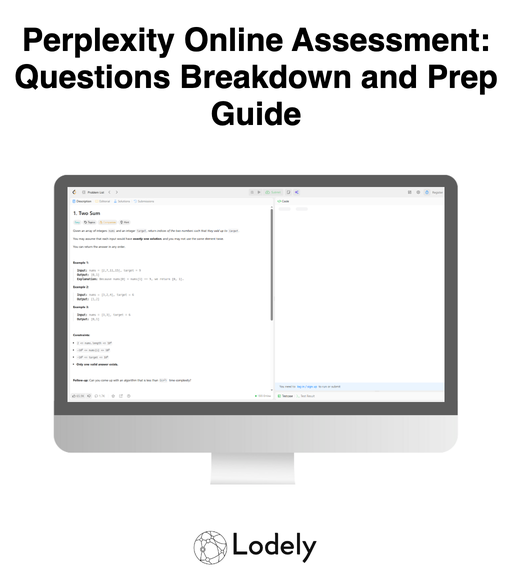
Here are featured sample problems inspired by Perplexity-style OAs. Master these patterns to cover most of what you’ll see.
1. Query Autocomplete with Prefix Ranking
- Type: Trie / String / Heap
- Prompt: Given a historical query log with frequencies, implement an autocomplete API that returns the top-k suggestions for a prefix. Support inserts and queries.
- Trick: Maintain counts at each node and use a bounded heap or store top-k at nodes for faster queries. Handle lowercase/uppercase normalization and non-alphanumeric characters.
- What It Tests: Trie design, memory/time trade-offs, tie-breaking, and robust string handling.
2. API Rate Limiter (Sliding Window / Token Bucket)
- Type: Design / Queue / HashMap
- Prompt: Build a per-user rate limiter allowing N requests per rolling T-second window. Implement allow(userId, timestamp) -> bool.
- Trick: Use a deque per key to evict stale timestamps in O(1) amortized; or implement token-bucket semantics. Watch for high cardinality keys and memory.
- What It Tests: Production-minded design, sliding window correctness, and big-O under load.
3. Top-K Streaming Results Under Memory Constraints
- Type: Heap / Streaming
- Prompt: Process a stream of scored results and maintain the current top-k by score. Support updates and queries at any time.
- Trick: Use a min-heap of size k. Be precise about tie-breaking, updates for existing IDs, and lazy deletion vs. index structures.
- What It Tests: Heaps, streaming discipline, and correctness under interleaved updates/reads.
4. Snippet Highlight Merge
- Type: Intervals / Sorting
- Prompt: Given a set of keyword match spans in a document, merge overlaps and return the minimal set of highlight intervals, then trim to a max output length.
- Trick: Sort by start, merge with O(n log n). For trimming, prefer intervals covering more keywords or earlier positions (define and implement a stable tie-break).
- What It Tests: Interval manipulation, sorting stability, and spec-driven decision-making.
5. URL Normalization and Canonicalization
- Type: Strings / Stack / Parsing
- Prompt: Normalize URLs: lowercase host, remove default ports, collapse “.” and “..” in paths, dedupe slashes, sort or strip tracking query params.
- Trick: Handle edge cases: trailing slashes, empty segments, percent-encoding, and query param ordering. Keep transformations deterministic.
- What It Tests: Robust parsing, careful state handling, and idempotent string transformations.
6. Token-Budgeted Chunk Selection for RAG
- Type: Greedy / Knapsack (0/1, light variant)
- Prompt: Given candidate text chunks with estimated token sizes and relevance scores, select a set that fits within a token budget to maximize total score.
- Trick: If items are small and scores roughly proportional to size, a greedy by score/size ratio can pass; otherwise, implement DP with pruning for tighter budgets.
- What It Tests: Approximation vs. exact solutions, trade-off reasoning, and handling large inputs efficiently.
What Comes After the Online Assessment

Passing the OA moves the conversation from “Can you code?” to “Can you build, iterate, and reason about an AI search product at scale?”
1. Recruiter Debrief & Scheduling
Expect an email with your result and next steps. Ask about round structure (coding, design, product/ML focus), interviewers’ backgrounds, and any prep recommendations.
2. Live Technical Interviews
You’ll pair with Perplexity engineers over Zoom and a collaborative IDE.
- Algorithm & Data Structure: Similar to OA, but interactive. Clarify assumptions, test cases first.
- Debugging: Walk through a broken function, fix edge cases, explain logs/observations.
- Product-aware Coding: Small changes to support features like pagination, streaming, or tie-breaks.
Pro tip: Review your OA solutions. It’s common to be asked, “How would you improve or test this further?”
3. System Design / Architecture Round
For mid-level and senior roles, expect a 45–60 minute design session. Example prompts:
- Design a retrieval pipeline that returns top-k citations in under 200ms
- Build a caching strategy for repeated queries with freshness guarantees
- Sketch a rate-limited API that streams partial results and scales under spikes
What they’re evaluating:
- How you decompose the system
- Latency, consistency, and failure handling
- Pragmatic trade-offs with clear communication
4. ML/Search/Relevance Deep Dive (Role-Dependent)
For Search/ML roles, there may be a focused session covering:
- Indexing basics, embeddings, vector search trade-offs
- Evaluation and A/B testing strategies
- Token budgeting, chunking heuristics, and citation integrity
You don’t need to reinvent IR, but you should articulate practical choices and their impact.
5. Behavioral & Values Interviews
Perplexity favors curiosity, product sense, and shipping. Expect prompts like:
- “Tell me about a time you simplified a complex system and improved reliability.”
- “Describe a decision you made with limited data and how you validated it.”
- “When did you push back on scope to protect quality or latency?”
Use the STAR method. Emphasize user impact, iteration speed, and engineering rigor.
6. Final Round / Onsite Loop
A multi-interview block may include:
- Another coding round
- A systems or product-focused design
- Cross-functional chats (e.g., product or research)
Plan for context switching and sustained focus across several hours.
7. Offer & Negotiation
If successful, you’ll get a verbal summary followed by a written offer. Comp typically includes base salary and equity. Research market ranges and come prepared with your priorities (cash vs. equity, role scope, growth trajectory).
Conclusion
You don’t have to guess; you have to prepare. The Perplexity OA is tough but predictable. If you:
- Diagnose your weak areas early,
- Drill Perplexity-style patterns (tries, heaps, streaming, rate limits, intervals),
- Practice under timed, platform-like conditions, and
- Write clean, tested, edge-case-aware code,
you’ll turn the OA from a hurdle into momentum. You don’t need to be an IR researcher to pass — but you do need disciplined problem solving and product-aware thinking. Treat the OA like your first interview, and you’ll set yourself up for a strong run through the loop.
For more practical insights and prep strategies, explore the Lodely Blog or start from Lodely’s homepage to find guides and career resources tailored to software engineers.
✉️ Get free faang interview cheat sheet and interview tips weekly
✉️ Get free faang interview cheat sheet and interview tips weekly


