





Rippling Interview Questions: 10 from Real Interviews

Rippling interviews include a recruiter conversation, coding screen, and onsite-style loop with coding, system design, and a project presentation. The strongest answers look production-ready: the model is clear, tradeoffs are explicit, tests are present, and you can show that you owned the result.
What to Expect: Rippling Interview Process
The senior loop has five stages: recruiter screen, technical coding screen, onsite coding, system design, and a project presentation. Some 2025 reports described machine coding or a loop split into two implementation rounds. Candidates in 2026 were offered a choice between traditional and AI-assisted coding, so confirm the permitted workflow before the interview.
Prepare to answer system design questions about storage, consistency, fault tolerance, monitoring, and the implications of changing requirements. Project presentations may be only two or three slides, so choose one example that shows clear ownership.
How to Prepare and Pass Rippling Interviews
Set aside six weeks if you already have implementation and system design skills, or eight to ten weeks if you need to rebuild your object-modeling skills or practice describing large systems without notes.
- Write working product code. Practice classes, APIs, dependencies, scheduling, and state versioning. Write tests as requirements evolve.
- Run one-hour design drills. Talk through scale, product behavior, data models, and failure recovery.
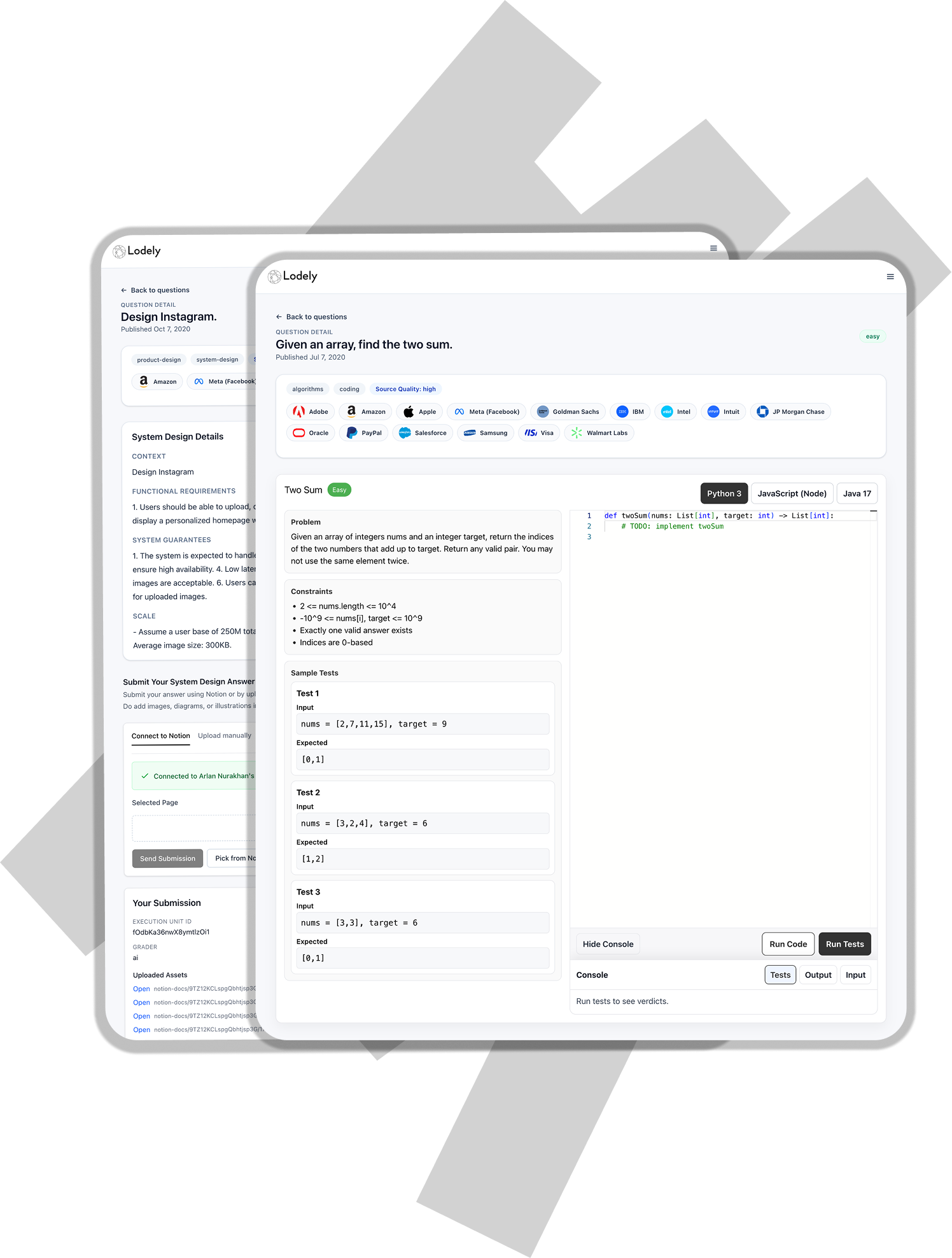
- Create a small project deck. Present your problem, decision, measurable result, and one challenging tradeoff. Use Lodely to rehearse Rippling coding, system design, and behavioral material in one focused sequence.

Rippling Interview Breakdown
Spiral Printing
Type: Matrix traversal. The trick: You can cross the shrinking boundary after any of the four sides, so every pass needs a guard. What it tests: Index discipline, clean control flow, and boundary testing.
Phrases Grouping
Type: Grouping and canonicalizing strings. The trick is to find a representation that groups equivalent phrases without losing distinctions required by the prompt. What it tests: Hash-key design, complexity analysis, and parsing.
React Component
Type: Frontend implementation. The trick: Handle interactions and edge cases while keeping the relationship between state and rendering behavior predictable. What it tests: Component design, browser fundamentals, and maintainable code.
The other seven questions cover performance analysis, task priority, network infection, similar strings, project-task dependencies, a spreadsheet model, and a snapshot map. They test aggregation, scheduling, graph propagation, string comparison, dependency tracking, formula state, and versioned reads.
What Comes After The Interview
The debrief weighs coding quality, system reasoning, product partnership, and project ownership. Reported U.S. annual total compensation ranges from roughly $208,000 at L5 to $644,000 at L8. Equity accounts for much of the increase at senior levels. Rippling is private, so ask how the option value, strike price, vesting, and liquidity assumptions were determined.
Candidate Experiences
One recent senior candidate described a recruiter call, a coding screen, and three onsite sessions. The onsite included another coding problem, a personalized news-feed design, and a two-to-three-slide project presentation focused on ownership and technical tradeoffs. The candidate chose the traditional coding path when offered an AI-assisted option. Prepare one project that you can defend from architecture through outcome.
Conclusion
Rippling rewards practical experience, system understanding, and clear evidence of ownership. Use Lodely to work through the Rippling questions and apply the same reasoning in your design and project rounds.
✉️ Get free faang interview cheat sheet and interview tips weekly
✉️ Get free faang interview cheat sheet and interview tips weekly