


Sigma Computing Interview Questions: 7 from Real Interviews

Sigma Computing's hiring process may begin with a conversation with the hiring manager, which is sometimes skipped. It then includes a technical phone interview and a four-round onsite panel. The panel covers technical implementation, system design, product design, and behavioral judgment. Problems in this process closely resemble those in analytics and spreadsheet applications.
What to Expect: Sigma Computing Interview Process
You must write runnable code and explain the model, architecture, and tests. Progress alone is insufficient in Sigma's technical rounds. Your code must be understandable and extensible, and you must demonstrate knowledge of the portion you finish. In system design, discuss limits, loads, and correctness. In product design, discuss interfaces and how to handle changing requirements.
Before the loop, learn how Sigma's spreadsheet interface turns user actions into queries on cloud data. That context helps you ask better questions about tables, formulas, permissions, and aggregation.
How to Prepare and Pass Sigma Computing Interviews
Plan four to six weeks if your implementation skills are solid. Plan eight weeks if you need to practice parsers, object models, or stateful APIs. Write tests before moving to the next iteration. When a requirement changes, explain which representation still applies and which part of the code must change.
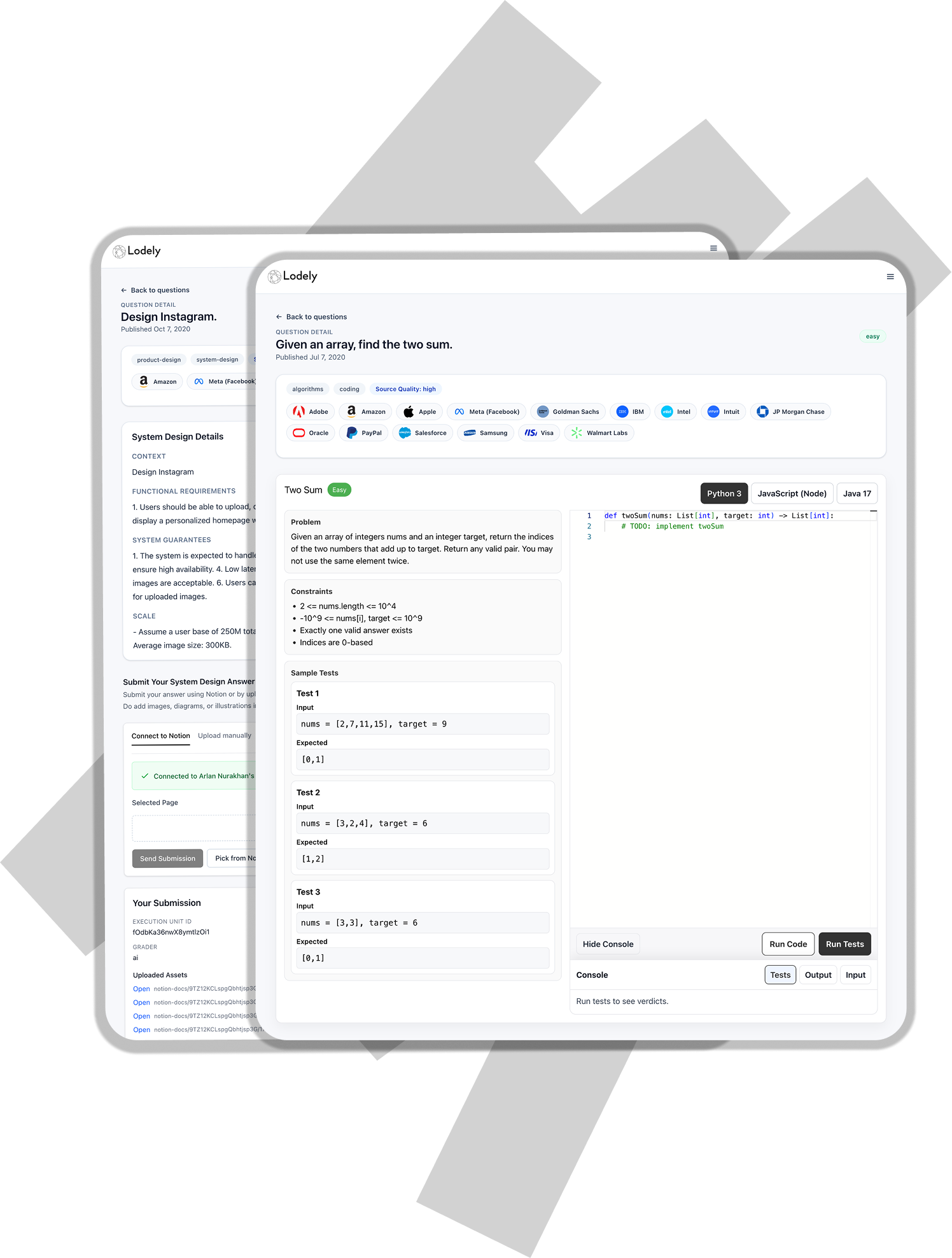
Solve the seven Sigma Computing practice questions on Lodely, then compare the editorial reasoning with yours. Sigma explicitly states in its published information that equal time is spent on code clarity and explanation.

Sigma Computing Interview Breakdown
JSON Parser
Consume a valid token stream and build an in-memory JSON representation that can be inspected and modified. Focus on parser state and nested structures.
Open Question on LodelyType: Token parsing and tree building. The Trick: Build a stateful parser that handles nested values and field boundaries. What It Tests: Decomposition, recursive thinking, and an extensible in-memory representation.
Pivot Table
Aggregate an underlying table across selected dimensions and measures, then extend the design to totals and additional axes without breaking earlier behavior.
Open Question on LodelyType: Aggregation and data modeling. The Trick: Separate dimensions from measures so follow-ups can add totals and additional dimensions without collapsing the model. What It Tests: Data transformation, API structure, and product thinking.
File System
Type: Data aggregation. The Trick: Account for files that appear in multiple collections. Determine how much data each collection uses, the total storage, and the top collection. What It Tests: Indexing choices, counting, and ranking.
Four questions remain:
- Permission System: Inherited access.
- Cell Table: An infinite-cell table with sparse storage.
- Order Data: Combining clients with orders before adding rich reporting.
- Token Tree: Converting prefix tokens to an expression tree that can be validated.
What Comes After The Interview
Ask the panel when the debrief will finish and whether level calibration will change your role. Reported U.S. median total compensation in September 2026 is $178K for L3, $224K for L4, $294K for L5, and $478K for L6. Equity is higher at senior levels and vests over four years.
Candidate Experiences
One recent senior candidate described a phone screen, a technical screen, and an onsite with a harder technical problem, system design, and behavioral discussion. The sessions focused on Sigma's business-intelligence product, including pivot-table design and follow-ups. The candidate felt the experience went well but did not receive an offer. Learn the product before you practice the loop.
Conclusion
Sigma Computing's interview process focuses on code quality, clarity of data models, and the ability to adapt designs when requirements change. Review the seven questions on Lodely, then go through each again with a new follow-up question.
✉️ Get free faang interview cheat sheet and interview tips weekly
✉️ Get free faang interview cheat sheet and interview tips weekly
