


The Trade Desk Interview Questions in 2026: 7 Examples

The Trade Desk's software engineering process typically includes an assessment or recruiter screen, a technical screen, and a multi-session final loop. Recent senior software engineer interviews have included coding, system design, in-depth behavioral questions, and runnable implementation in a single sequence. The company’s current careers site emphasizes advertising technology at global scale, so production judgment matters throughout the interview.
What to Expect: The Trade Desk Interview Process
The path varies by level. Recent candidates described a 70-minute, four-question assessment; a 30-minute recruiter conversation; a technical screen; and a coding and system-design interview. One recent senior candidate described a four-hour virtual onsite with a hiring-manager discussion, two design exercises, runnable coding, and whiteboard work.
In 2026, expect deeper follow-up questions after your first correct answer. Interviewers have asked candidates to start with a simple approach, run it, and then improve it while justifying complexity and design choices.
How to Prepare and Pass The Trade Desk Interviews
Plan for six weeks if you are already comfortable with coding under time pressure. If you need to work on object-oriented design or distributed systems, plan for eight to ten weeks.
- Build working code first. Practice building parsers, calculators, sliding windows, and small stateful components. Explain your tests and edge cases before optimizing.
- Design to scale for ad traffic. Analyze high-throughput data propagation, media delivery, caching, partitioning, and failure recovery. Relate each design decision to latency, freshness, cost, and load.
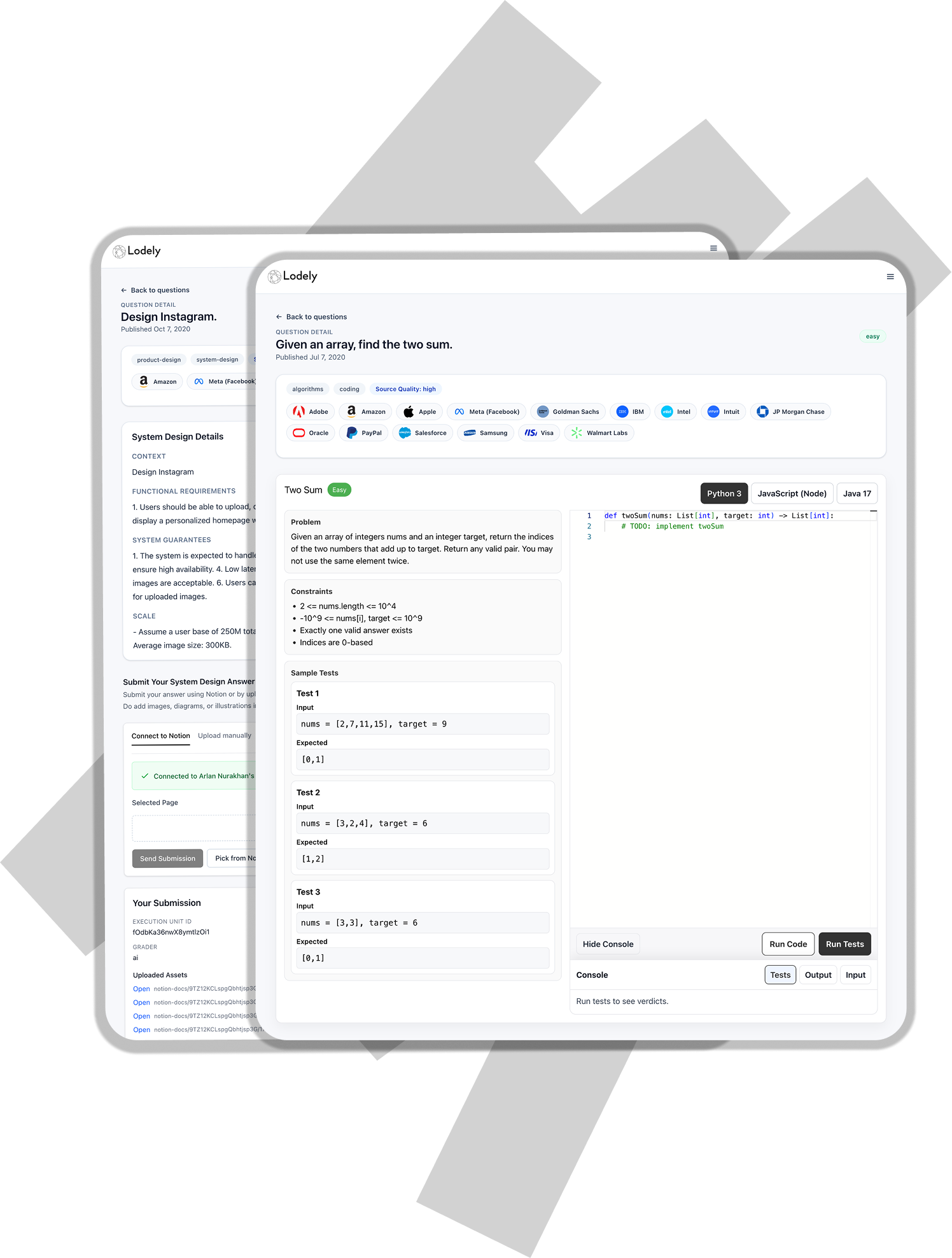
- Prepare detailed project stories. Expect questions about what you owned, why you designed it that way, and what you changed after a failure. Lodely combines company-specific coding questions with system-design and behavioral practice.

The Trade Desk Interview Breakdown
JSON Validator
Type: Parser and state-machine coding. You validate a given JSON subset without using a parsing library.
The Trick: Quotes, escaping, whitespace, and nested containers each require explicit state in addition to bracket counting.
What It Tests: Incremental design, correctness, and invalid-input handling.
Basic Calculator I, II, III
Type: Evaluate an expression and design an object-oriented solution across three calculators of increasing complexity.
The Trick: Preserve operator precedence and parentheses while keeping the shared design clear.
What It Tests: Decomposition, stack reasoning, and the ability to extend working code under time pressure.
Activity Benchmark Distance
Type: Two pointers and interpolation over cumulative trackpoints.
The Trick: Missing and non-uniform samples are not recorded. Hence the fastest interval between two samples may start or end before the recorded sample.
What It Tests: Careful modeling, numerical bounds, and staged optimization.
The remaining four examples broaden the loop. Longest Subarray with Frequency Threshold requires a sliding window and frequency map. Design a System Like YouTube separates the media pipeline from metadata services. Redux/Zustand Store Implementation requires you to build state, dispatch, and subscriptions from scratch. The startup-fit question tests whether your reasons for preferring pace and ambiguity are specific and credible.
What Comes After The Interview
Reported 2026 total compensation runs from about $192,000 for Software Engineer I to $641,000 for Senior Staff Software Engineer. Equity becomes a larger part of the package at senior levels, and reported options vest over four years.
Candidate Experiences
One recent senior candidate described a four-session virtual onsite lasting about four hours. It included a 75-minute hiring-manager, behavioral, and system-design session, a low-latency data-replication design, runnable calculator code, and whiteboard coding. The interviewers repeatedly asked the candidate to improve basic solutions, so reserve time to refine working code.
Conclusion
The Trade Desk loop rewards executable code, explicit trade-offs, and systems thinking at scale. Use the seven company questions on Lodely to practice improving a clear first answer until it is production-ready.
✉️ Get free faang interview cheat sheet and interview tips weekly
✉️ Get free faang interview cheat sheet and interview tips weekly