





xAI Interview Questions in 2026: 10 Examples

The process has four steps: application review by technical team members, a short screening interview, technical interviews, and an offer. The screening interview covers your background and short technical questions, while the technical interviews assess how you think through a complex problem. See the xAI careers page.
The application asks for a statement of exceptional work. Treat this statement like an interview and prepare to defend the limitations, decisions, failed approaches, and measurable results of your chosen project.
What to Expect: xAI Interview Process
Today’s roles range across model training, inference, infrastructure, networking, product, safety, and the X platform. A software-engineering loop may include coding, distributed systems, concurrency, hands-on work, a project deep dive, and a team conversation. The exact mix depends on the role.
Interviewers may ask directly about a design's correctness or your ownership of it. They may ask how you would simplify the design, handle a race condition, estimate throughput, or explain why a model-serving change you made would improve cost and latency.
How to Prepare and Pass xAI Interviews
Create a six- to eight-week plan. Build your coding skills, then focus on concurrency, distributed systems, observability, GPU infrastructure, and basic model serving for the role. Prepare 20-minute and 5-minute versions of a project story based on numbers you can explain.
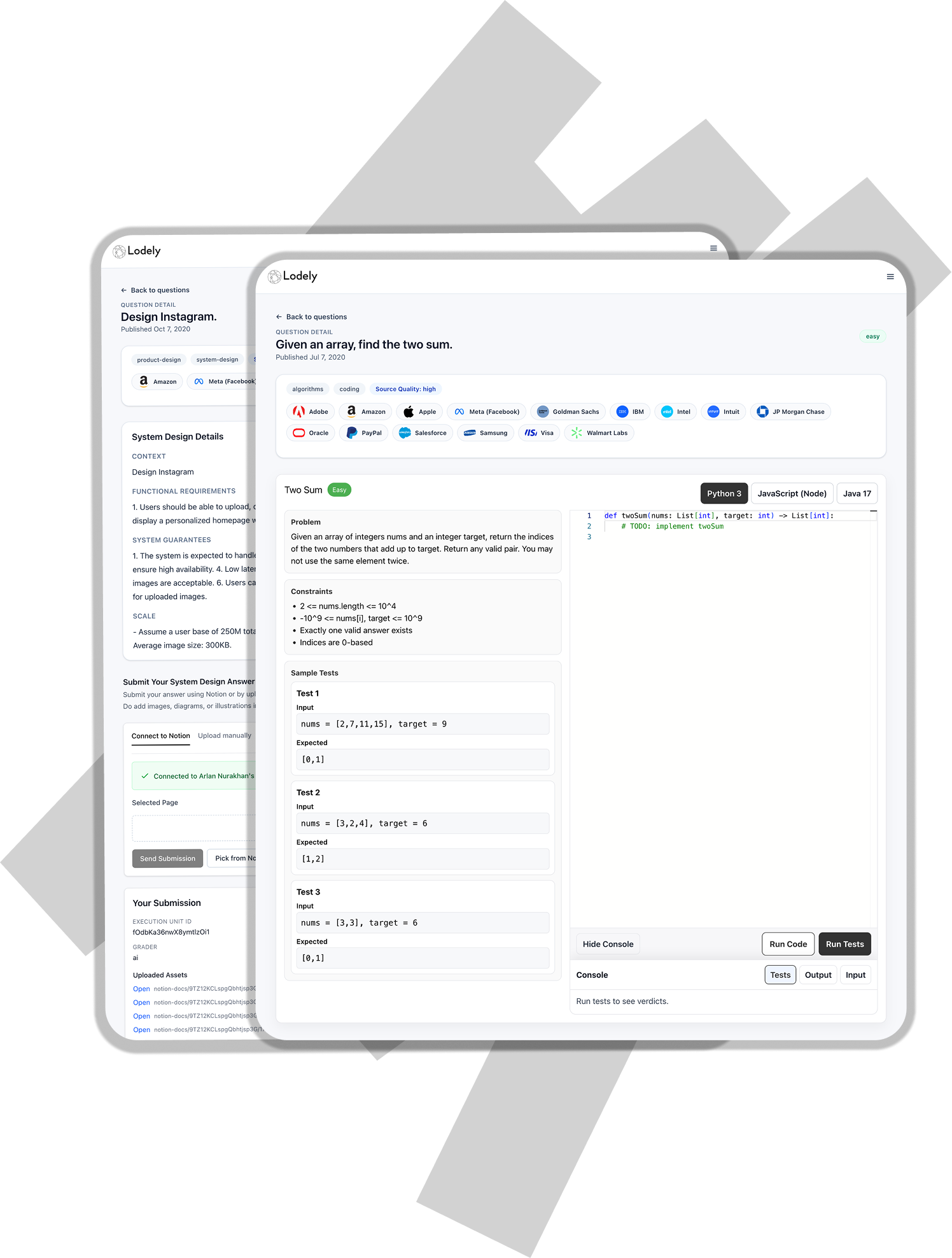
Use Lodely to practice xAI coding, system-design, and behavioral questions. The mock sessions include higher-level requirements and a reviewer who questions your assumptions.

xAI Interview Breakdown
Design a Rate Limiter
Type: Distributed-system design. The Trick: Handle global limits, bursts, clocks, and partial failures. What It Tests: Requirements, consistency, and trade-offs.
Transformer Attention Optimization
Type: Performance coding. The Trick: Make memory or computational trade-offs while preserving numerical accuracy. What It Tests: Tensor manipulation, profiling, and hardware awareness.
Model Version Management
Type: Infrastructure design. The Trick: Plan for reproducibility, rollback, compatibility, and auditability across a deployment with many serving nodes. What It Tests: Lifecycle design and reliability.
Seven additional examples cover fan-out notifications, high-throughput model serving, a four-hour take-home, GPU-node grouping, an embedding service, context-window optimization, and a training data pipeline. Together, they test failure handling, batching, placement, data quality, and how model behavior interacts with production infrastructure.
What Comes After The Interview
Technical-team input influences the offer decision. Reported 2026 median U.S. software-engineer compensation for a level 4 package is $640,000, including a $240,000 base and $400,000 in annualized stock. The data indicates a four-year equity schedule.
Candidate Experiences
One recent software-engineering candidate described a three-week process, a 45- to 60-minute live coding interview, a 60-minute distributed-systems interview, hands-on concurrent programming, and a project presentation. During the concurrency interview, the candidate received an open-ended problem to solve in a short time. The candidate abandoned a lock-free approach because proving correctness was too difficult and switched to explicit locks. The project interview covered technology choices, measurement, and alternatives. Be ready to simplify quickly when challenged.
Conclusion
xAI interviews focus on technical depth, speed, and measurable ownership of your work. Use Lodely to practice all 10 xAI interview questions in one difficult, role-specific loop.
✉️ Get free faang interview cheat sheet and interview tips weekly
✉️ Get free faang interview cheat sheet and interview tips weekly