HackerRank Pricing 2026: Plans, Costs & What You Actually Get

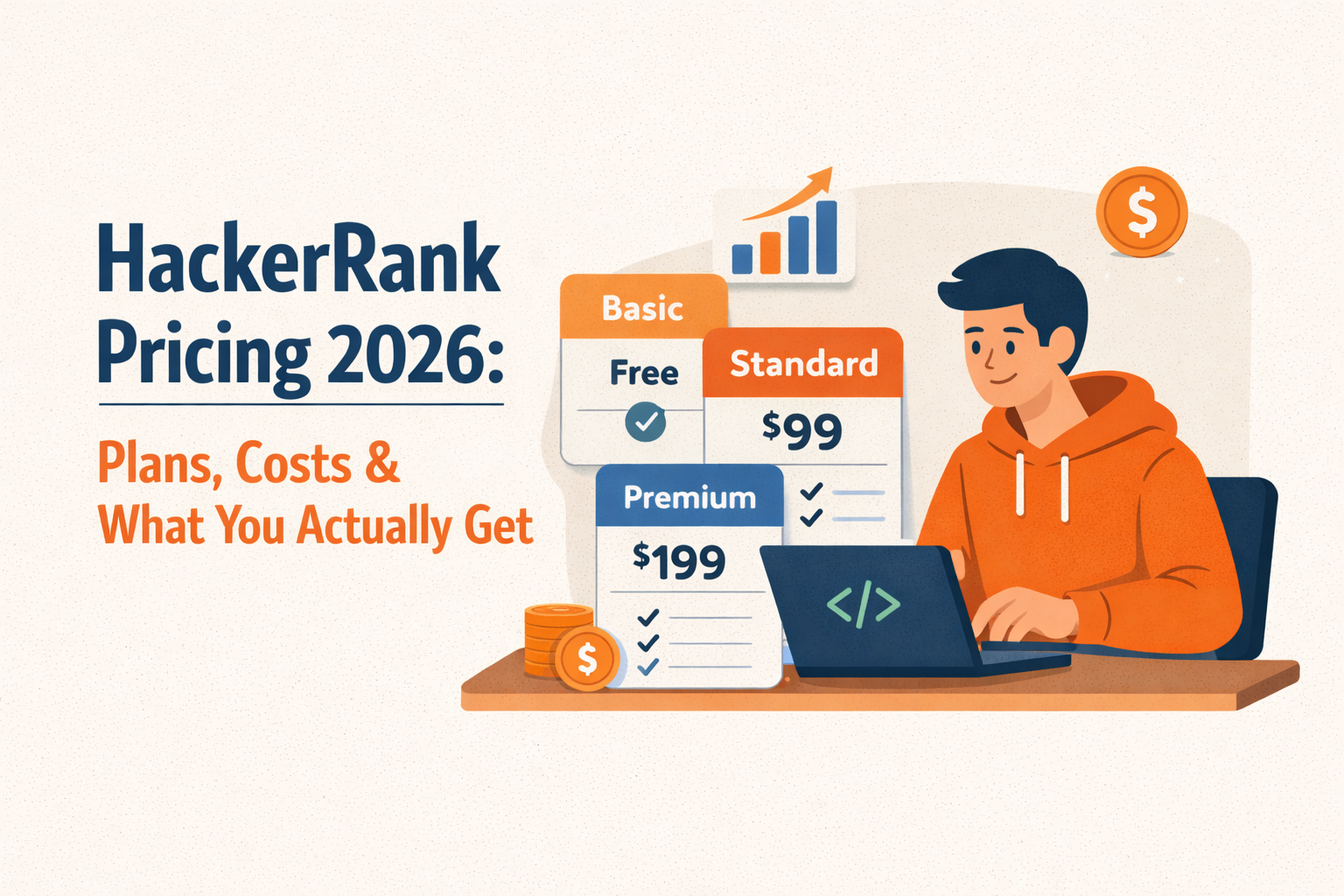
You've seen HackerRank pop up in every "best coding platforms" listicle since 2015. Maybe you've solved a few challenges there yourself, or maybe you just bombed one of their assessments during a job application and now you're stress-Googling what it even costs. Either way, you're here because you want actual numbers, not vague "contact sales" runarounds.
Let's break down exactly what HackerRank charges in 2026, what each tier gets you, and whether the platform is even worth your time as a developer trying to land a real offer.
What Is HackerRank, Really?
HackerRank is a technical skills platform that operates on two sides. On one side, it's a free playground for developers to solve coding challenges, earn certifications, and prep for interviews. On the other, it's a paid hiring tool that companies use to screen and interview engineering candidates at scale.
Over 26 million developers have created accounts on HackerRank, and thousands of companies use it to run technical assessments before they ever talk to you on a Zoom call. If you've applied to a mid-to-large tech company in the last few years, there's a decent chance you've already taken a HackerRank test whether you realized it or not.
The platform supports 55+ programming languages and maintains a library of over 7,500 questions spanning algorithms, data structures, SQL, AI, and more. It also offers a collaborative interview tool where hiring teams can watch you code in real time, which is either exciting or terrifying depending on which side of the screen you're on.
HackerRank's Core Features
Before we get into pricing, here's what the platform actually does. HackerRank splits its product into two main modules:
Screen lets companies send out take-home coding assessments. Think of it as the automated gatekeeper: candidates get a timed test, write code in a browser-based IDE, and the platform grades it automatically. It includes plagiarism detection, question-leak protection, and proctoring features so companies can trust the results. The question library is curated by experts and validated by industrial psychologists for fairness.
Interview is the live coding side. It gives interviewers a shared coding environment where they can pair-program with candidates, review code in real time, and evaluate problem-solving skills beyond just "did the test pass." It's designed to mimic actual day-to-day engineering work rather than trivia-style gotcha questions.
As of 2025, HackerRank also rolled out AI-assisted IDE features, including copilot tools, real-time chat assistance, and usage transcripts. The idea is to mirror how developers actually work now (with AI tools) rather than testing them in an artificial vacuum. Smart move, honestly.
HackerRank Cost Breakdown
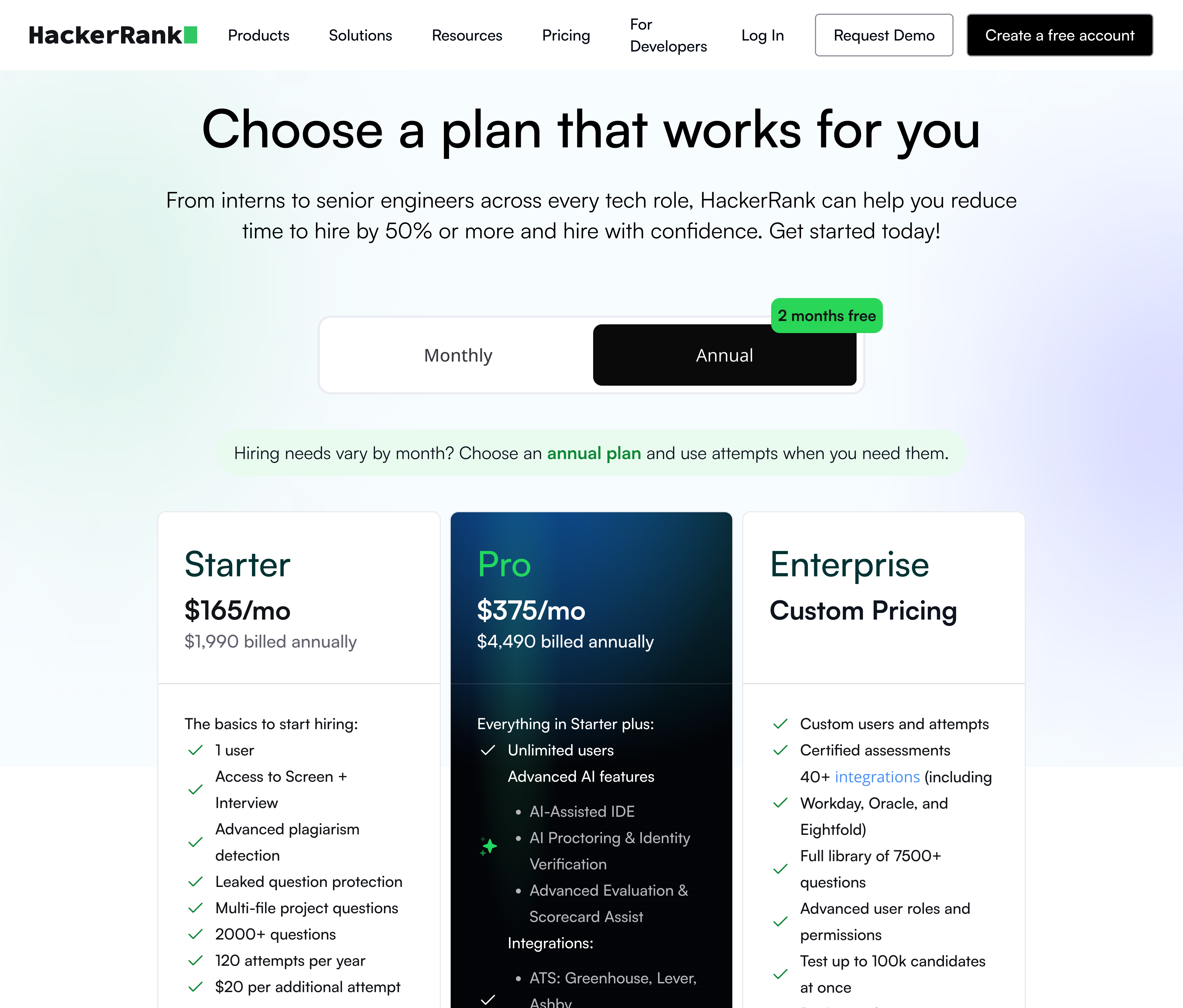
Here's where it gets real. HackerRank's pricing is structured around three tiers, all aimed at companies doing the hiring, not individual developers:
Starter: $100/month (billed annually) This is the entry point. You get one user license, access to both Screen and Interview modules, and 120 candidate attempts per year. If you blow past that cap, each additional attempt runs you $20. The question library includes 2,000+ challenges with plagiarism detection baked in. For a small team making a handful of hires per year, this covers the basics.
Pro: $450/month (billed annually) Now we're talking. Pro unlocks unlimited user seats, a broader question repository (4,000+ problems), and integrations with major ATS platforms like Greenhouse, Lever, and Ashby. Calendar integrations are also included, which makes scheduling live interviews much less painful. If your team is hiring more than a few engineers per quarter, this is where the value starts to kick in.
Enterprise: Custom pricing For large organizations with serious hiring volume, HackerRank offers custom Enterprise deals. These typically include everything in Pro plus dedicated support, advanced security certifications (SOC2, ISO), granular permissions, and volume discounts. Based on reported deals, Enterprise customers can negotiate 16-29% discounts depending on deal size, potentially saving $13,000-17,000 annually compared to list pricing.
If you don't want to commit annually, month-to-month pricing starts around $199/month for the Starter tier. But you'll save roughly two months of cost by going annual, so most teams lock in the yearly plan.
What Each Pricing Tier Actually Includes
Here's the side-by-side so you can see what you're paying for at a glance:
Starter ($100/mo annual)
- 1 user license
- Screen + Interview access
- 2,000+ question library
- Plagiarism detection and question-leak protection
- 120 candidate attempts/year ($20 per overage)
Pro ($450/mo annual)
- Unlimited user seats
- 4,000+ question library
- ATS integrations (Greenhouse, Lever, Ashby)
- Calendar integrations
- Everything in Starter
Enterprise (Custom)
- Everything in Pro
- Dedicated account support
- SOC2 and ISO security certifications
- Granular user permissions
- Volume-based discounts
- Custom onboarding and training
The jump from Starter to Pro is significant. If you're a growing engineering team, the unlimited seats and ATS integrations alone justify the upgrade. Running a hiring pipeline with manual scheduling and one user license gets old fast.
Is HackerRank Free for Developers?
Yes. And this is important to understand because HackerRank's pricing structure confuses a lot of people.
If you're a developer, you pay nothing. Zero. You can create a free account and immediately access coding challenges across dozens of topics, participate in coding competitions, work through tutorials, and even earn skill certifications. HackerRank's business model charges companies for the hiring tools, not developers for the practice platform.
That said, "free" comes with caveats. The developer side of HackerRank is solid for raw practice and building familiarity with timed coding environments. But it's not designed to be a structured interview prep program. There's no guided curriculum, no system design content, no behavioral prep, and no one telling you whether you're actually ready for real interviews. You get a pile of problems and you're on your own to figure out what matters.
If your goal is just to get comfortable solving algorithm problems under time pressure, the free tier does the job. If your goal is to actually land an offer at a top tech company, you'll need more than a problem bank.
Similar Sites Like HackerRank
HackerRank is great at what it does: automated technical assessments and raw coding practice. But if you're a software engineer preparing for interviews, the platform has some clear blind spots. Here are two alternatives worth knowing about depending on what you actually need.
Lodely
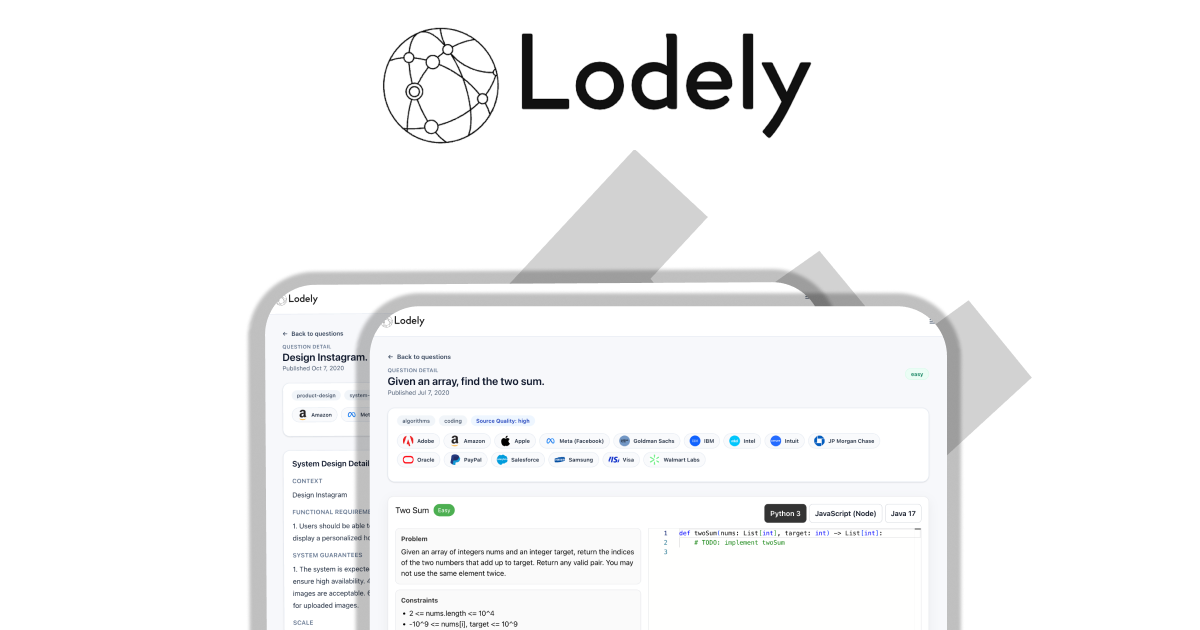
If HackerRank gives you a pile of problems, Lodely gives you a path. That's the core difference.
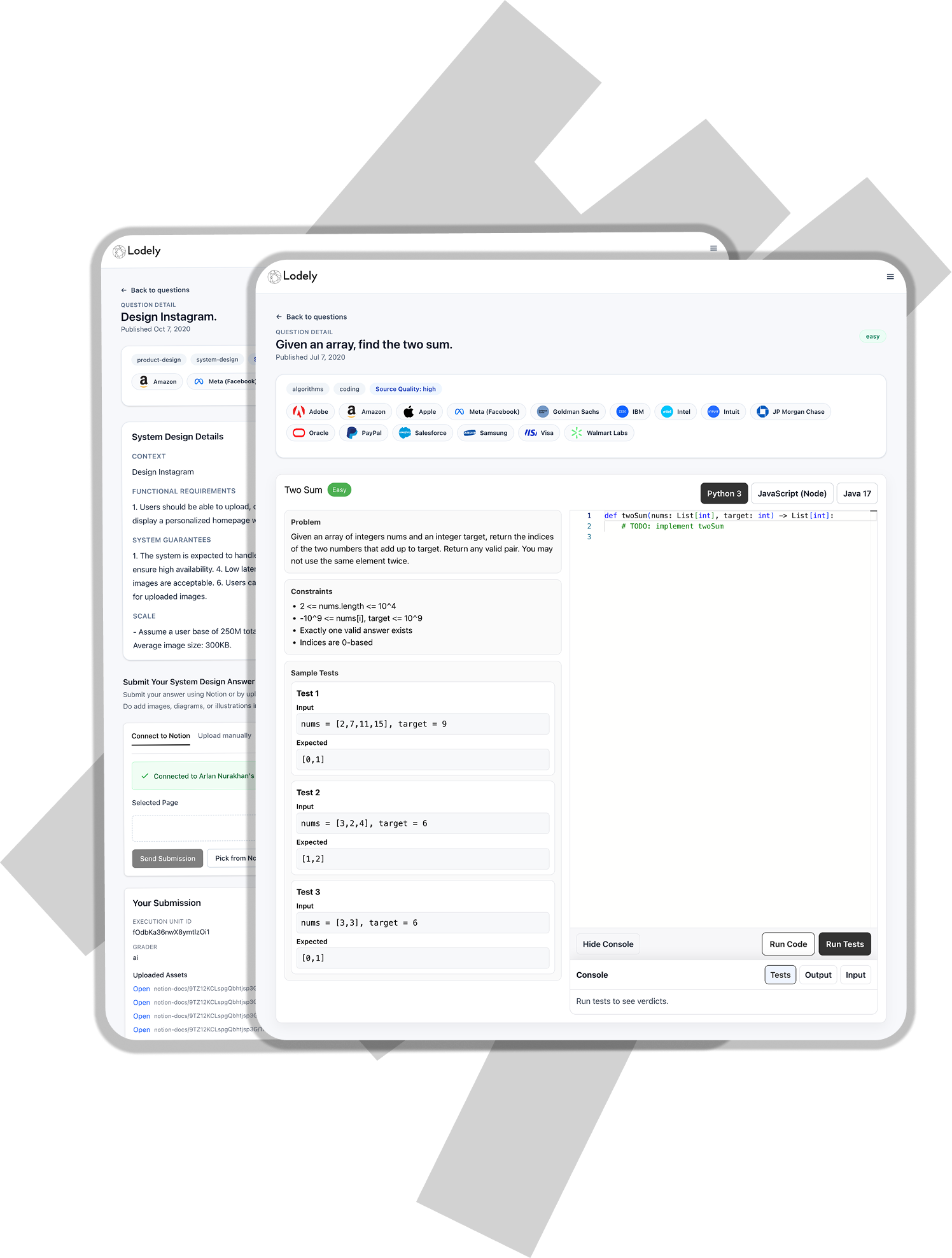
Lodely is a guided interview prep program built specifically for software engineers targeting top tech companies. Instead of dumping 7,500 questions in your lap and wishing you luck, Lodely tells you exactly what to work on next based on where you are in your prep. It covers the full interview loop: 4,000+ real coding questions sourced from actual interviews, system design frameworks, behavioral coaching, and company-specific prep guides for over 1,000 companies including Google, Meta, Amazon, Stripe, and more.
Where HackerRank asks "can you solve this problem?", Lodely answers the question most engineers actually struggle with: "Am I doing the right things, am I actually getting close to an offer?" If you've ever ground through hundreds of LeetCode or HackerRank problems and still felt lost, that's the gap Lodely fills.
Exponent
Exponent takes a broader approach, covering interview prep for product managers, data scientists, UX designers, and software engineers under one roof. For SWEs specifically, they offer courses on data structures, algorithms, and system design, plus a large question bank with expert solutions.
The standout feature is their mock interview system. You can schedule free peer mock interviews or pay for expert coaching sessions with personalized feedback. Pricing starts around $12/month, making it one of the more affordable options out there.
The trade-off is depth. Exponent spreads itself across multiple roles, so the software engineering content isn't as specialized or as deeply sourced from real interviews as what you'd get from a platform built exclusively for SWEs. If you want a general-purpose prep tool that covers the basics well, Exponent is solid. If you want surgical precision for landing a top-tier engineering role, you'll likely want something more focused.
The Bottom Line
HackerRank's pricing makes sense when you understand who it's actually for. Companies pay $100-450+/month for hiring tools. Developers practice for free. Simple as that.
But here's what most engineers miss: getting good at HackerRank challenges and getting good at landing offers are two different skills. One tests whether you can solve algorithm puzzles under a timer. The other requires knowing what to study, when you're ready, how to handle system design rounds, how to nail behavioral questions, and how to position yourself for the specific companies you're targeting.
If you're an engineering team looking for a reliable technical screening tool, HackerRank delivers. If you're a developer looking for structured, end-to-end interview prep that actually gets you to an offer, you need a guided path, not just another problem bank.
✉️ Get free faang interview cheat sheet and interview tips weekly
✉️ Get free faang interview cheat sheet and interview tips weekly