HackerRank Tips & Tricks: Ace Your Coding Interview

You just got an email with the subject line "Next Steps — Technical Assessment." Inside, there's a HackerRank link and a 7-day deadline. Your stomach drops.
If that's you right now, take a breath. HackerRank assessments are one of the most predictable parts of the entire hiring process — once you know what you're actually walking into. Most people don't fail because they can't code. They fail because they don't understand the format, run out of time, or panic on problem types they've never practiced.
This is the no-fluff breakdown of exactly how HackerRank interviews work, what companies are actually evaluating, and how to pass yours on the first try.
What Does a HackerRank Interview Actually Look Like?
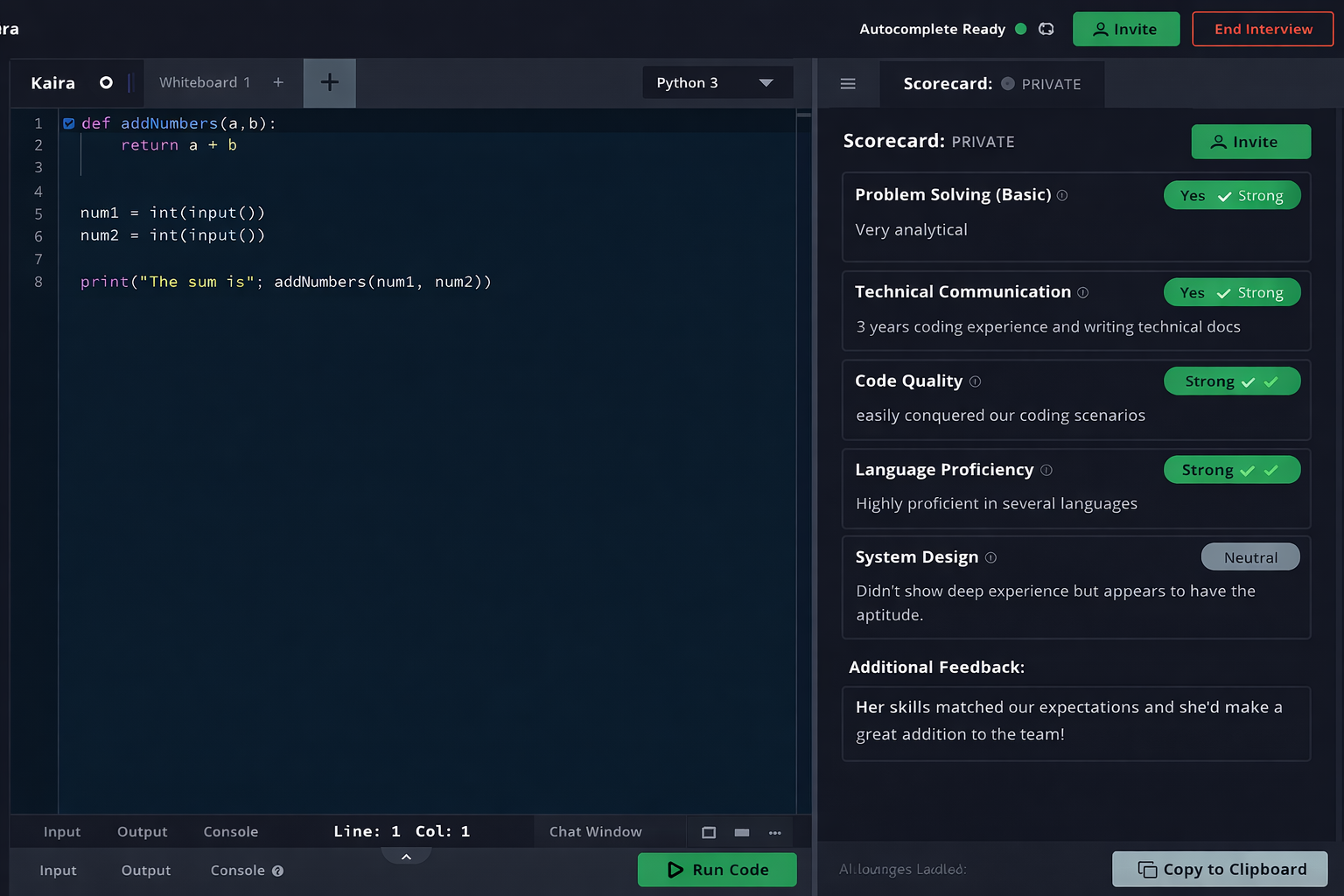
Let's kill the mystery. A HackerRank assessment is a timed, browser-based coding test. You'll get a set of algorithmic problems, a code editor, and a countdown clock. That's it. No interviewer watching you, no whiteboard, no small talk.
Here's the typical setup:
- Number of questions: 2-4 problems per assessment
- Time limit: 60-90 minutes (some companies give up to 120)
- Environment: Browser-based editor with language selection (Python, Java, C++, JavaScript, etc.)
- Testing: Your code runs against hidden test cases — you'll see some sample cases upfront, but the real evaluation happens behind the scenes
- Proctoring: Many companies enable webcam monitoring and screen recording, so treat it like someone's watching
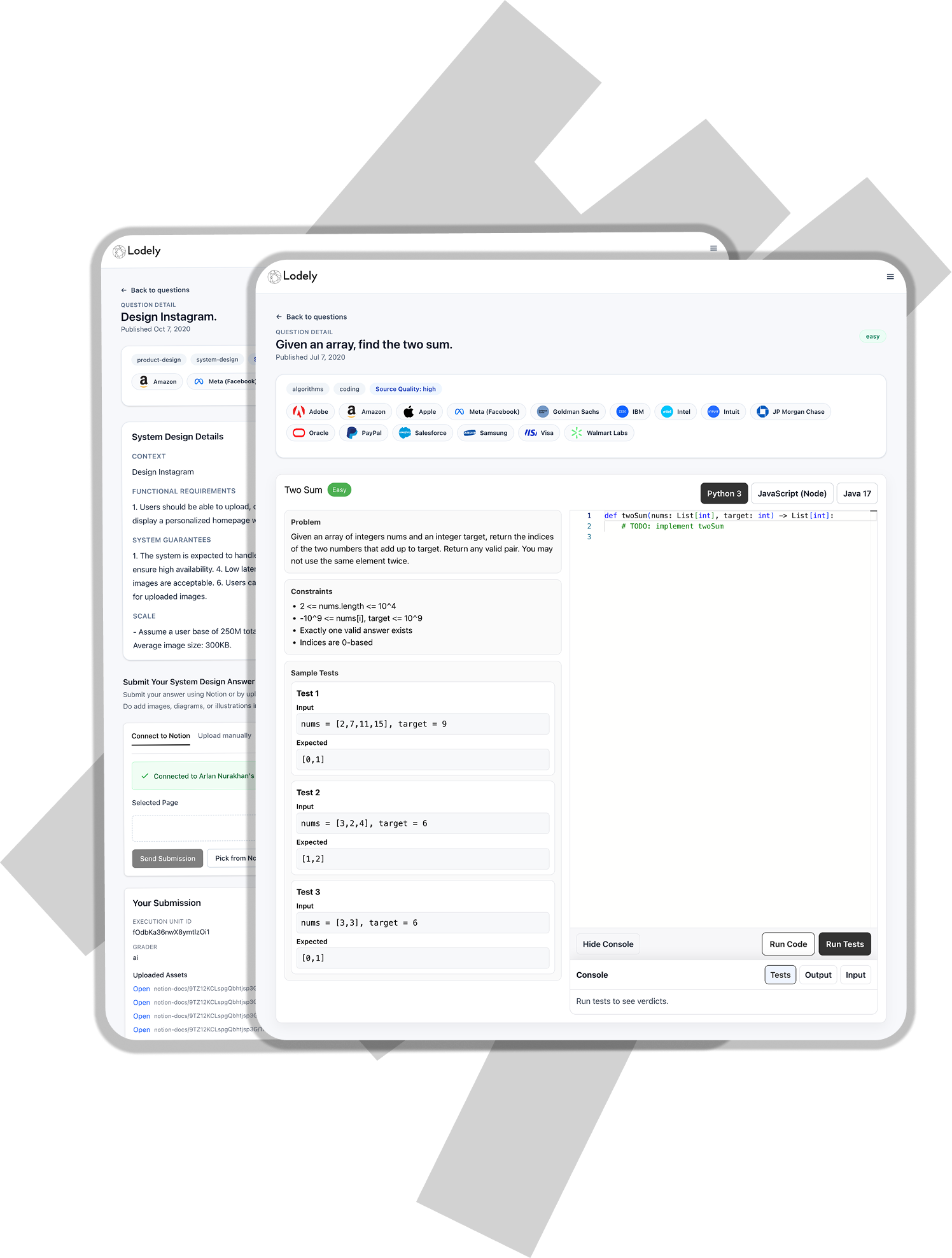
The interface is straightforward: problem description on the left, code editor on the right, and a "Run Code" / "Submit" button at the bottom. You can run your code against sample inputs before submitting, and you should — every single time.
When You'll Get a HackerRank Assessment
HackerRank almost always shows up as the first technical gate. It's the filter before the real interviews begin.
Here's where it typically falls in the pipeline:
- You apply (or a recruiter reaches out)
- Recruiter screen — a 15-30 minute call to check basic fit
- HackerRank assessment — sent via email with a deadline (usually 3-7 days)
- Technical phone screen — if you pass the HackerRank
- On-site / virtual loop — the final rounds
Companies like Amazon, Goldman Sachs, Cisco, Oracle, JPMorgan, and hundreds of startups use HackerRank as their go-to screening tool. Amazon's Online Assessment (OA) is one of the most well-known, and it follows this exact format — two coding problems in 70 minutes.
The key insight: HackerRank is a pass/fail gate. You don't need a perfect score. You need to clear the bar, which is typically solving 70-80% of the test cases. Clearing this stage gets you to the interviews where you can really differentiate yourself.
HackerRank Problem Types You'll Actually See

Not all problems are created equal. Here's what shows up most frequently, ranked by how often they appear:
- Arrays and strings — manipulation, searching, sliding window. These are the bread and butter. If you're not comfortable here, nothing else matters.
- Hash maps and sets — frequency counting, duplicate detection, two-sum style problems. Show up in nearly every assessment.
- Sorting and searching — binary search variants, custom sorting logic. Companies love these because they test both implementation and edge-case thinking.
- Dynamic programming — the one that scares everyone. Usually appears as the hardest problem in a set. You don't always need to solve it fully to pass, but getting partial credit helps.
- Trees and graphs — BFS, DFS, path finding. More common in assessments for mid-level and senior roles.
- Greedy algorithms — interval scheduling, activity selection. Often disguised as "optimization" problems.
Pro tip: 80% of HackerRank assessments can be handled with strong fundamentals in arrays, strings, hash maps, and basic sorting. Master these before chasing exotic topics like segment trees or advanced graph theory.
If you want to compare how these problem types stack up across different platforms, here's a breakdown of the best HackerRank alternatives for interview prep.
How to Prepare for a HackerRank Interview (Step-by-Step)
Randomly grinding problems is the fastest way to burn out and still fail. Here's the systematic approach that actually works.
Step 1: Lock in your language (Day 1)
Pick one language and commit. Python is the best choice for most people — it's concise, readable, and lets you focus on logic instead of syntax. Java works if you're already fluent. Don't try to learn a new language while prepping for an assessment.
Step 2: Drill the fundamentals (Week 1-2)
Before touching HackerRank, make sure you can implement these without Googling:
- Array traversal, two-pointer technique, sliding window
- Hash map operations (insert, lookup, frequency counting)
- Basic string manipulation (reversal, substring search, anagram detection)
- Sorting algorithms and when to use built-in sort vs. custom comparators
- Stack and queue operations
Step 3: Practice on HackerRank's actual platform (Week 2-3)
This matters more than people think. Every platform has quirks — how input is read, how output is formatted, how edge cases are structured. HackerRank's "Interview Preparation Kit" and "Problem Solving" sections are gold. Do 3-5 problems per day in timed conditions.
Step 4: Simulate real conditions (Week 3-4)
Set a timer. Close all other tabs. No IDE autocomplete. Read the problem once, plan your approach for 5 minutes, then code. This is where most people discover their real weak spots — time management, not algorithms.
Step 5: Review company-specific patterns
Different companies favor different problem types. Amazon leans heavily on arrays, graphs, and BFS/DFS. Goldman Sachs likes math-heavy problems. If you know which company sent the assessment, study their patterns specifically.
A software engineering career coach can help you decode company-specific patterns fast, so you're not wasting prep time on problems that won't show up in your particular assessment.
How Companies Actually Evaluate Your Submission
Here's what most candidates don't realize: passing test cases isn't the only thing that matters.
Companies evaluate HackerRank submissions on multiple dimensions:
- Correctness — does your code produce the right output for all test cases, including edge cases? This is the primary metric. Hidden test cases often include empty inputs, extremely large inputs, and boundary values.
- Time complexity — a brute force O(n²) solution might pass small test cases but time out on large ones. Companies deliberately include test cases that punish inefficient solutions.
- Code quality — some companies (especially larger ones) review your actual code after the automated scoring. Clean variable names, logical structure, and readable code matter.
- Completion rate — solving 2 out of 3 problems completely beats solving 3 problems partially. Focus on getting full marks on problems you can solve rather than partial credit everywhere.
- Time taken — while you won't be penalized for using the full time, finishing significantly early on a correct solution signals strong ability.
The scoring breakdown typically looks like this: each problem has multiple test cases worth different point values. You might get 8/15 test cases right and still advance if those 8 cover the core logic. The remaining 7 might test performance optimization — worth attempting, but not always necessary to pass.
Tips to Pass Your HackerRank Interview
These are the high-leverage moves that separate people who pass from people who almost pass.
Read the entire problem before writing a single line of code. Seriously. Most time-wasting mistakes come from misunderstanding the problem, not from coding errors. Read it twice. Check the constraints section — it tells you what time complexity you need.
Start with brute force, then optimize. A working O(n²) solution submitted with 10 minutes left beats an incomplete O(n log n) solution every time. Get something correct first, then improve it if time allows.
Test with the sample cases before submitting. HackerRank gives you sample inputs for a reason. Run your code against them. Then manually add your own edge cases — empty arrays, single elements, negative numbers, duplicates.
Handle edge cases explicitly. Add checks for empty inputs, null values, and boundary conditions at the top of your function. This takes 30 seconds and can save you from failing 3-4 hidden test cases.
Manage your time ruthlessly. If you have 3 problems in 90 minutes, spend no more than 30 minutes per problem. If you're stuck after 15 minutes, move on and come back. Partial progress on all problems beats perfect progress on one.
Use built-in functions. Python's collections.Counter, heapq, itertools, and sorted() with custom keys exist for a reason. Don't re-implement what the standard library already handles — it saves time and reduces bugs.
Common Mistakes That Cost People the Assessment
Knowing what NOT to do is just as important as knowing what to do.
- Jumping straight into coding without a plan. Five minutes of planning saves twenty minutes of debugging. Sketch your approach in comments first.
- Ignoring time complexity. If the input size is 10⁵ or larger, your solution needs to be O(n log n) or better. An O(n²) approach will timeout on large test cases every time.
- Not reading the constraints. The constraints section literally tells you the expected complexity. Input size of 10³? Brute force is fine. Input size of 10⁶? You need an optimized approach.
- Submitting without testing. One click of "Run Code" against the sample cases catches 80% of silly mistakes — off-by-one errors, wrong variable names, misread input format.
- Overthinking the hard problem. If the last problem is clearly a step above your level, don't spend 40 minutes staring at it. Lock in full points on the easier problems first, then take a shot at the hard one with whatever time remains.
- Copying solutions from the internet. Companies track plagiarism. HackerRank has built-in similarity detection. Getting flagged for cheating is worse than failing honestly — it can blacklist you from the company entirely.
You're More Ready Than You Think
HackerRank assessments aren't designed to find genius-level programmers. They're designed to filter for people who can solve structured problems under time pressure — and that's a trainable skill, not a talent you're born with.
If you focus your prep on the right problem types, practice under real conditions, and manage your time strategically, you'll clear the bar. The engineers who land offers at top companies aren't the ones who memorized 500 LeetCode problems. They're the ones who practiced the right problems, understood the patterns, and showed up prepared.
Stop guessing at what to study. Know exactly what's coming, prepare for it systematically, and walk into your assessment with confidence.
FAQ
How hard are HackerRank interview questions? Most assessments range from easy to medium difficulty. You'll rarely see hard-level problems unless you're interviewing for a senior role. Solid fundamentals in arrays, strings, hash maps, and basic algorithms cover 80% of what you'll face.
Can I use Google during a HackerRank test? Technically, most assessments don't block other browser tabs. But many companies enable proctoring (webcam and screen recording), so switching tabs to search for solutions is risky and can be flagged. Know your stuff before you start.
What programming language should I use? Python is the most popular choice for a reason — it's concise and lets you focus on problem-solving instead of boilerplate syntax. Use whatever language you're fastest and most comfortable in. Speed matters more than language choice.
What happens if I fail a HackerRank assessment? Most companies have a cooldown period of 6-12 months before you can re-apply. This is why preparation matters — you don't want to burn an attempt at your target company because you weren't ready. Take the assessment seriously the first time.
How long should I prepare before taking a HackerRank test? If you have solid programming fundamentals, 2-4 weeks of focused daily practice is usually enough. If you're rustier, budget 4-6 weeks. Quality of practice beats quantity — 5 well-analyzed problems per day beats 20 problems you rushed through without understanding.
✉️ Get free faang interview cheat sheet and interview tips weekly
✉️ Get free faang interview cheat sheet and interview tips weekly