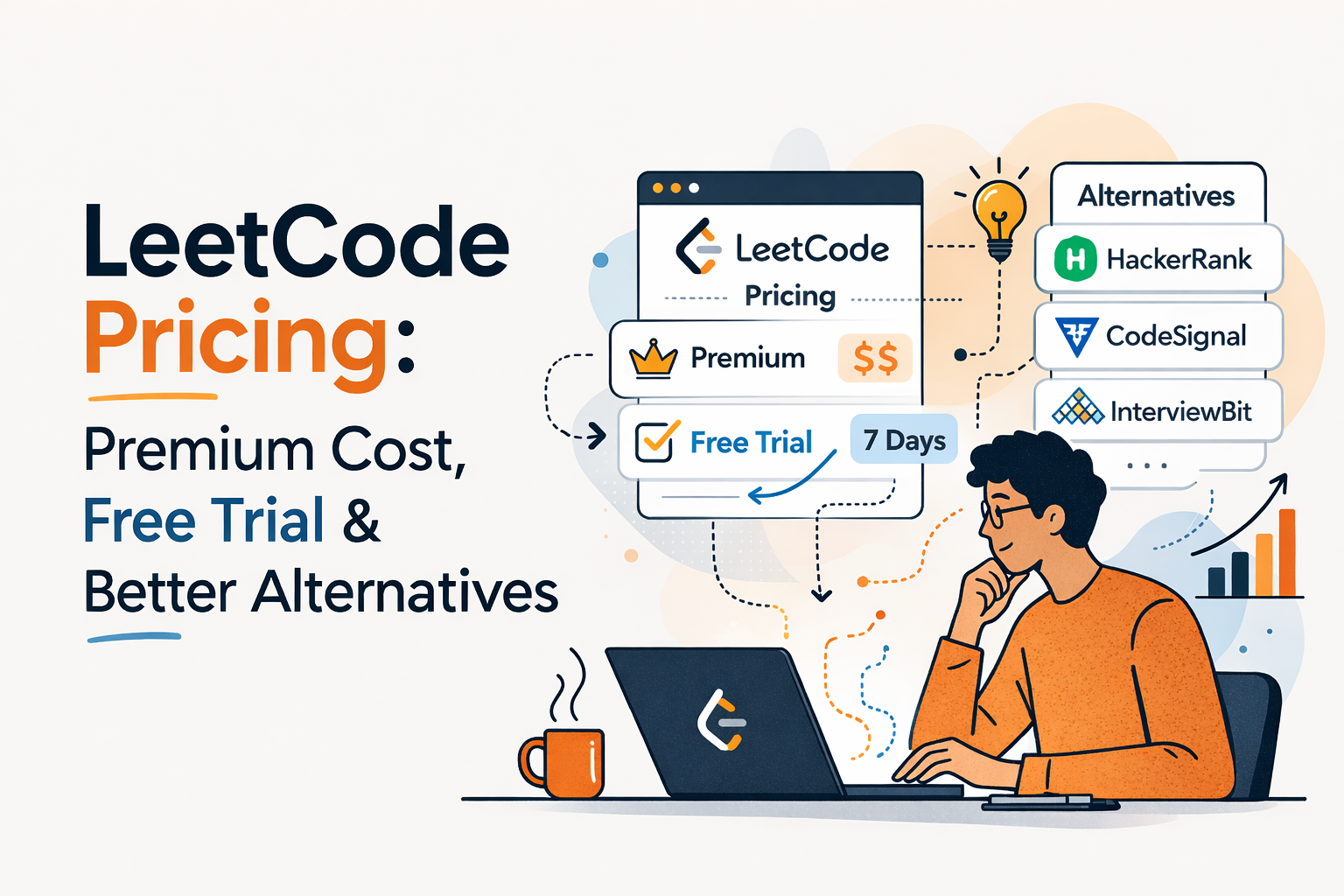
LeetCode Pricing: Premium Cost, Free Trial & Better Alternatives

Think LeetCode is the only way to crack a FAANG interview? Think again. Engineers are landing $300K+ offers using smarter prep strategies, and some of them never paid for Premium at all.
If you're trying to figure out whether LeetCode Premium is worth your money or if there's a better way to spend your prep budget, this is the honest, no-fluff breakdown you actually need.
What Is LeetCode?
LeetCode is the 800-pound gorilla of coding interview prep. It's an online platform with a massive bank of algorithm and data structure problems designed to help software engineers prepare for technical interviews at companies like Google, Meta, Amazon, and pretty much every other tech company that uses whiteboard-style coding rounds.
The platform launched as a problem repository and has grown into the default destination for anyone grinding for a tech interview. It now hosts over 3,000 problems across easy, medium, and hard difficulty levels, runs weekly coding contests, and has built one of the largest engineering communities on the internet.
LeetCode Features That Actually Matter
Let's cut through the marketing and talk about what you actually get:
Problem database. Over 3,000 coding problems spanning arrays, trees, graphs, dynamic programming, and every other topic that shows up in technical interviews. The breadth is genuinely impressive, and problems are tagged by topic and difficulty.
In-browser IDE. You can write, run, and test code directly in the browser across 20+ programming languages. The online judge is fast and reliable, which matters when you're submitting 10+ solutions a day.
Discussion forums. Every problem has a discussion section where users share solutions, explanations, and alternative approaches. This is arguably one of LeetCode's most valuable features, and it's completely free.
Contests. Weekly and biweekly coding competitions that let you benchmark yourself against other engineers. Contest ratings are public and some recruiters actually look at them.
Company tags (Premium). See which problems were recently asked at specific companies. This is the crown jewel of Premium and the main reason most people upgrade.
Explore cards. Curated learning paths that group problems by topic, which offer slightly more structure than the raw problem list.
The Pros: What LeetCode Gets Right
Credit where it's due. LeetCode dominates interview prep for real reasons:
The problem quality is consistently high. The community-driven model means problems get battle-tested by millions of users, and the best solutions bubble up through upvotes. When you solve a LeetCode medium cleanly, you can be reasonably confident you'd handle a similar question in an actual interview.
The community is massive. With millions of active users, you're never stuck on a problem without help. The discussion sections, YouTube walkthroughs, and Reddit threads around LeetCode problems create an ecosystem that no other platform can match in raw volume.
Contest ratings give you signal. Unlike grinding problems in isolation, contests let you measure where you actually stand. If you're consistently rating 1800+ in LeetCode contests, that tells you something concrete about your readiness.
The company tags (Premium feature) are legitimately useful. Knowing that Amazon asked a specific problem 47 times in the last 6 months is actionable intelligence you can't easily get elsewhere.
The Cons: Where LeetCode Falls Short
Now here's the part nobody puts on the sales page:
It's directionless. This is the biggest criticism, and it's valid. LeetCode gives you 3,000+ problems but doesn't tie in on your specific journey towards an offer. You're essentially handed a pile of high quality stuff. Good luck assembling it into a job. Most engineers waste weeks grinding random problems and feel productive.
The discussion section is a mess. Yes, community solutions are valuable in theory. In practice, you're scrolling through 47 different Python one-liners, half of them poorly explained, trying to figure out which approach actually teaches you something. It's noisy, cluttered, and there's no quality filter.
It doesn't teach. LeetCode editorials show you the optimal solution, but they rarely build your intuition for how to arrive at that solution yourself. Reading an editorial is passive. You think you understand it, then you sit down with a similar problem and go completely blank.
It's not beginner-friendly. If you're early in your coding journey or transitioning from another field, the jump from "I understand Python basics" to "solve this medium-difficulty graph problem" is brutal. LeetCode assumes a baseline of CS knowledge it never helps you build.
It covers only one dimension of interviews. Real tech interviews at top companies include system design, behavioral rounds, and sometimes take-home projects. LeetCode only covers data structures and algorithms. If that's the only thing you're prepping, you're leaving gaps in your preparation.
LeetCode Premium: How Much Does It Actually Cost?
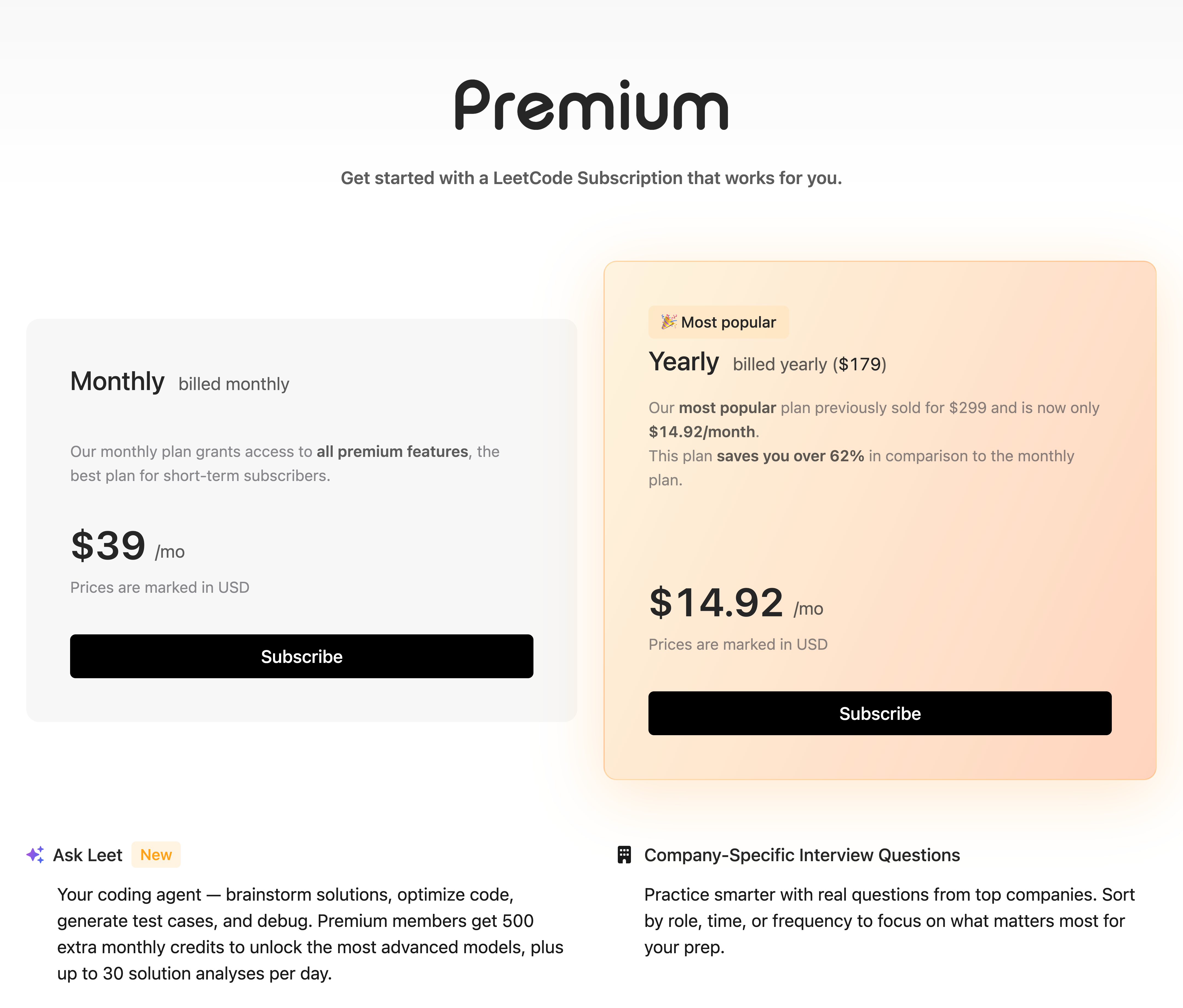
Let's talk real numbers. Here's the current LeetCode Premium pricing:
- Monthly plan: $35/month
- Annual plan: $159/year (works out to ~$13.25/month)
The annual plan saves you roughly 62% compared to paying monthly, which is a significant discount if you know you'll be prepping for more than a couple of months.
There's also a student option. If your school qualifies, you can get the annual plan for around $119/year, which knocks another $40 off.
To put this in perspective: the average software engineer salary in the US is well over $120,000. A $159 annual subscription is 0.13% of that salary. Even the monthly plan at $35 is the cost of a mediocre dinner out. If Premium helps you land an offer even one week faster, the ROI is absurd. We're talking about a tool that costs less than a pair of decent headphones, preparing you for roles that pay $150K-$400K+.
The real cost of LeetCode isn't the subscription price. It's the months of undirected grinding if you don't use it strategically.
What Do You Get With LeetCode Premium?
Premium unlocks a handful of features on top of the free tier. Here's what's actually behind the paywall:
Company-tagged questions. This is the headliner. Premium shows you which problems have been asked at specific companies, how frequently, and how recently. If you have an Amazon on-site in two weeks, you can filter for the exact problems Amazon has been asking. This alone is the reason most people buy Premium.
Frequency data. Beyond just company tags, you get data on how often each problem appears in interviews. This helps you prioritize high-frequency problems over obscure ones that rarely come up.
Premium-only problems. Around 300+ additional problems that are only available to paying subscribers. Many of these are hard-level questions that show up at top-tier companies.
Official editorial solutions. Detailed, step-by-step breakdowns for every problem, written by LeetCode's editorial team. These are generally better organized than community solutions, though they still tend to show the final answer rather than building intuition.
Mock interview simulator. Timed sessions that simulate real interview conditions with random problem selection. You get basic feedback on your pacing and performance.
Autocomplete and debugging tools. Quality-of-life improvements to the coding environment.
Is There a Free Trial?
This is where it gets a little murky. LeetCode does not consistently offer a standard free trial for Premium.
However, there are a few workarounds worth knowing about. LeetCode has a virtual currency system called LeetCoins that you earn by solving problems, maintaining streaks, and participating in contests. You can redeem 5,000 LeetCoins for a 30-day Premium subscription, which is essentially a free trial if you're willing to invest the time upfront.
LeetCode also occasionally runs promotional free trial periods around major events or product launches, but these aren't predictable or guaranteed.
The bottom line: don't count on a free trial being available when you need it. If you want to test Premium, the most reliable strategy is either grinding for LeetCoins or buying a single month at $35 to evaluate whether the features are worth committing to the annual plan.
Is LeetCode Premium Worth It?
This is the question everyone asks, and the honest answer is: it depends on where you are in your prep.
The community sentiment is surprisingly consistent on this. One of the most common takes you'll find across Reddit, forums, and engineering communities is some variation of: "Premium didn't make me better at solving problems, but it helped me practice more strategically." That's a meaningful distinction.
If you're actively interviewing at specific companies within the next 60 days, Premium is almost certainly worth it. The company tags alone can save you dozens of hours of unfocused grinding. When you can filter for the 20 problems Amazon asks most frequently and drill those specifically, your prep becomes surgical instead of scattered.
If you're still building fundamentals, learning patterns, and not yet at the stage where you're targeting specific companies, Premium adds very little value. The free tier has more than enough problems to build a strong foundation, and the company tags are useless if you don't have interviews lined up.
The smart move? Don't buy the annual subscription upfront. Wait until you've built a solid problem-solving foundation, then grab one month of Premium right when you get that recruiter screen. Use the company tags to do targeted prep for your specific interviews.
LeetCode Premium vs Free: What's the Real Difference?
Let's break this down feature by feature so you can see exactly where the paywall sits:
Problem access. Free gives you access to roughly 2,700+ problems. Premium adds around 300 more. Unless you've already exhausted the free library (you haven't), this isn't a dealbreaker.
Company tags. Free shows nothing. Premium shows which companies ask which problems and how often. This is the single biggest differentiator and the main reason to upgrade.
Editorials. Free gives you community solutions only. Premium adds official editorial solutions. The official ones are more polished, but plenty of free YouTube channels (like NeetCode) cover the same problems with arguably better explanations.
Mock interviews. Free doesn't include them. Premium does. That said, the mock interview feature is widely considered the weakest Premium offering. You're better off doing mock interviews with a real person.
Contests. Fully free. No Premium required.
Discussion forums. Fully free. The community's collective knowledge doesn't sit behind a paywall.
For most engineers, the only Premium feature that justifies the cost is company tags. Everything else either has a free alternative or isn't worth paying for on its own.
LeetCode Premium Coupons & Discounts
Before you pay full price, it's worth knowing that LeetCode runs discounts more often than you'd think.
Here are some currently reported codes and strategies worth trying:
- THANKS2025 - has been reported as working for $40 off the annual subscription, bringing it down to around $119
- Seasonal sales - LeetCode typically offers promotions during Black Friday, Thanksgiving, New Year, and back-to-school season with 20-30% off annual plans
- Birthday coupon - LeetCode sends registered users a 20% discount coupon around their birthday, valid for 30 days. If your birthday is coming up, wait for it
- Student discount - if you have a valid .edu email, you can get the annual plan for $99-$119 depending on the current promotion
A few general tips: coupon codes rotate frequently, so what works today might not work next month. Before purchasing, check aggregator sites like SimplyCodes or WorthEPenny for the latest verified codes. And never buy the monthly plan if you think you'll prep for more than 4-5 weeks. The annual plan is dramatically cheaper per month.
Better Alternatives to LeetCode Premium
Here's what most LeetCode-obsessed engineers miss: the platform's core weakness isn't something Premium fixes. LeetCode, even with Premium, is still a directionless problem bank. Paying $35/month doesn't change that. It just gives you a fancier directionless problem bank.
If you're looking for alternatives that address that fundamental gap, or that cover interview dimensions LeetCode ignores entirely, here are options worth considering. And if you want a deeper dive, check out our full guide on LeetCode Alternatives: Top Platforms for Coding Interview Prep for the complete breakdown.
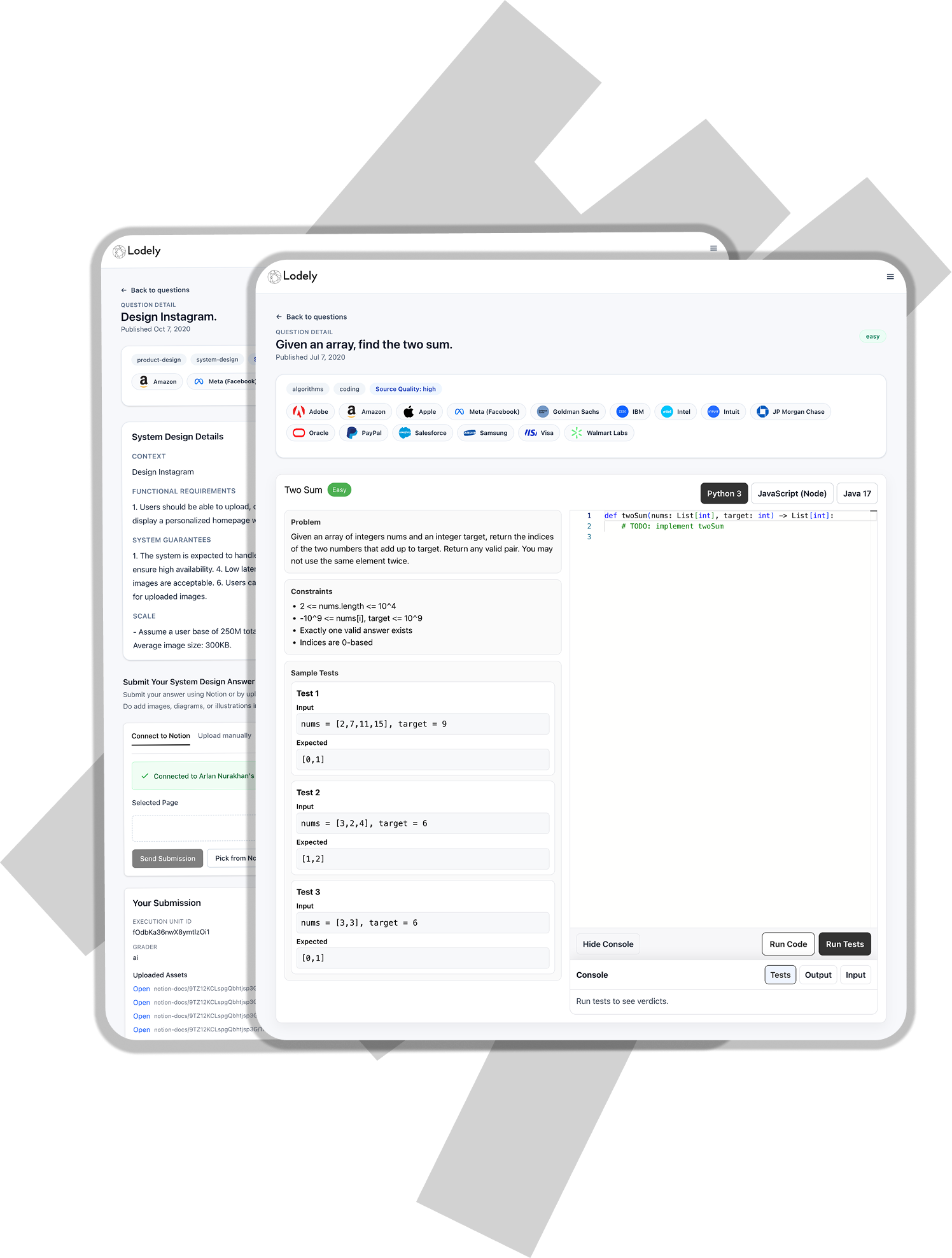
Lodely
This is where we're biased, and we'll own it, but here's why Lodely exists in the first place: most engineers don't fail interviews because they couldn't find enough problems to solve. They fail because they didn't know what to focus on, when to move on, or how to prep for the non-coding rounds that actually make or break offers.
Lodely is a guided interview prep program built by engineers who've been through the process at Google, Meta, and other top companies. Instead of handing you a pile of 3,000+ problems and wishing you luck, Lodely tells you exactly what to work on next based on where you are in your prep.
Here's what that actually looks like:
- 4,000+ real interview questions sourced from what companies actually ask, not invented practice problems
- Company-specific prep guides for 1,000+ companies including detailed OA breakdowns for Amazon, Google, Meta, and more
- System design and behavioral prep built into the same platform, so you're not duct-taping three different tools together
- 100+ interview simulations that go beyond just coding rounds
The core difference: LeetCode is a content library. Lodely is a guided path. Most platforms give you a mountain of content. Lodely gives you a plan, tells you when you're ready, and covers every round of the interview process, not just the algorithm portion.
If your problem is "I need more problems to solve," LeetCode has you covered. If your problem is "I don't know what I should be doing right now, and I have interviews in 6 weeks," that's what Lodely was built for.
HackerRank
HackerRank takes a different angle than LeetCode. While it does have a problem library for interview prep, its real strength is as a platform that companies use to administer coding assessments. If a company sends you an online assessment link, there's a good chance it's hosted on HackerRank.
This makes HackerRank useful for a specific reason: practicing in the same environment where you'll actually be tested. The interface, time constraints, and problem format on HackerRank practice problems mirror what you'll see in a real HackerRank-hosted assessment.
HackerRank also offers structured certification paths and skill-based tracks, which give slightly more direction than LeetCode's raw problem list. However, its problem library is smaller, the community is less active, and it doesn't have the depth of company-specific data that LeetCode Premium offers.
Use HackerRank to familiarize yourself with the assessment format. But don't rely on it as your primary prep tool. The problem quality and community depth don't match LeetCode, and it doesn't offer the guided approach you'd get from a platform like Lodely.
Stop Grinding Blindly. Start Prepping With a Plan.
Here's the bottom line: LeetCode is a powerful tool, but it's still just a tool. Premium makes it marginally more useful if you're at the right stage in your prep, mainly through company tags. But no subscription tier fixes the fundamental issue: LeetCode doesn't tell you what to do, when to do it, or when you're ready.
The engineers who land top offers aren't the ones who solved the most LeetCode problems. They're the ones who prepped strategically across every interview dimension, coding, system design, behavioral, and company-specific prep, with a clear plan and honest feedback on where they stood.
Whether you go with LeetCode free, LeetCode Premium, or a more guided approach, the key is this: don't confuse activity with progress. Solving 500 random problems feels productive. It usually isn't.
If this was useful, there's more where it came from. Subscribe below for no-fluff interview prep advice that actually moves the needle.
✉️ Get free faang interview cheat sheet and interview tips weekly
✉️ Get free faang interview cheat sheet and interview tips weekly