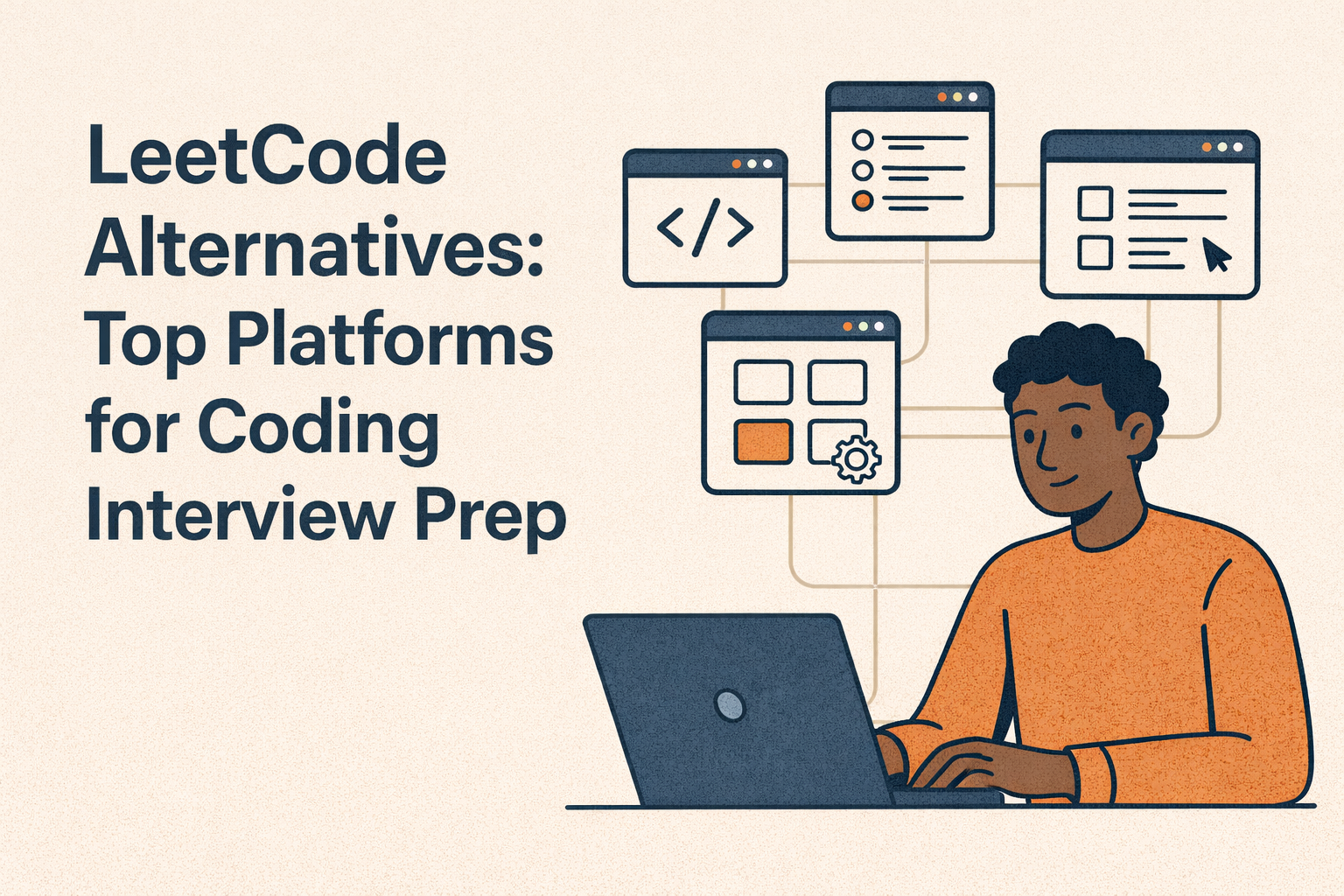
LeetCode Alternatives: Top Platforms for Coding Interview Prep

Think LeetCode is the only way to prep for coding interviews? Think again. Engineers are passing Google on-sites using HackerRank. Career switchers are landing $200K+ offers after prepping on platforms most people have never heard of. And some of them barely touched LeetCode at all.
If you're looking for the best LeetCode alternatives that actually move the needle on your interview performance, this is the real, no-fluff breakdown you've been searching for.
What LeetCode Actually Is (And What It's For)
LeetCode is, at its core, a massive problem bank. Over 3,000 coding challenges organized by difficulty, topic, and company tag. You pick a problem, solve it in an online editor, and check your solution against test cases. That's it.
It became the default interview prep tool because it does one thing well: it gives you a near-endless supply of data structures and algorithms problems that mirror what shows up in technical interviews. The company-tagged questions (a Premium feature) let you see which problems Google, Meta, and Amazon have actually asked candidates, which is genuinely useful intel.
But here's what LeetCode is not: a structured learning program. It doesn't improve your system design. It doesn't help you tell your story in behavioral rounds. It doesn't coach you on job search or help you figure out which companies to target.
For the narrow task of grinding coding problems, LeetCode is solid. For everything else involved in actually landing a tech offer, you need more.
A Quick Look at the Tech Interview Process
Before we compare platforms, let's get clear on what you're actually preparing for. Most software engineering interviews at top companies follow a predictable structure:
Recruiter screen — a 15-30 minute call to check basic qualifications and motivation. Online assessment (OA) — a timed coding test, usually 60-90 minutes, with 2-4 algorithm problems. Phone/technical screen — a live coding session with an engineer, typically one medium-difficulty problem. On-site (or virtual loop) — 4-6 rounds covering coding, system design, and behavioral questions.
Here's what most people miss: the coding rounds aren't about raw genius. They're about pattern recognition. A "hard" LeetCode problem feels impossible the first time you see it. But after you've solved 15 variations of dynamic programming on subsequences, that same "hard" problem suddenly looks familiar. You've seen the pattern before, you know the approach, and you can execute under pressure.
That's the real value of any prep platform — not memorizing solutions, but building enough pattern exposure that even difficult problems trigger recognition instead of panic. The question is which platform gives you that exposure most efficiently, and which ones fill the gaps LeetCode can't.
Where LeetCode Falls Short (And Where Alternatives Win)
LeetCode dominates the coding problem space, but it has real blind spots that cost engineers offers every single day:
No structure or guidance. You open LeetCode, stare at 3,000+ problems, and ask yourself: "Where do I start?" There's no adaptive path, no signal on when you've practiced enough of a topic, and no system telling you what to work on next. Most people end up grinding random problems for months with no clear sense of progress.
Zero system design coverage. System design rounds are worth just as much as coding rounds at most companies, and LeetCode doesn't touch them. If you're interviewing at the senior level or above, this is a massive gap.
No behavioral prep. "Tell me about a time you disagreed with your manager" can sink your candidacy just as fast as failing a coding question. LeetCode has nothing for this.
No career strategy. Which companies should you target? How do you position your resume? How should you fill your interview pipeline? LeetCode doesn't care. It just serves you another problem.
These gaps are exactly where alternatives step in. Let's break them down.
LeetCode
What it is: The largest coding problem repository for interview prep, with 3,000+ problems spanning easy, medium, and hard difficulties across dozens of data structure and algorithm categories.
Strengths:
- Massive problem library — you'll never run out of material
- Company-tagged questions show what specific companies actually ask (Premium)
- Active discussion forums with multiple solution approaches for every problem
- Weekly contests keep your skills sharp under timed pressure
- Strong community that shares tips, patterns, and strategies
Weaknesses:
- No structure or guided learning path — you're on your own to figure out what to study
- Coding only — no system design, behavioral, or career prep
- Easy to fall into "tutorial hell" and grind without direction
- Premium features (company tags, frequency data) locked behind paywall
- Can feel isolating without mentorship or feedback
Price: Free tier with 2,000+ problems. Premium at $35/month or $159/year.
HackerRank
What it is: A dual-purpose platform that serves both individual developers looking to practice and companies running technical assessments. If you've ever taken a coding test as part of a job application, there's a good chance it was on HackerRank.
Strengths:
- Free for individual developers — no paywall on practice problems
- Over 28 million developers use the platform, which means a massive community
- Covers a broader range of skill domains beyond pure algorithms (databases, regex, Linux shell, AI)
- Built-in certifications you can add to your resume and LinkedIn
- Familiarity advantage — many companies use HackerRank for their actual online assessments, so practicing there means you already know the IDE and interface when it counts
Weaknesses:
- Problem quality is inconsistent — some challenges feel more academic than interview-relevant
- Less focused on interview-specific patterns compared to LeetCode
- The platform's primary business is selling to employers, so the candidate experience can feel secondary
- No system design or behavioral prep
- Discussion and editorial sections are less robust than LeetCode's community solutions
Price: Free for individual practice and skill certification. The paid plans ($165-$375/month) are designed for employers running assessments, not individual engineers.
Lodely
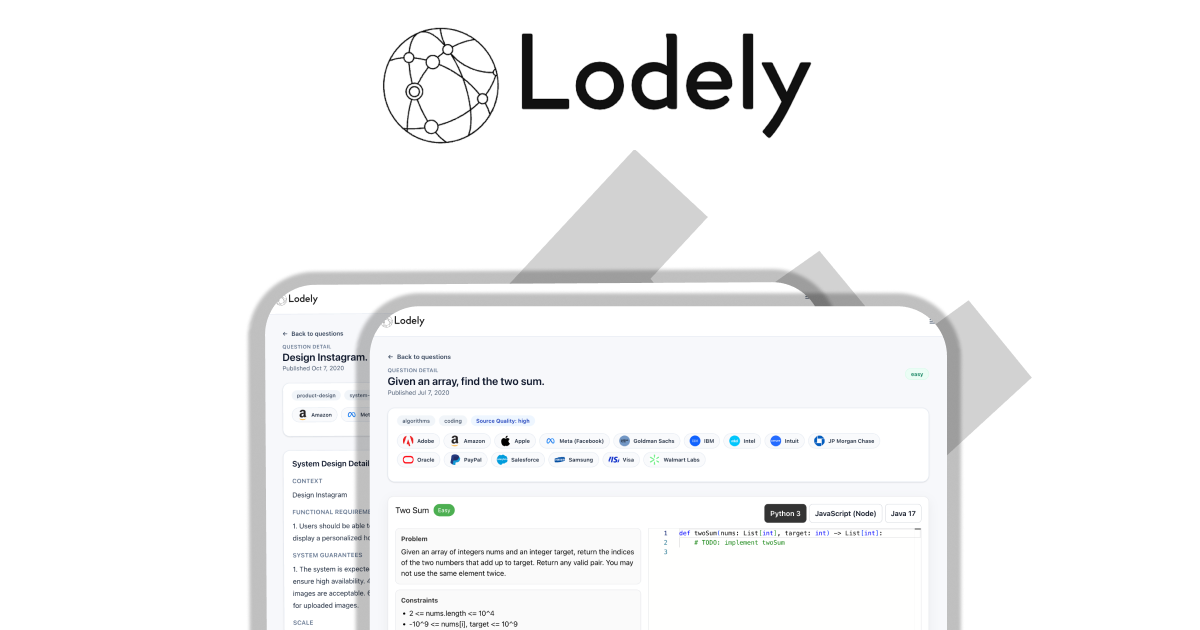
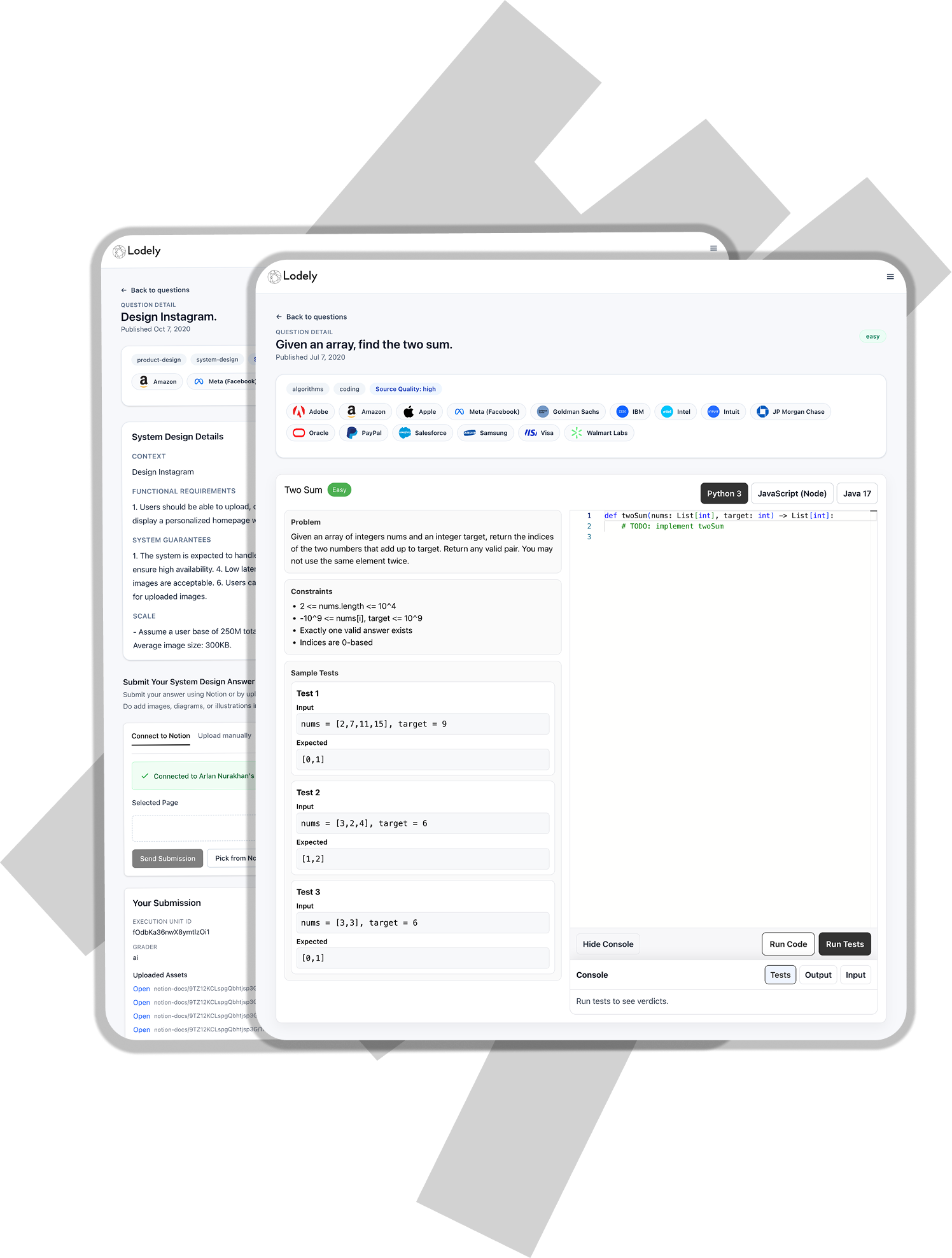
What it is: A guided interview prep program built by engineers who've landed offers at Google, Meta, and other top companies. Unlike platforms that hand you a pile of problems and wish you luck, Lodely tells you exactly what to work on next — across coding, system design, behavioral, and career strategy — based on where you actually are in your prep.
Strengths:
- End-to-end coverage — coding, system design, behavioral, and career strategy in one place
- 4,000+ real interview questions sourced from 1,000+ tech companies — not invented practice problems, actual questions candidates have been asked
- 100+ graded interview simulations that test readiness across all interview types
- Premium content covering algorithms, system design, behavioral and job search.
- 1:1 coaching from experienced engineers who've been through the process
- Guided path that directs your effort instead of leaving you to figure it out alone
Weaknesses:
- Smaller community compared to LeetCode's massive user base
- Newer platform, so fewer third-party reviews and community content
- Best suited for engineers who already have baseline coding skills — not a learn-to-code platform
Price: $49/month with a no questions asked 5-day refund policy.
CodeSignal
What it is: An AI-powered skills assessment platform that companies like Uber, Brex, and Robinhood use to evaluate engineering candidates. For individual developers, CodeSignal offers practice modules and learning paths designed to mirror what you'll see in real technical assessments.
Strengths:
- Practice environment matches what you'll encounter in actual company assessments — same IDE, same format
- Structured learning paths (like the four-week coding interview prep) give you a clear timeline
- Supports 40+ programming languages
- Your practice scores are private — companies only see assessment results they send you
- The General Coding Assessment (GCA) score is accepted by multiple companies, meaning one test can open multiple doors
Weaknesses:
- Smaller problem library compared to LeetCode or HackerRank
- Primary focus is on employer-side assessments, so candidate-facing features can feel limited
- No system design, behavioral prep, or career coaching
- Pricing for advanced features isn't transparent — you often need to contact sales
- Less community discussion and solution-sharing compared to LeetCode
Price: Free practice modules available for individual developers. Enterprise pricing (for companies running assessments) requires a sales conversation.
GeeksforGeeks

What it is: A massive computer science learning portal that started as a blog and grew into a full platform with courses, practice problems, and tutorials. If you've ever Googled a data structures question, you've probably landed on a GeeksforGeeks article. Here's how it compares to leetcode.
Strengths:
- Extensive free content library — thousands of articles explaining algorithms, data structures, and CS fundamentals
- Problems are organized by topic and difficulty with detailed editorial explanations
- Strong coverage of company-specific interview questions with walkthroughs
- Courses spanning everything from DSA to web development to machine learning
- Particularly strong for engineers who need to build or refresh foundational CS knowledge
Weaknesses:
- Content quality varies — some articles are well-maintained, others are outdated or poorly written
- The platform can feel overwhelming and cluttered with ads (free tier)
- Practice environment and code editor aren't as polished as LeetCode or HackerRank
- More of a reference library than a structured interview prep system
- No behavioral prep, system design depth, or career strategy guidance
Price: Free tier with extensive content. Premium at roughly $10/month (varies by region) for ad-free access, courses, doubt support, and AI-powered learning tools.
Codeforces
What it is: The gold standard for competitive programming. Codeforces hosts weekly contests where thousands of programmers from around the world compete in real-time, solving algorithmic problems under strict time constraints. Over 11,000 registered competitors participate per round on average.
Strengths:
- Unmatched for building raw problem-solving speed and algorithmic thinking
- Regular contests (weekly rounds, educational contests) keep you consistently practicing
- Elo-style rating system gives you a clear, objective measure of your skill level
- Problems are genuinely challenging and push you beyond what typical interviews require
- Massive archive of past contests for practice, filterable by difficulty and topic
- Completely free
Weaknesses:
- Problems skew heavily toward competitive programming, which doesn't always map to interview-style questions
- Steep learning curve — beginners can find even "easy" problems intimidating
- No interview-specific features like company tags, mock interviews, or assessment practice
- Zero coverage of system design, behavioral prep, or career strategy
- The culture is competitive-programming-first, not job-search-first
Price: Completely free.
Is LeetCode Enough to Land a Tech Offer?
Here's the honest answer: LeetCode is excellent at what it does. For the narrow task of grinding coding problems until pattern recognition becomes second nature, it's hard to beat. If all you needed to land an offer was solving algorithm questions, LeetCode alone would get you there.
But that's not how tech interviews work anymore.
Most engineers open LeetCode, grind random problems, fill out applications, feel productive, and repeat. Day after day. Week after week. But without the right plan, you end up with gaps you don't even know about — the kind that cost you offers. You nail the coding round and then bomb system design because you never prepped for it. You get to the behavioral round and fumble because you didn't practice telling your story. You apply to 200 companies cold and don't hear back.
The best outcome? Use LeetCode specifically for what it's built for: drilling coding problems to perfection. Build your pattern recognition. Get comfortable with mediums and hards under time pressure. LeetCode is the right tool for that job.
But everything outside that scope — system design frameworks, behavioral storytelling, company-specific strategy, knowing when you're actually ready to interview, and having someone in your corner who's been through the process — pick a holistic program that covers the full picture. That's exactly what Lodely was built for: collapsing the noise into a single guided path so your effort actually turns into offers.
And if you want to go deeper on the coding side, check out the specific LeetCode problems that companies like Anthropic and Salesforce ask in their online assessments. Knowing what a company actually tests isn't a nice-to-have — it's a competitive edge most candidates ignore.
You don't need ten platforms and a dozen browser tabs. You need one system for coding reps, one program for everything else, and the discipline to follow through. That's the formula that gets offers.
✉️ Get free faang interview cheat sheet and interview tips weekly
✉️ Get free faang interview cheat sheet and interview tips weekly