Understanding Meta Software Engineering Levels: Roles and Compensation


If you’re digging into Meta’s software engineer levels, you’re likely trying to get a clearer picture of how the company evaluates engineers and what separates one level from the next.
It’s common to look at titles like “Senior Software Engineer” and wonder how that translates inside Meta’s system, what kind of ownership each level carries, and how compensation changes as the expectations rise.
This guide lays everything out in a way that’s easy to follow.
You’ll see how Meta structures its engineering ladder, what each level actually represents, and how to understand where your own experience might fit.
Meta SWE Levels Overview

Meta SWE levels are the internal system Meta uses to classify software engineers based on their responsibilities, technical ability, and overall impact on the company.
Instead of relying on traditional job titles, Meta assigns engineers an E-level that reflects where they currently stand in their engineering journey.
Each level represents a step in ownership, problem-solving ability, leadership expectations, and influence on the products and systems Meta builds.
How Meta’s Engineering Levels Work
Meta’s engineering levels follow a structured progression where each step reflects wider ownership, deeper technical responsibility, and broader impact.
Ownership Scope
At Meta, your level depends heavily on what you own.
Engineers at lower levels handle defined tasks and small features, while senior and staff engineers take on larger projects and lead work across multiple teams.
The more responsibility you manage without needing direction, the higher you generally map.
Technical Breadth and Depth
Technical depth grows with each level.
Early engineers focus on writing reliable code, mid-level engineers contribute to design decisions, and senior engineers shape architectures that other teams depend on.
Staff-level engineers solve complex problems and guide others through technical decisions.
Impact Reach
Impact reflects how far your work travels.
Team-focused work aligns with early levels, system-level impact aligns with senior levels, and org-wide influence is what Meta expects at the highest tiers.
The broader your impact, the higher your fit in Meta’s leveling system.
With these three signals in mind, let’s break down what each Meta SWE level actually looks like so you can see where your experience fits.
What Are the Software Engineer Levels at Meta?
Meta’s engineer levels range from E3 to E10, each reflecting increasing responsibility, technical depth, and impact.
The table below gives you a quick snapshot of how each level differs.
E3: Entry Level Software Engineer (0 - 2 Years of Experience)
E3 is where most engineers at Meta begin. At this stage, you are focused on building strong habits that set the foundation for the rest of your career.
You work on well-defined tasks, learn the internal tools, understand the codebase, and get used to Meta’s fast feedback cycles. Guidance from senior engineers is expected.
The main goal here is to show consistent progress, improve quickly, and become reliable enough to take on larger responsibilities.
E4: Mid Level Engineer (2 - 4 Years of Experience)
E4 is when you move from doing tasks to owning features.
You handle projects with far less oversight, participate in design discussions, and make technical decisions with confidence. You also start helping junior engineers unblock themselves.
This level exists to establish you as someone your team can rely on when something important needs to be shipped from idea to production.
A few expectations become more noticeable here…
• Deliver features end to end
• Make sound technical tradeoffs
• Collaborate effectively with cross functional teams
E5: Senior Software Engineer (4 - 6 Years of Experience)
E5 is where your impact starts to increase significantly.
You are expected to lead complex projects, handle ambiguity, anticipate failure cases, and raise the quality bar for your team. You contribute to architecture discussions, mentor multiple engineers, and help shape the systems you work on.
When a hard problem shows up, the team looks at you first because you know how to break it down and move it forward.
At this level, you are no longer just shipping code. You are creating clarity, direction, and momentum for others.
E6: Staff Software Engineer (6 - 10 Years of Experience)
E6 engineers operate across multiple teams or systems. You work on high risk, high complexity areas where decisions have long term consequences.
You help define technical roadmaps, coordinate cross team efforts, mentor senior engineers, and solve problems that do not have obvious answers.
A staff engineer at Meta typically
• Shapes architecture that other teams depend on
• Removes blockers at an org wide scale
• Guides technical direction rather than only execution
This level exists for engineers who can raise the effectiveness of an entire organization, not just a single team.
E7: Senior Staff Engineer (10 - 15 Years of Experience)
E7 engineers influence technical strategy across large sections of Meta. You are leading initiatives that span multiple products or entire problem domains.
Other staff engineers look to you for direction. You drive engineering standards, mentor high performing engineers, and tackle challenges that shape Meta’s long term priorities.
At this point, the scope of your work reaches well beyond system design. You are helping teams align, move faster, and operate with a shared vision.
E8: Principal Engineer (15+ Years of Experience)
E8 engineers set the technical direction for major product families or foundational systems.
You are responsible for long horizon decisions that may shape Meta’s engineering ecosystem for years. You identify risks early, influence architectural strategy, and play a major role in cross org decision making.
Your work supports Meta at a scale where even small improvements can affect millions or billions of users.
E9: Distinguished Engineer (Company Level Technical Leader)
E9 engineers are extremely rare. At this level, your work is tied directly to Meta’s most critical technologies and long term vision. You guide entire divisions, mentor senior staff and principal engineers, and solve problems that only a handful of people in the company have the expertise to approach.
Distinguished engineers often push the industry forward, not just Meta.
E10: Meta Fellow (Top 0.01 Percent Technical Leadership)
E10 represents the highest level of technical leadership at Meta.
This role exists for engineers whose work shapes Meta’s future at a company wide and industry wide level.
You guide long term technical strategy, influence Meta’s largest product bets, and contribute to decisions that redefine how Meta builds and scales its technologies.
Engineers at this level create impact measured in decades, not quarters.
How Much Does Meta Pay at Each SWE Level?
After seeing how Meta’s levels work, the natural next question is “What does each level actually pay?”
Meta’s compensation grows quickly as your scope increases, and understanding these salary bands helps you gauge where you stand and what you can aim for.
Below is a clear breakdown of what engineers typically earn at each level based on publicly shared data.
E3 Salary (around US $160,000 to US $200,000 total compensation)
At the E3 level (entry-level engineer), typical total compensation in the U.S. is about US $177,000 per year.
Breakdown: roughly a $133,000 base salary, ~$30,000/year in stock grants, and ~$14,000 bonus.
Even at the earliest level, Meta offers six-figure compensation. Your goal here: prove you’ll scale quickly so you’re in a strong comp band early.
E4 Salary (around US $260,000 to US $340,000 total compensation)
For E4 engineers, reported U.S. total compensation is about US $312,000 per year.
Example breakdown: ~$181,000 base, ~$107,000 stock/year, ~$24,000 bonus.
Engineers at this level own full features, work with minimal oversight, and contribute directly to product velocity. The equity portion jumps significantly here, reflecting the expectation that you deliver independently and collaborate at a higher level.
E5 Salary (around US $420,000 to US $560,000 total compensation)
At E5, typical U.S. total compensation is around US $506,000 per year.
Breakdown: ~$220,000 base, ~$263,000 stock/year, ~$23,000 bonus.
At “Senior Engineer” level you’re well into the half-million range. Equity becomes a huge part of your compensation.
E6 Salary (around US $700,000 to US $900,000 total compensation)
For E6 (Staff Software Engineer), U.S. total compensation averages about US $800,000 per year.
Example: ~$269,000 base, ~$495,000 stock/year, ~$36,000 bonus.
When you reach this level, your compensation reflects broad impact. Your challenge: show influence beyond a single team or system.
E7 Salary (often US $1,000,000+ total compensation)
While exact median numbers for E7 are less publicly shared, compensation data shows engineers at this level often cross US $1 million+ in total comp in strong markets.
At E7 you are in leader-engineer territory — compensation reflects cross-org impact and strategic leadership.
E8 Salary (commonly US $1,500,000 to US $3,000,000+ total compensation)
E8 Principal Engineers define long-term technical direction across major product families or foundational systems. Their compensation reflects both the rarity of the role and the scale of company-wide responsibilities they take on.
E9 Salary (can reach US $3,000,000 to US $4,500,000+ total compensation)
E9 Distinguished Engineers are among the highest-impact technical leaders at Meta.
They guide critical company-level initiatives and often influence Meta’s long-term technological vision.
Very few engineers ever reach this level, and compensation reflects exceptional scope and influence.
E10 Salary (can exceed US $5,000,000+ total compensation)
E10 Meta Fellows represent the highest level of technical leadership in the company, and compensation reflects that level of influence.
Engineers at E10 guide Meta’s long-term technical future, shape company-wide strategy, and work on challenges that impact billions of users.
Because the role is extremely rare, public salary data is limited, but industry reports and executive-level equity packages show that total compensation can surpass US $5 million per year, especially when stock grants and long-horizon equity awards are included.
Important Notes & Context:
- These numbers are U.S. data; compensation varies significantly by region (e.g., Asia, Europe) and role (infrastructure, ML, ads).
- Total compensation = base salary + annual bonus + stock (RSUs/vested grants) — expect equity to be a large portion at higher levels.
- Compensation isn’t the only metric. Scope of work, ownership, growth path and cultural fit matter a lot.

How to Know Which Meta SWE Level YOU Fit Into

Once you understand how Meta structures its engineering ladder and how compensation scales, the next step is figuring out where you realistically align
Here’s how Meta uses these signals and how you can use them to gauge your level.
Step 1: Evaluate Your Ownership Scope
At Meta, your level is heavily influenced by what you actually own.
Engineers who deliver well-defined tasks usually sit at the lower levels, while those who can take a vague problem, shape it into a plan, and drive it to completion sit at the higher ones.
Ownership is the clearest early indicator of where you belong.
You want to look at your day-to-day and ask yourself
• Do I only complete tasks, or do I decide how the work should be done?
• Do I own a single feature… or the system it belongs to?
• Can I handle ambiguity without waiting for someone to define everything for me?
If your work is mostly executing on guidance, you’re closer to E3–E4. If you’re the person others rely on to lead projects or define direction, you’re stepping into E5–E6 territory. And if you’re shaping multi-team initiatives, you’re already operating at the senior IC levels.
Step 2: Evaluate Your Technical Breadth and Depth
Your technical strength isn’t defined by how many languages you know… it’s about how effectively you solve problems at the scale Meta cares about.
As levels rise, Meta expects you to move from writing good code to designing systems that hold up under massive usage.
Here’s the mental model I recommend:
- E3–E4 engineers demonstrate strong programming fundamentals.
- E5 engineers design systems, mentor others on technical decisions, and foresee architectural issues before they become real problems.
- E6 and above are consulted for complex design challenges because they understand how multiple systems interact and where they’re likely to fail.
If teammates regularly come to you for architectural input, design clarity, or help with scaling challenges, that’s a strong signal you’re aligned with higher engineering levels.
Step 3: Evaluate Your Impact (Team → Org → Company)

Impact is where Meta differentiates between “solid engineer” and “senior engineering leader”. It’s not just about what you build… it’s about who benefits from the work you do.
Engineers at lower levels influence their immediate team. Senior engineers influence entire systems.
Staff and senior staff engineers influence the organization. Principal and distinguished engineers influence the company’s long-term technical direction.
A simple way to frame it is
• If your work mainly unblocks your team… you’re E3–E4.
• If your work shapes how multiple teams operate… you’re E5–E6.
• If your decisions change Meta-wide strategy… that’s E7–E10.
This is the metric Meta cares about the most at the higher levels. The more people and systems that rely on your decisions, the higher your level tends to be.
FAQs
What happened to E1 and E2?
These levels are mostly used for interns or pre-full-time roles. Full-time engineers start at E3, which is why public data begins there.
Can I negotiate my level when interviewing at Meta?
Yes, but only if your experience clearly matches a higher scope. Meta may level you up or down based on your interview performance and portfolio.
What does Meta look for when promoting engineers?
Meta promotes based on ownership, technical strength, and impact. You level up when you consistently handle bigger responsibilities and influence more systems or teams.
How should I prepare for Meta interviews based on level?
Match your prep to the level you’re targeting. Early levels focus on coding, mid-levels on system design, and senior levels on architecture and leadership examples.
What mistakes do people make when estimating their Meta level?
People rely too much on years of experience or job titles. Meta prioritizes scope of ownership, technical depth, and the reach of your impact.
Conclusion
We hope this guide gave you the clarity you needed as you explored Meta’s software engineer levels and what each stage looks like in practice.
If you want more guidance, we share practical career and interview insights on our blog, including tools and platform deep dives like our Replit review for developers who want to sharpen their workflow or explore new environments.
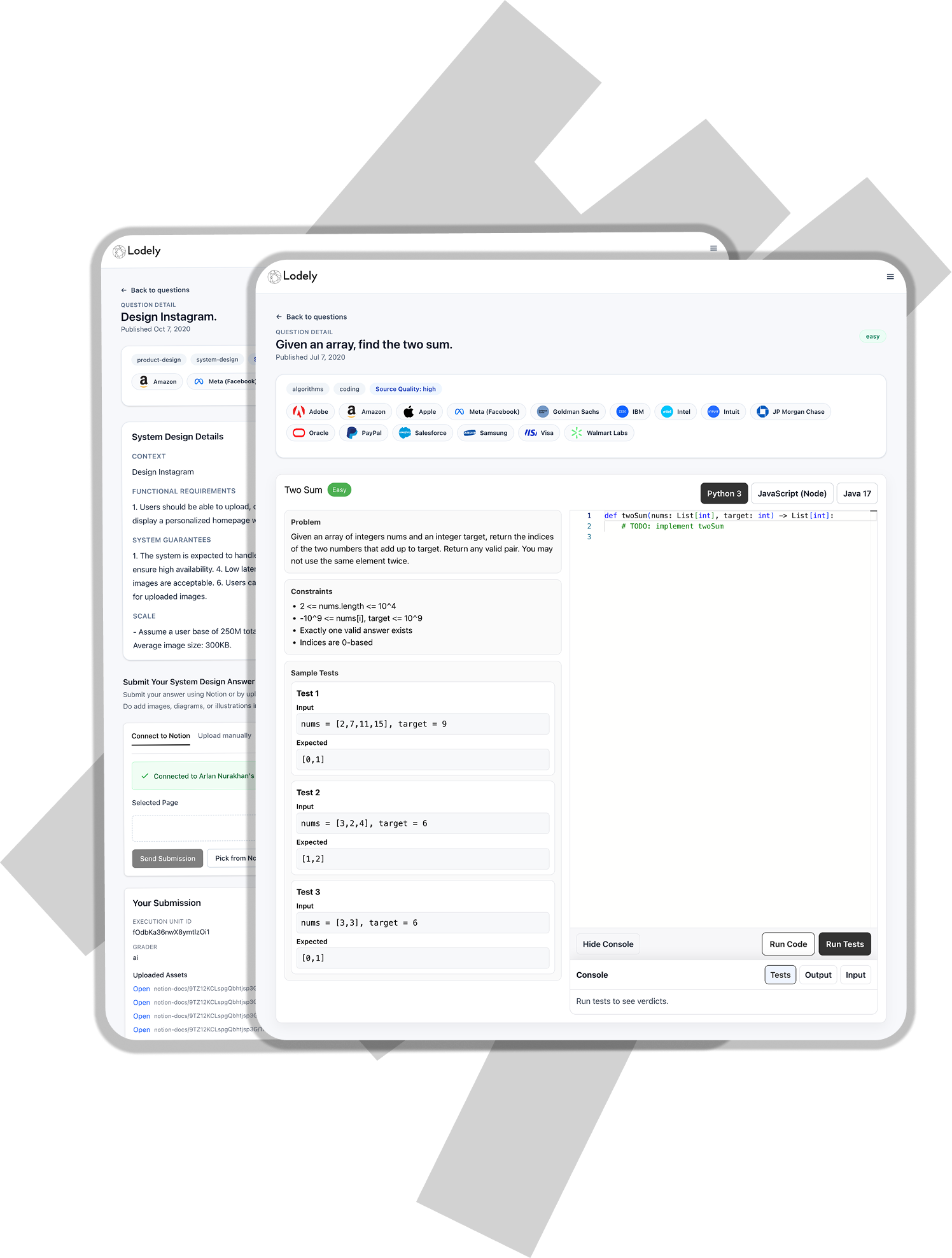
You can also visit Lodely to see the full range of resources we offer for software engineers.
For those preparing for technical assessments, you can check out our company online assessments and our dedicated Meta online assessment guide. If you want to strengthen your system design fundamentals, we created a comprehensive system design resource that many engineers find helpful during interview prep.
And if you prefer more tailored support, our software engineering career coaching is designed to help you understand your level, communicate your impact clearly, and approach interviews with confidence.
Whatever direction you decide to take after this, we are wishing you all the best. If any of our resources can help you move forward, feel free to explore them at your own pace.
✉️ Get free faang interview cheat sheet and interview tips weekly
✉️ Get free faang interview cheat sheet and interview tips weekly