


Abnormal AI Online Assessment: Questions Breakdown and Prep Guide

Curious what’s inside the Abnormal AI OA and how to train for it without guessing? You’re in the right place. Abnormal AI builds AI-driven defenses for email and collaboration platforms, so their assessment leans on pragmatic problem solving: streaming data, graph-leaning models, robust parsing, and performance under adversarial inputs.
Use this guide as your playbook: clear expectations, realistic practice, and company-specific patterns to focus your prep.
When to Expect the OA for Your Role
Abnormal AI calibrates content and timing by role and level. What candidates commonly see:
- New Grad & Intern — An OA link within a week or two of initial recruiter contact. Often the primary technical screen before final rounds.
- Software Engineer (Backend / Full-Stack / ML / Infra) — Expect a HackerRank or CodeSignal assessment shortly after you connect with the recruiter. Emphasis on data structures/algorithms, streaming windows, and correctness at scale.
- Security Engineering / SRE / Data Engineering — Similar OA flow, with domain-flavored tasks (log parsing, rate limiting, anomaly-style counters, queue-backed processing).
- Senior Roles — Mixed reports. Some move straight to live coding or design, but many still include an OA as an initial filter.
- Non-Engineering (PM / Ops) — Rare, typically logic/analytics when used.
Action step: Ask your recruiter, “What’s the OA format for this role?” They’ll usually share platform, duration, number of questions, and whether it’s proctored.
Does Your Online Assessment Matter?
Yes — and it’s more signal than you might think.
- It’s the main filter. Strong resumes get invites; strong OAs get interviews.
- It sets the tone. Your submitted code may be referenced later to shape on-site questions.
- It’s security-realistic. Expect tests of robustness: input validation, worst-case complexity, and resilience to adversarial patterns (e.g., degenerate regex, pathologic inputs).
- It signals engineering style. Clean structure, clear naming, edge-case coverage, and complexity awareness all count.
Pro tip: Treat the OA as a first interview. Aim for production-quality clarity: early input validation, tight complexity, and defensive coding.
Compiled List of Abnormal AI OA Question Types
Candidates report mixes of classic DSA with security/streaming twists. Practice these patterns:
- Design Hit Counter / Rate Limiter — type: Queue/Deque, Sliding Window
- Wildcard Matching (domain/pattern) — type: DP / Greedy
- Reconstruct Itinerary (thread/message linking) — type: Graph / Hierholzer / DFS
- Top K Frequent Elements (senders/subjects) — type: Heap / Hash Map
- Merge Intervals (quarantine windows) — type: Interval / Sorting
- Longest Substring with K Distinct (unique recipients window) — type: Sliding Window
- Contains Duplicate II (near-duplicate alerts) — type: Hashing / Sliding Window
- Find Median from Data Stream — type: Two Heaps
- LRU Cache (policy cache) — type: Design / LinkedHashMap
- Valid Parentheses (robust parsing) — type: Stack
- Rabin–Karp / Substring Search (signature detection) — type: Rolling Hash
- Number of Provinces (union similar entities) — type: Union-Find / Graph
- Network Delay Time (propagation time) — type: Dijkstra / Graph
- Decode String (header-like nested fields) — type: Stack / String

How to Prepare and Pass the Abnormal AI Online Assessment
Think “training camp,” not rote memorization. Build reflexes for correctness, speed, and robustness.
1. Assess Your Starting Point (Week 1)
List the topics you’re solid on (arrays, hashes, sliding windows) and the ones you dodge (graphs, heaps, DP). Use LeetCode “Explore” or HackerRank warmups to benchmark. This becomes your focus map.
2. Pick a Structured Learning Path (Weeks 2-6)
Options that work:
- Self-study on LeetCode/HackerRank
- Low cost, flexible. Pair daily practice with a spaced repetition list of patterns.
- Mock assessments/platforms
- Timed, proctored OAs mirror CodeSignal/HackerRank constraints.
- Mentor or coach
- A software engineer career coach can stress-test your solutions for edge cases and time management.
3. Practice With Realistic Problems (Weeks 3-8)
Favor Abnormal AI-flavored sets:
- Sliding windows for rate limiting and unique counters
- Graphs for relationship/thread reconstruction
- Heaps for top-K, streaming medians
- Robust string parsing and normalization (case, Unicode, punycode considerations)
- Union-Find for entity resolution
Timebox each session. After solving, refactor for clarity and add unit tests for boundary inputs.
4. Learn Abnormal AI-Specific Patterns
Given their domain, expect:
- Event ingestion and streaming logic — windowed counts, deduplication, and latency-aware structures
- Email/thread modeling — message graph linking (Message-ID/In-Reply-To), grouping, and ordering
- Robust parsing — avoid catastrophic regex; validate and normalize inputs defensively
- Graph/Entity resolution — users, senders, domains, tenants; unify correlated signals
- Performance discipline — predictable O(n log n) or O(n) paths under worst-case inputs
5. Simulate the OA Environment
Recreate the constraints:
- Platform: HackerRank or CodeSignal
- Duration: often 75–90 minutes for 2–3 problems
- Rules: limited library usage; read constraints carefully
- Practice with strict timers, no external notes, and large hidden test sets
6. Get Feedback and Iterate
Post-mortem each session:
- Did you miss an edge case (empty inputs, Unicode, extreme sizes)?
- Was your approach optimal in complexity and memory?
- Could another data structure simplify the code?
Track repeated mistakes and fix them with targeted drills.
Abnormal AI Interview Question Breakdown
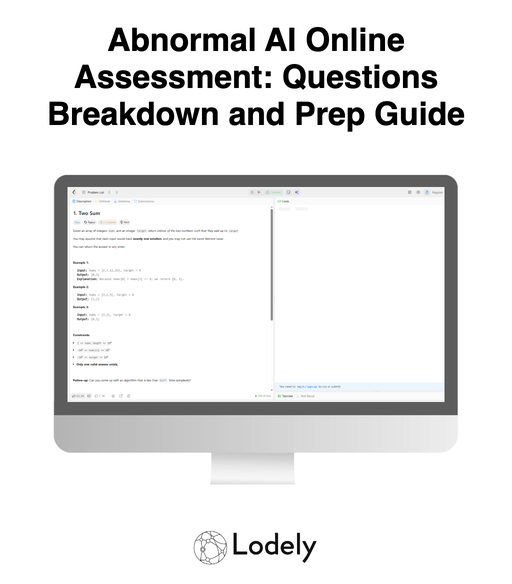
Here are sample problems inspired by common Abnormal AI OA themes. Master these patterns.
1. Sliding-Window Rate Limiter for Login Events
- Type: Queue/Deque, Sliding Window
- Prompt: Implement a rate limiter that allows at most N events per user in any rolling T-second window. Given a stream of (timestamp, userId), return which events are allowed.
- Trick: Maintain per-user deque of timestamps. Pop from the left while timestamps are outside the window; push current; allow if size <= N. Watch off-by-one on inclusive/exclusive boundaries.
- What It Tests: Sliding window mastery, per-key state, memory bounds, and adversarial input handling.
2. Reconstruct Email Threads from Headers
- Type: Graph / DFS / Topological Ordering
- Prompt: Given messages with id and inReplyTo (possibly missing), cluster into threads and order each thread from root to leaves. Ties break lexicographically by id.
- Trick: Map ids to nodes, build child adjacency from inReplyTo, detect cycles/missing parents gracefully, and produce stable order.
- What It Tests: Graph building, cycle safety, ordering guarantees, and careful edge-case reasoning.
3. Domain Block/Allow Matching with Wildcards
- Type: Trie / DP / Greedy
- Prompt: You have rules like *.example.com (block) and login.safe.com (allow). Given sender domains, decide allow/deny with priority for exact matches over wildcards.
- Trick: Normalize case, split by dots, match suffix wildcards efficiently (reverse trie or suffix match), and handle precedence deterministically.
- What It Tests: String normalization, trie/suffix structures, and policy precedence logic.
4. Deduplicate Alerts in a Rolling Window
- Type: Hashing / Sliding Window
- Prompt: Stream of alert keys (strings) with timestamps. Only surface an alert if an identical key hasn’t been seen in the last W seconds.
- Trick: Maintain a queue of (timestamp, key) plus a hash with last-seen time; expire old entries. Consider heavy churn and memory bounds.
- What It Tests: Amortized complexity, memory-aware design, and stream correctness.
5. Top-K Frequent Senders per Tenant
- Type: Heap / Hash Map
- Prompt: Given events (tenantId, sender), output the K most frequent senders per tenant after processing all events.
- Trick: Use a hash map per tenant for counts, then a bounded min-heap of size K (or bucket sort if universe is large but counts are small).
- What It Tests: Heap fluency, partitioned aggregation, and scalable per-key bookkeeping.
6. Merge Quarantine Windows and Compute Exposure
- Type: Intervals / Sorting
- Prompt: Given multiple quarantine intervals for a mailbox, merge overlaps and return the total non-quarantined duration across a time horizon.
- Trick: Sort by start, merge greedily, then subtract merged coverage from the horizon. Handle edge-touching intervals and empty sets.
- What It Tests: Interval logic, boundary math, and correctness under corner cases.
What Comes After the Online Assessment

Clearing the OA unlocks the deeper evaluation: how you design, communicate, and collaborate in security-focused engineering.
1. Recruiter Debrief & Scheduling
Expect an email within a few days with next steps. Ask for the upcoming interview structure, topics to expect, and any prep suggestions.
2. Live Technical Interviews
Interactive coding on a shared IDE or whiteboard-style tool. Expect:
- DSA problems similar to the OA, but with guided exploration
- Debugging or refactoring a flawed snippet
- Communication around trade-offs and testing strategy
Pro tip: Review your OA solutions — interviewers may ask you to walk through them.
3. Design Deep-Dive (Backend/Infra/ML)
A 45–60 minute design session, tailored by role. Examples:
- High-throughput event ingestion and deduplication
- Feature store and signals pipeline for ML detection
- Reliable quarantine/release workflow with idempotency
They’re looking for clear interfaces, scaling strategies, consistency choices, and failure handling.
4. Behavioral & Values Alignment
Expect security- and customer-focused prompts:
- “Tell me about a time you designed for failure or abuse cases.”
- “Describe a time you pushed for a correctness fix under time pressure.”
Use STAR. Emphasize ownership, bias for action, and empathy for customers under threat.
5. Final Loop
A multi-interview sequence combining:
- Another coding round
- Another design/system session
- Cross-functional conversations (e.g., product, security)
Plan for context switching and energy management across a half day.
6. Offer & Negotiation
If successful, you’ll receive a verbal summary followed by a written offer (base, bonus, equity). Research market ranges and be prepared to negotiate thoughtfully.
Conclusion
You don’t need to guess; you need to train like it’s production. The Abnormal AI OA rewards engineers who:
- Diagnose weak areas early and practice with timers
- Master streaming windows, graphs, heaps, and robust parsing
- Write clean, defensive, complexity-aware code
Treat the OA as your first interview, not a hurdle. If you prep with Abnormal AI’s problem patterns in mind, you’ll walk into each stage clear, confident, and ready to execute.
For more practical insights and prep strategies, explore the Lodely Blog or start from Lodely’s homepage to find guides and career resources tailored to software engineers.
✉️ Get free faang interview cheat sheet and interview tips weekly
✉️ Get free faang interview cheat sheet and interview tips weekly


