


Airtable Online Assessment: Questions Breakdown and Prep Guide

Trying to figure out what’s in Airtable’s OA and how to prep without guessing? You’re in the right place. Airtable’s product blends the flexibility of a spreadsheet with the rigor of a database, so their assessments tend to reward clarity, correctness, and strong fundamentals — with a sprinkle of real-world data modeling and collaboration themes.
If you want to walk into the Airtable Online Assessment confident and ready to execute, this guide is your playbook. No fluff. Clear breakdowns. Strategic prep.
When to Expect the OA for Your Role
Airtable’s OA timing depends on team, level, and location, but candidates consistently report the following patterns:
- New Grad & Intern (SWE)
- Expect an OA link shortly after recruiter contact. Often 1–2 coding problems plus a few short-answer items. For internships, it may be the only technical screen before final rounds.
- Software Engineer (Backend / Full-Stack / Web)
- Standard practice. Recruiters typically send a HackerRank or CodeSignal link soon after a screen. Questions are DS&A heavy with occasional practical twists.
- Frontend Engineer (Web)
- Often a DS&A-focused OA; some roles add a small JS/TypeScript or DOM-oriented question. Frontend specifics (React state, component patterns) usually show up in later rounds.
- Data / Infra / Platform
- Still an OA, usually DS&A plus a system-thinking flavor (concurrency, caching, rate limiting).
- Senior+ Roles
- Many senior candidates still complete an OA as an initial filter, though some pipelines replace it with a live coding screen or a take-home.
Action step: As soon as you get the recruiter email, ask: “Which platform, how many questions, how long, and which languages are allowed?” If you’re applying for frontend, ask whether the OA includes any JavaScript/TypeScript specifics.
Does Your Online Assessment Matter?
Short answer: yes.
- It’s the main filter. A polished resume earns the invite; your OA determines whether you progress.
- It sets the tone. Your submitted code may be reviewed by interviewers and can guide follow-up questions.
- It mirrors the work. Airtable cares about correctness under edge cases, readable code, and pragmatic complexity — reflecting a product used by millions in collaborative scenarios.
- It signals engineering craft. Clear naming, small functions, basic tests (when supported), and attention to complexity all matter.
Pro Tip: Treat the OA like a first interview, not a hurdle. Pre-write a quick template for your chosen language (I/O, basic helpers), time your practice, and always handle edge cases.
Compiled List of Airtable OA Question Types
Candidates report seeing a mix of classic DS&A and problems that map well to Airtable’s domain. Practice these:
- Top K Frequent Elements — type: Hash Map / Heap
- Group Anagrams — type: String Normalization / Hashing
- Merge Intervals — type: Sorting / Intervals
- Course Schedule (Topological Sort) — type: Graph / Kahn’s Algorithm
- Evaluate Reverse Polish Notation — type: Stack / Expression Eval
- Basic Calculator II — type: Parsing / Stack
- LRU Cache — type: Design / Hash + DLL
- Logger Rate Limiter — type: Sliding Window / Design
- Implement Trie (Prefix Tree) — type: Trie / String
- Range Sum Query 2D – Immutable — type: Prefix Sums / 2D Arrays
- Edit Distance — type: Dynamic Programming / Strings
- Kth Smallest in a Sorted Matrix — type: Heap / Binary Search
- Design Hit Counter — type: Queue / Sliding Window
- Flatten Nested List Iterator — type: Iterator / Stack
Why these? They map cleanly to Airtable-flavored themes: filtering and grouping records, dependency resolution across views/automations, formula parsing, rate-limiting webhooks, caching, prefix search, and spreadsheet-like 2D operations.
How to Prepare and Pass the Airtable Online Assessment
Think of this as training for precise execution under time pressure — with code clarity that would make your future teammates nod.
1. Assess Your Starting Point (Week 1)
- Take 1–2 timed mock OAs on CodeSignal/HackerRank.
- Identify weak zones: parsing, graphs, intervals, heaps, DP, or JS/TS-specific pitfalls (if frontend).
- Set a baseline: target solving 2 medium problems in 70–90 minutes consistently.
2. Pick a Structured Learning Path (Weeks 2-6)
- Self-study (LeetCode/HackerRank)
- Curate 50–70 problems from the list above. Track mistakes in a doc and return to them weekly.
- Mock assessments
- Timed, proctored sessions help with pacing and environment stress.
- Mentor or coach
- A software engineer career coach can push communication, code structure, and review patterns specific to your target role (e.g., frontend JS/TS clarity).
3. Practice With Realistic Problems (Weeks 3-8)
- Emphasize arrays, hashing, sorting, graphs, stacks/queues, and parsing.
- Add 2D operations (prefix sums), simple design (LRU, rate limiter), and dependency graphs.
- After coding, refactor: extract helpers, rename variables, and add brief comments — habits Airtable interviewers tend to value.
4. Learn Airtable-Specific Patterns
Expect questions that mirror real product concerns:
- Linked-record modeling and in-memory “joins” by key
- Dependency ordering for views, formulas, or automations (topo sort)
- Formula parsing and evaluation (operator precedence, function calls)
- Rate limiting and batching (webhooks, automations)
- Caching recently accessed records or computed views (LRU)
- Prefix search and fast filtering (tries, hash indexing)
- Interval merging for schedules or time-bound automations
- Cursor-based pagination and stable sorting
- Conflict-handling and idempotency for repeat events
5. Simulate the OA Environment
- Practice on HackerRank or CodeSignal with the exact time box (often 70–90 minutes for 2–3 problems).
- Disable distractions, use a single monitor, and code in your target language (Python, Java, JS/TS, Go, etc.).
- If you’re a frontend applicant, run 1–2 sessions in TypeScript to sharpen syntax and typing speed.
6. Get Feedback and Iterate
- Re-solve missed problems 2–3 days later without peeking.
- Share solutions with a peer/mentor. Ask: “Could this be cleaner? Any obvious edge cases missing?”
- Track recurring errors: off-by-ones, missing null/empty handling, unnecessary O(n log n) where O(n) is possible.
Airtable Interview Question Breakdown
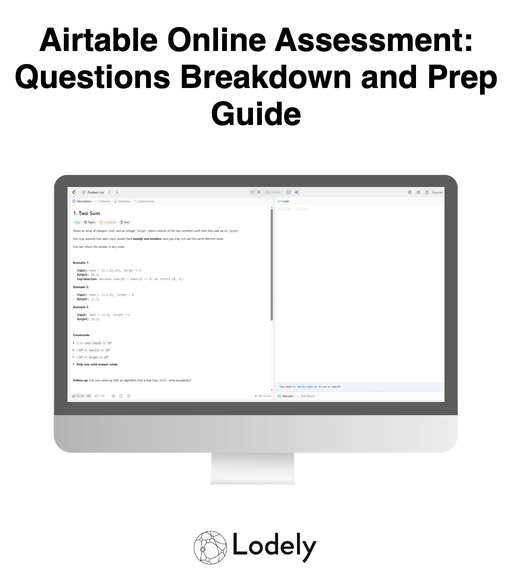
Here are featured sample problems inspired by common Airtable themes. Nail these patterns to cover most OA scenarios.
1. Evaluate Spreadsheet-Like Formulas
- Type: Parsing / Stack
- Prompt: Evaluate a string expression containing integers, +, -, *, /, parentheses, and simple functions like SUM(a,b,...) and MIN(a,b). No cell references; whitespace may appear.
- Trick: Tokenize; use two stacks (operands/operators) with operator precedence. For functions, collect arguments until the closing parenthesis and apply the function.
- What It Tests: Robust parsing, operator precedence, function handling, and input sanitization — core skills behind formula engines.
2. Dependency Resolution for Views/Automations
- Type: Graph / Topological Sort
- Prompt: Given a list of tasks and dependencies (A depends on B), return a valid execution order. If multiple independent tasks exist, you may batch by “levels” (all tasks available at each step).
- Trick: Use Kahn’s algorithm with in-degree tracking and a queue. For batching, process the queue layer by layer.
- What It Tests: Graph fundamentals, cycle detection, and the ability to structure outputs for practical execution.
3. Rate Limiter for Webhook Triggers
- Type: Queue / Sliding Window / Design
- Prompt: Implement allow(timestamp) that returns true if an event can proceed under a limit of N events per rolling window W seconds, otherwise false.
- Trick: Keep a queue of timestamps; evict events older than timestamp - W; accept only if size < N. Aim for amortized O(1).
- What It Tests: Time-window logic, data structure choice, and production-aware code paths.
4. Merge and Compact Overlapping Time Windows
- Type: Intervals / Sorting
- Prompt: Given a list of [start, end] windows representing scheduled automations, merge overlaps and return a minimal set of windows.
- Trick: Sort by start; sequentially merge by extending the end pointer while intervals overlap.
- What It Tests: Sorting, clean iteration, edge-case handling (touching intervals, singletons).
5. Deduplicate Records by Canonical Key
- Type: Hashing / Normalization
- Prompt: Given a list of user records with fields like name and email (potentially varied casing/spacing), group duplicates using a canonical key (e.g., lowercased email; trimmed, normalized name).
- Trick: Build a normalization function; use a hash map from normalized key to group. Consider ties or missing fields.
- What It Tests: Practical string handling, grouping, and data hygiene — very relevant to spreadsheet-to-database workflows.
What Comes After the Online Assessment

Clearing the OA moves you from “can you code?” to “can you build, collaborate, and ship?” Here’s what typically follows.
1. Recruiter Debrief & Scheduling
Expect an email within a few days if you pass. You’ll get timing for the next stages and high-level guidance. Ask about interview formats (coding vs. design vs. product-focused) and any role-specific prep tips.
2. Live Technical Interviews
You’ll pair with Airtable engineers in a collaborative editor (e.g., CoderPad, CodeSignal). Expect:
- Algorithms & Data Structures: similar to OA but interactive
- Debugging: walk through broken code or failing tests
- Communication: narrate trade-offs, complexity, and edge cases
If you’re frontend, be ready for practical JS/TS exercises, data transformation, and clean code patterns.
3. System Design / Architecture
More common for mid-level and senior roles. Potential prompts:
- Designing a simplified formula engine (parsing, dependency graph, incremental recompute)
- Building an event-driven automations pipeline (triggers, rate limits, idempotency)
- Modeling linked records and fast filtering for large bases (indexes, caching, pagination)
They’re looking for:
- Clear decomposition and pragmatic trade-offs
- Consistency vs. availability reasoning
- Observability, failure modes, and backpressure strategies
4. Behavioral & Values Interviews
Airtable emphasizes product quality, customer empathy, and collaborative execution. Expect:
- “Tell me about a time you significantly improved a system’s usability or reliability.”
- “Describe a disagreement with a teammate and how you resolved it.”
- “When did you ship under ambiguity? What did you optimize for?”
Use STAR (Situation, Task, Action, Result), and tie outcomes to user impact or team velocity.
5. Final Round / Virtual Onsite
A block of interviews that may include:
- Another coding session (often tougher or multi-part)
- A design or architecture deep dive
- Cross-functional conversation with PM/Design (product sense for engineers)
- For frontend roles: a UI/React-focused session (state, data fetching, component boundaries)
Prepare for context switching and sustained focus.
6. Offer & Negotiation
If successful, you’ll receive verbal feedback followed by a written offer. Compensation typically includes base salary, equity, and benefits. Research market ranges for the level and location, and be ready to discuss alternatives or constraints respectfully.
Conclusion
You don’t need to guess the Airtable OA — you need to prepare deliberately. If you:
- Diagnose weak areas early and practice under a timer,
- Focus on Airtable-relevant patterns (parsing, dependencies, rate limiting, intervals, hashing),
- Write clean, readable code with disciplined edge-case handling,
you’ll turn the OA into a strong first impression. Treat it like your first interview, not a gate, and you’ll be in excellent shape for the rounds that follow.
For more practical insights and prep strategies, explore the Lodely Blog or start from Lodely’s homepage to find guides and career resources tailored to software engineers.
✉️ Get free faang interview cheat sheet and interview tips weekly
✉️ Get free faang interview cheat sheet and interview tips weekly


