


Applied Intuition Interview Questions: 6 from Real Interviews

Applied Intuition's software engineering interview loop is short and technical. It typically moves from recruiter and hiring-manager conversations to live coding and an onsite with coding, system-design, low-level-design, and behavioral interviews.
What to Expect: Applied Intuition Interview Process
A current Applied Intuition process overview describes a coding screen followed by a four- to six-round "super day." Recent candidates reported loops with two coding rounds, two design rounds, and two behavioral conversations. The subject matter depends on the role, such as simulation, autonomy, machine learning, or infrastructure. Across roles, interviewers assess implementation quality and tradeoff reasoning.
Coding problems may include difficult extensions. Interviewers assess how you clarify requirements, plan the implementation, handle edge cases, and adapt when the prompt changes.
Interviewers may add domain requirements, sensor data, vehicle status, or simulation constraints. State your assumptions clearly and update the design when the interviewer changes a requirement.
How to Prepare and Pass Applied Intuition Interviews
Allow six to eight weeks. Review arrays, strings, maps, parsing, graph and geometry fundamentals, event-driven state management, object design, and scalable storage. For machine-learning roles, also cover data quality, offline evaluation, deployment, drift, and monitoring.
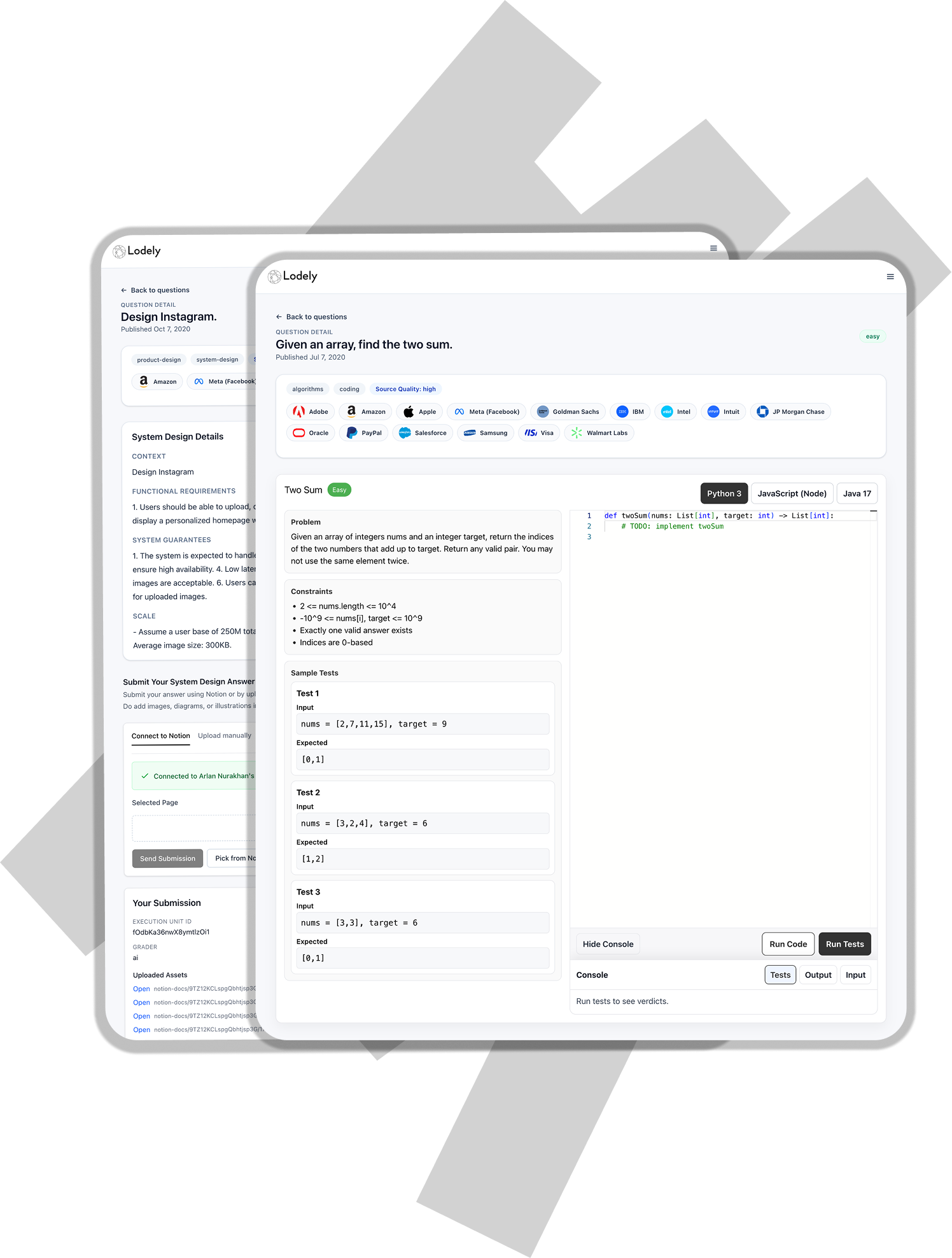
Practice without coding assistance because the current screen limits its use. Use Lodely to work through Applied Intuition coding and design questions, then practice the behavioral examples you'll need during the condensed onsite.
Practice explaining how each change affects correctness, failure handling, and the assumptions already in your design.

Applied Intuition Interview Breakdown
Encode String
Type: String encoding and collision handling. What It Tests: Representation design, grouping, and edge cases. The Trick: Start with the shortest possible abbreviation, then reveal only as many characters as needed to make each code unique and unambiguous.
Job Monitor
Type: Event-stream state management. What It Tests: Timestamp ordering, lifecycle tracking, and efficient expiration. The Trick: A job's last start or ping determines its timeout, while an end event closes it. Define how the system handles duplicate and out-of-order events.
Vehicle Velocity
Type: Applied coding. What It Tests: Converting physical observations into a correct calculation. The Trick: Define the units, order of operations, and handling of invalid data before implementing the formula.
Lane Segment adds geometry and connectivity constraints. ML System Design covers data collection, evaluation, deployment, and monitoring. Message Parser tests grammar handling, validation, and errors. Together, the six questions test core skills in domain-specific settings.
What Comes After The Interview
After the onsite, several interviewers may reconcile their feedback during final calibration. When evaluating an offer, review base pay, equity, vesting, and the assumptions used to value private shares.
Candidate Experiences
One referred candidate completed recruiter and hiring-manager interviews followed by a remote onsite. The onsite included two coding interviews, two system-design interviews, and two behavioral interviews. The candidate received an offer, viewed the team positively, and described a six-round format that required stamina.
Conclusion
Applied Intuition values durable code, accurate implementation of requirements, and design decisions grounded in physical-system constraints. Practice these six examples with Lodely before your technical screen and onsite.
✉️ Get free faang interview cheat sheet and interview tips weekly
✉️ Get free faang interview cheat sheet and interview tips weekly
