


BCG Online Assessment: Questions Breakdown and Prep Guide

Wondering what “BCG’s OA” actually looks like for software engineering roles? You’re not alone. Candidates see a mix of coding, SQL, and case-flavored prompts that test not just algorithms—but also product thinking and data hygiene. If you want to show up prepared, this guide will help you train for exactly what BCG (especially BCG X and data-focused teams) tends to emphasize: correctness, clarity, and business impact.
When to Expect the OA for Your Role
BCG uses an OA to screen for several engineering tracks. Timing and content can vary by role and team.
- New Grad & Intern (BCG X, Data/AI, Platform)
- Common to receive an OA 1–2 weeks after recruiter contact. Often includes one coding task and one SQL/data task.
- Software Engineer (Backend / Full-Stack / Platform)
- Expect a HackerRank, CodeSignal, or Codility link shortly after initial screen. Emphasis on DS&A plus clean, maintainable code.
- Data Engineering / Analytics Engineering / ML Engineering
- Likely a coding task plus SQL or data manipulation question. Expect joins, window functions, and ETL-style logic.
- Senior & Staff Engineers
- Some teams skip a generic OA and move directly to live coding or design. Many still keep an OA as a quick filter.
- Non-Engineering Roles
- Rare. When present, tests are more logic/analytics than coding.
Action step: Ask your recruiter which platform and sections (DS&A, SQL, data manipulation, short design) will be included for your role. You’ll often get duration and number of questions, which is key to pacing.
Does Your Online Assessment Matter?
Short answer: yes—more than you might think.
- It’s the main gate. A strong resume gets you the link; your OA decides if you move on.
- It sets the tone. OA code is sometimes referenced later to guide interview questions.
- It’s realistic to the work. BCG engineering involves data-heavy scenarios, thoughtful trade-offs, and clean interfaces.
- It signals how you work. Clear structure, readable naming, tests, and edge-case handling all matter.
Pro tip: Treat the OA like a first-round interview. Favor clarity over cleverness, include brief comments, and verify edge cases with small tests.
Compiled List of BCG OA Question Types
You’ll see classic DS&A with a business flavor, plus SQL/data tasks. Practice these patterns:
- Meeting Rooms II — type: Intervals / Heap (scheduling, resource allocation)
- Accounts Merge — type: Union-Find / Graph (entity resolution)
- LRU Cache — type: Design / Hash + DLL (caching, system primitives)
- Top K Frequent Elements — type: Heap / Counting (rollups, KPIs)
- Minimum Window Substring — type: Sliding Window (target coverage in streams)
- Is Graph Bipartite? — type: Graph / BFS-DFS (constraints/compatibility)
- Time Based Key-Value Store — type: Design / Binary Search (temporal data)
- Merge Intervals — type: Intervals / Sorting (calendar, bookings, ETL dedupe)
- Design Hit Counter — type: Design / Queue (rate-limiting basics)
- K Closest Points to Origin — type: Heap / Geometry (nearest neighbors)
- Partition Equal Subset Sum — type: DP (budgeting/packing analogy)
- Department Highest Salary — type: SQL / Aggregation + Join
- User Activity for the Past 30 Days II — type: SQL / Windowing/Filters
- Trips and Users — type: SQL / Conditional Joins + Grouping
Note: For SQL, also practice window functions (ROW_NUMBER, SUM OVER), date/time filters, and left vs. inner join behaviors.
How to Prepare and Pass the BCG Online Assessment
Think of prep as building reflexes for clean, business-aware coding—under time pressure.
1. Assess Your Starting Point (Week 1)
- Baseline yourself across arrays, strings, hashing, heaps, graphs, intervals, and DP.
- For data roles, add SQL joins, window functions, and date/time filtering.
- Do 1–2 timed mini-assessments to identify pacing gaps and weak topics.
2. Pick a Structured Learning Path (Weeks 2-6)
- Self-study on LeetCode/HackerRank
- Low cost and flexible. Build a curated list from the problem types above.
- SQL practice sets
- Use LeetCode Database or Mode/Strata-style challenges to practice joins and windows.
- Mock assessments or coaching
- Timed, proctored simulations help with nerves and pacing. A mentor can review code clarity and edge-case strategy.
3. Practice With Realistic Problems (Weeks 3-8)
- Build a 40–60 question set spanning intervals, heaps, graphs, sliding window, DP, design primitives (LRU, counters), and SQL.
- Timebox: 30–45 minutes per coding question; 10–15 minutes per SQL prompt.
- After solving, refactor for readability: function decomposition, naming, invariants, and basic tests.
4. Learn BCG-Specific Patterns
Expect case-flavored prompts, especially for BCG X and data teams:
- Entity resolution and deduplication (customer 360, multi-key matching)
- Scheduling/allocations (rooms, consultants, compute resources)
- Rolling metrics and cohorts (7-day active users, retention windows)
- ETL-style logic (joins, null safety, dedupe, late-arriving data)
- Lightweight systems design (rate limiter, cache, time-series store)
- Privacy/compliance constraints (data minimization, PII handling)
Tip: Practice articulating assumptions and trade-offs like you would in a client conversation.
5. Simulate the OA Environment
- Use HackerRank/CodeSignal practice modes. Recreate constraints: 60–90 minutes, 2–3 tasks, minimal Googling.
- Alternate formats: 2 coding + 1 SQL, or 1 coding + 1 SQL + 1 small design.
- Turn off distractions. Track time per question and hold yourself to it.
6. Get Feedback and Iterate
- Review solutions 24 hours later to catch missed edge cases.
- Share with a peer or mentor. Ask: Is the code self-explanatory? Are tests meaningful? Is complexity appropriate?
- Keep a “mistake log” (off-by-ones, overflow, join direction, window boundaries) and revisit weekly.
BCG Interview Question Breakdown
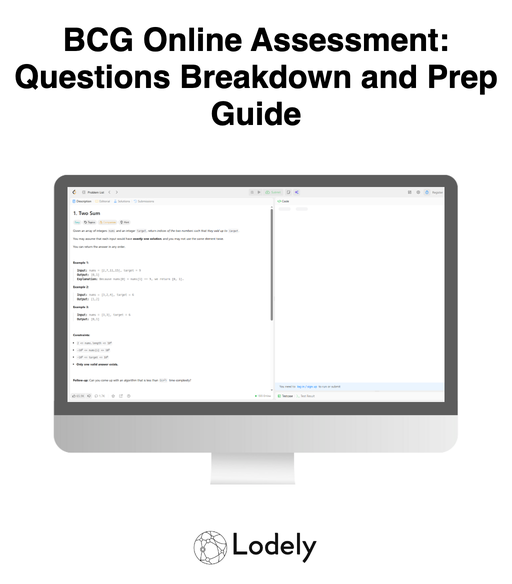
Below are sample, BCG-flavored problems. Practice the patterns and you’ll cover the OA’s core.
Consultant Scheduling to Minimize Rooms
- Type: Intervals / Heap
- Prompt: Given start and end times for client meetings across teams, compute the minimum number of rooms needed so no meetings overlap.
- Trick: Sort by start time and use a min-heap of end times to free rooms as meetings finish. Don’t linearly scan for availability.
- What It Tests: Interval reasoning, heap usage, time complexity, edge cases (identical times, zero-length meetings).
Join and Deduplicate Customer Records
- Type: SQL + Entity Resolution
- Prompt: You receive two tables of client accounts with partial overlaps. Return a deduped list keyed by a stable identifier, favoring the most recent non-null fields, and report counts per region.
- Trick: Use LEFT JOINs with COALESCE for field selection, partitioned ROW_NUMBER for latest record per entity, and GROUP BY for rollups. Be explicit about null handling.
- What It Tests: Join correctness, window functions, data hygiene, and clear, auditable SQL.
Budget-Constrained Feature Selection
- Type: Dynamic Programming (Knapsack)
- Prompt: Given features with costs and expected impact scores, select a subset within a fixed budget to maximize total impact.
- Trick: Use 0/1 knapsack DP (either O(n*budget) table or optimized 1D). Watch for large budgets requiring memory-optimized loops.
- What It Tests: Trade-off modeling, DP implementation discipline, and explaining business implications.
Rolling 7-Day Active Users
- Type: Sliding Window / SQL Window Functions
- Prompt: From an events table (user_id, event_time), compute daily 7-day active users and flag streak breaks per user.
- Trick: For code—two pointers with a queue of timestamps per day. For SQL—DENSE_RANK per user and date truncation, then windowed counts; beware of duplicate events.
- What It Tests: Time-window logic, deduplication, handling time zones, performance on large datasets.
API Rate Limiter for a Client-Facing Service
- Type: Design / Queue + Hash
- Prompt: Implement a per-user rate limiter allowing N requests per T seconds with O(1) amortized ops; expose allow(user_id, ts).
- Trick: Track timestamps per user with a deque, evict older-than-window entries on each call, and compare size to N. Discuss memory bounds and sharding.
- What It Tests: Systems design fundamentals, clean interfaces, complexity analysis, and practical constraints.
What Comes After the Online Assessment
Passing the OA moves you from “can you code?” to “can you build, explain, and collaborate in a BCG context?”
Recruiter Debrief & Scheduling
You’ll get timing on next steps and a high-level readout of your OA performance. Ask about upcoming rounds (coding, design, case-infused questions), interviewers’ focus areas, and logistics.
Live Technical Interviews
Expect collaborative coding in a shared editor. Interviews may include:
- DS&A similar to the OA, but interactive
- Debugging or refactoring an existing snippet
- Clear narration of trade-offs and assumptions
Tip: Revisit your OA code—interviewers sometimes ask you to walk through it.
Case-Infused Coding or Data Exercise
Some teams blend light case context into coding:
- A small dataset plus a business question (e.g., retention dip analysis)
- Writing a function with constraints tied to product or client realities
- Short SQL to diagnose a KPI anomaly
They’re evaluating whether you connect code to outcomes and communicate clearly.
System Design / Architecture Round
For mid/senior roles, expect a 45–60 minute design session. Sample prompts:
- Design a lightweight experimentation metrics pipeline
- Build a client-facing API with rate limiting and caching
- Sketch an entity resolution service across multiple sources
They’re listening for simplicity first, then scale, reliability, privacy, and cost.
Behavioral & Consulting Mindset
BCG values collaboration, ownership, and communication. Expect:
- “Tell me about a time you simplified a complex system under a deadline.”
- “Describe a trade-off you made that balanced speed and quality.”
Use STAR. Translate technical decisions into business impact.
Final Round / Onsite Loop
A multi-interview block that can include:
- Another coding round
- Deeper design or data architecture
- Cross-functional conversations with product or data leaders
Manage energy and context-switching. Bring questions that show product sense.
Offer & Negotiation
If successful, you’ll receive feedback and a formal offer. Compensation typically mixes base, performance components, and equity (varies by team/region). Do market research and be ready to discuss expectations.
Conclusion
You don’t need to guess—just prepare with intent. If you:
- Benchmark your skills early (including SQL and data hygiene),
- Practice BCG-style patterns under realistic time limits,
- Write clean, testable code and narrate trade-offs,
you’ll convert the OA from a hurdle into momentum for the rest of the process. Treat it like your first interview, keep business context in view, and you’ll be ready for the rounds that follow.
For more practical insights and prep strategies, explore the Lodely Blog or start from Lodely’s homepage to find guides and career resources tailored to software engineers.
✉️ Get free faang interview cheat sheet and interview tips weekly
✉️ Get free faang interview cheat sheet and interview tips weekly


