


Blackrock Online Assessment: Questions Breakdown and Prep Guide

Thinking about “Cracking BlackRock’s Assessment” but not sure what you’re getting into? You’re not alone. Engineers see a mix of LeetCode-style problems, data-heavy parsing tasks, and sometimes SQL — sprinkled with finance-flavored edge cases like business days, time zones, and precision math.
If you want to walk into the BlackRock Online Assessment (OA) confident, prepared, and ready to deliver under time pressure, this guide is your playbook. No fluff. Real breakdowns. Strategic prep.
When to Expect the OA for Your Role
BlackRock’s OA varies by role and location, but the patterns are consistent:
- New Grad & Intern (Aladdin Product Group, Technology) – Expect an OA within 1–2 weeks of recruiter contact. Typically 2–3 coding questions with arrays/strings/graphs plus occasionally a short SQL or debugging task. For some intern pipelines, the OA is the primary technical screen before final rounds.
- Software Engineer (Backend / Full-Stack / Platform) – Standard practice. Anticipate a HackerRank or CodeSignal link after initial recruiter chat. Problems tend to be data structures and algorithms with production-minded constraints (streaming input, large files, precision).
- Data Engineering / Analytics Engineering – Often includes SQL-heavy sections, CSV/JSON parsing, window functions, joins, and reasoning about schemas or ETL correctness.
- SRE / Cloud / Platform Reliability – OA may combine a coding task with practical scenarios: log parsing, rate limiting, Linux fundamentals, or networking basics.
- Quant Developer / Research Engineering – You may see algorithmic problems with math angles (time series, statistics, DP) and careful handling of numeric precision.
- Senior Engineering Roles – Some pipelines skip a generic OA and move straight to live coding or design. That said, many senior candidates still receive a brief OA as a first filter.
- Technical PM / Non-Engineering – Rare. When present, it’s more analytical/logic-focused, sometimes with light SQL.
Action step: When you receive the recruiter email, ask: “What’s the expected OA format for this role? Platform, number of questions, languages allowed, and whether there’s SQL or debugging.” Clarity here lets you tailor practice.
Does Your Online Assessment Matter?
Short answer: yes — it’s the first real gate.
- It’s the primary filter. Your resume opens the door; your OA performance determines whether you advance.
- It sets the tone. OA code can be reviewed by later interviewers to shape follow-up questions.
- It’s realistic. BlackRock works with Aladdin-scale data, regulated workflows, and time-series constraints. OAs often reflect these realities.
- It signals work style. Reviewers look at clarity, variable naming, testable structure, edge-case handling (time zones, business days), and complexity trade-offs.
- It surfaces domain awareness. You won’t need deep finance knowledge, but recognizing precision issues (BigDecimal vs float), stable sorting, and deterministic behavior is a plus.
Pro Tip: Treat the OA like your first interview. Write clean, readable code. State assumptions. Handle edge cases (empty inputs, duplicates, time boundaries). Add small sanity checks if the platform allows.
Compiled List of BlackRock OA Question Types
Expect a blend of classic DSA, data processing, and occasional SQL. Practice these:
- Merge Intervals — type: Intervals / Sorting
- Meeting Rooms II — type: Scheduling / Heaps
- Time-Based Key-Value Store — type: HashMap + Binary Search / Time Series
- Sliding Window Maximum — type: Deque / Sliding Window
- Top K Frequent Elements — type: Heap / Hashing
- LRU Cache — type: Design / LinkedHashMap
- Network Delay Time — type: Graph / Dijkstra
- Course Schedule — type: Graph / Topological Sort
- Find Median from Data Stream — type: Heaps / Streaming
- Kth Largest Element in a Stream — type: Heap / Streaming
- Valid Parentheses — type: Stack / Strings
- Group Anagrams — type: Hashing / Strings
- Department Top Three Salaries — type: SQL / Window Functions
- Trips and Users — type: SQL / Joins & Aggregation
- Game Play Analysis III — type: SQL / Window Functions
- Time Delta — type: Parsing / Time Zones
Finance-adjacent twists you might see: business-day calculations, UTC vs local time, CSV parsing with messy fields, precision-safe arithmetic.
How to Prepare and Pass the BlackRock Online Assessment
Think of prep as building reflexes. You’re optimizing for correctness under constraints, not just getting AC.
1. Assess Your Starting Point (Week 1)
- Take a timed baseline: 2–3 mixed problems (array/hash/graph) in 75–90 minutes.
- Do one SQL set (joins, window functions) if your role is data-facing.
- Note weak spots: interval logic, heaps, off-by-one errors in windows, or time-zone parsing. This becomes your focus list.
2. Pick a Structured Learning Path (Weeks 2-6)
- Self-study on LeetCode/HackerRank
- Great if you’re disciplined. Target a 40–60 problem list centered on BlackRock themes: intervals, heaps, streaming, time-series indexing, SQL windows.
- Mock assessments / proctored practice
- Paid platforms simulate OA environments and enforce pacing. Useful for test anxiety and time management.
- Career coach or mentor
- A software engineer career coach can review code clarity, help with trade-off narration, and fine-tune SQL reasoning.
3. Practice With Realistic Problems (Weeks 3-8)
- Alternate between classic DSA and data parsing tasks. E.g., “merge intervals” followed by “parse messy CSV and aggregate by timestamp bucket.”
- Add SQL reps: partitions, ranking, last-value-by-time, gap-filling.
- Use a 30–40 minute cap per medium problem. After solving, refactor for readability and stability (naming, early exits, edge cases).
4. Learn BlackRock-Specific Patterns
Expect patterns aligned with portfolio and risk workflows:
- Portfolio aggregation over time series (missing data handling, forward-fill/backfill, stable ordering).
- Business-day logic (holidays, settlement dates, weekends, end-of-month boundaries).
- Precision-safe math (avoid float drift; prefer decimal/BigDecimal; careful rounding).
- Streaming/large input handling (process line-by-line; bounded memory; heaps for top-k).
- Compliance-style rule evaluation (filters, whitelists/blacklists, deterministic ordering).
- Data lineage and schemas (consistent keys, idempotent transforms, null semantics).
- Time zones (normalize to UTC, daylight-saving pitfalls, consistent formatting).
5. Simulate the OA Environment
- Use the exact languages you’ll choose on the OA (commonly Java, Python, or C++; Scala for some data roles).
- Practice in a browser-based editor or the platform’s sandbox. Disable autocomplete-heavy plugins.
- Set strict timers (e.g., 90 minutes for 2–3 problems). No external libraries unless allowed.
- Get comfortable writing small helpers and tests inline (sanity checks for empty input, single element, boundary timestamps).
6. Get Feedback and Iterate
- Do a post-mortem on each session: What slowed you down? Which edge cases did you miss?
- Maintain a personal checklist: “Intervals sorted? Time normalized? Duplicates? Off-by-one in windows? Overflow/precision?”
- Share solutions with peers/mentors. Refactor for clarity and add comments on assumptions.
BlackRock Interview Question Breakdown
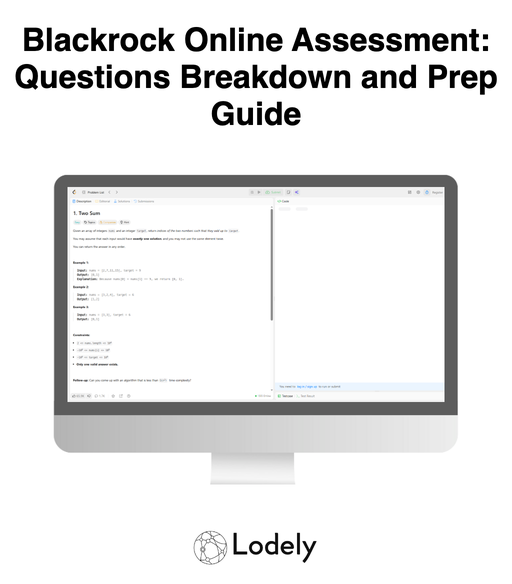
Here are featured sample problems tailored to BlackRock-style assessments. Master these patterns and you’ll cover most OA scenarios.
1. Portfolio Daily PnL Aggregation with Missing Data
- Type: Time Series / HashMap + Sorting
- Prompt: Given trades and daily prices for tickers, compute daily PnL per portfolio. Prices may be missing for some days; assume carry-forward of the last known price. Return a time-ordered list with zero for days before first price.
- Trick: Normalize timestamps (UTC), sort once, and maintain last-seen price per ticker. Use carry-forward carefully and handle portfolios with no trades yet.
- What It Tests: Time-series joins, edge-case handling, deterministic ordering, and memory-conscious aggregation.
2. Validate Orders Against Business Calendar
- Type: Intervals / Scheduling
- Prompt: You receive order timestamps and allowed trading windows (by local market). Determine which orders are valid after converting to UTC and excluding holidays/weekends.
- Trick: Convert all times to a single zone (UTC), merge overlapping windows, and use binary search or sweep-line to check inclusion efficiently.
- What It Tests: Interval reasoning, time-zone correctness, and careful boundary handling.
3. Time-Based Snapshots (Get by Timestamp)
- Type: HashMap + Binary Search
- Prompt: Implement set(key, value, timestamp) and get(key, timestamp) to return the most recent value at or before timestamp.
- Trick: Store per-key a sorted list of (ts, value). Use binary search for get; ensure stable ties.
- What It Tests: Data modeling for time-series retrieval, log-structured thinking, and O(log n) query performance.
4. Order Book Match (Simplified)
- Type: Heap / Greedy
- Prompt: Given incoming buy/sell orders (price, size), match them against an order book to produce trades. Use price-time priority.
- Trick: Two heaps (max-heap for buys, min-heap for sells). When buy.price >= sell.price, match and reduce quantities; maintain FIFO within price.
- What It Tests: Priority queues, stable ordering, and correctness under partial fills.
5. SQL: Top 3 Sector Weights per Portfolio
- Type: SQL / Window Functions
- Prompt: Given holdings(portfolio_id, ticker, shares) and security_master(ticker, sector, price), compute top 3 sectors per portfolio by market value and their percentage weights.
- Trick: Join, aggregate by (portfolio_id, sector), compute totals, apply DENSE_RANK over sector value, filter to rank <= 3, then compute percentage.
- What It Tests: Joins, grouping, window functions, and numeric precision.
6. Rate Limiter for Market Data API
- Type: Sliding Window / Deque
- Prompt: Implement allow(request_id, ts) that returns true if requests in the last W seconds are < K; otherwise false.
- Trick: Monotonic queue or timestamp deque; evict stale entries and keep O(1) amortized.
- What It Tests: Sliding window reasoning, amortized complexity, and production-minded constraints.
What Comes After the Online Assessment

Passing the BlackRock OA is your entry ticket. Next rounds assess how you design, communicate, and collaborate on real systems.
Recruiter Debrief & Scheduling
You’ll typically hear back within a few days. Expect high-level feedback, the structure of next rounds, and logistics. Ask about focus areas: coding vs. design vs. SQL, and which language the interviewers prefer.
Live Technical Interviews
Paired with BlackRock engineers in a collaborative editor or video call. Expect:
- Algorithms & Data Structures (similar to OA, interactive and deeper on trade-offs)
- Debugging & Refactoring (take a working-but-messy function and improve it)
- Readable Code Under Constraints (naming, tests, complexity discussion)
Pro Tip: Review your OA submissions — interviewers may ask you to walk through them.
System Design / Architecture Round
For mid-level and senior roles, you’ll design components akin to:
- A simplified portfolio analytics service (compute exposures, cache results, handle backfills)
- A data ingestion pipeline for market data (schema evolution, dedupe, idempotency, lineage)
- An entitlements-aware API (multi-tenant access control, PII, auditability)
They evaluate your ability to:
- Decompose problems and reason about scale/latency
- Choose storage and compute models (streams vs. batch; cache vs. DB; decimal vs. float)
- Address reliability, observability, and failure modes
SQL / Data Interview (Role-Dependent)
Data-facing roles include hands-on SQL and data modeling:
- Complex joins, window functions, and last-known-value lookups
- Data quality checks, null semantics, and business-day logic
- Reasoning about performance (indexes, partitions, approximate aggregations)
Behavioral & Values Alignment
Expect questions around collaboration, ownership, and client focus, such as:
- “Tell me about a time you resolved a data quality issue under pressure.”
- “Describe a situation where you simplified a complex system for reliability.” They’re listening for clear communication, bias for action, and a principled approach to risk and quality.
Final Round / Virtual Onsite
A multi-interview loop combining:
- Another coding session (often more open-ended)
- Design or data architecture
- Cross-functional conversations (product, data governance, risk) Plan for 3–4 hours with short breaks — manage your energy.
Offer & Negotiation
If successful, you’ll get a verbal call followed by a written offer. Compensation may include base, bonus, and equity. Research market ranges, prepare your priorities, and negotiate respectfully.
Conclusion
You don’t need to guess — you need to prepare. The BlackRock OA is demanding but predictable. If you:
- Identify weak areas early and target them,
- Practice BlackRock-style problems under timed conditions,
- Write clean, precise, and edge-case-aware code,
you’ll turn the OA from a bottleneck into momentum. Finance expertise isn’t required, but rigor is. Treat the OA like your first interview, and you’ll be ready for the rounds that follow.
For more practical insights and prep strategies, explore the Lodely Blog or start from Lodely’s homepage to find guides and career resources tailored to software engineers.
✉️ Get free faang interview cheat sheet and interview tips weekly
✉️ Get free faang interview cheat sheet and interview tips weekly


