


Capital One Online Assessment: Questions Breakdown and Prep Guide

Thinking about “Cracking Capital One’s Assessment” but not sure what’s inside the box? You’re not alone. Candidates see CodeSignal/HackerRank links, time pressure, and fintech-flavored twists — and the hardest part is knowing what to train for.
If you want to walk into the Capital One Online Assessment (OA) confident and ready to execute, this guide is your blueprint. No fluff. Real breakdowns. Strategic prep.
When to Expect the OA for Your Role
Capital One varies OA timing and content by role and seniority. Here’s what candidates commonly see:
- New Grad & Intern (Technology Development Program, Summit) – Expect an OA within 1–2 weeks of initial recruiter contact. Often the core technical filter before a condensed “Power Day” style final round.
- Software Engineer (Backend / Full-Stack / Platform) – Standard. Typically a CodeSignal or HackerRank OA with 2–4 coding questions in 70–90 minutes. Languages like Java, Python, and JavaScript are common.
- Data Engineering / Analytics / Machine Learning – A coding OA plus SQL or data transformation tasks (window functions, joins, aggregations). Occasional probability/statistics mini-questions.
- Cloud / SRE – Coding plus practical scenarios involving logs, reliability, or resource constraints. Expect some AWS-flavored context.
- Senior Roles – Some loops skip a generic OA and move to live coding + design, but many candidates still get an OA as an initial filter.
Action step: Once a recruiter reaches out, ask directly, “What’s the OA platform and format for this role?” You’ll usually get duration, languages allowed, and number of questions.
Does Your Online Assessment Matter?
Short answer: yes — it’s a major gate.
- It’s the main filter. Your resume gets you the invite; the OA gets you the interview loop.
- It sets the tone. Your OA code may be reviewed by future interviewers.
- It reflects real work. Capital One problems often feel “production-adjacent” — think time-series, event streams, idempotency, and correctness under edge cases.
- Code quality counts. Clear naming, tests (when supported), and handling worst-case complexity all matter.
Pro Tip: Treat the OA like a first-round interview. Time yourself, write maintainable code, and cover edge cases explicitly.
Compiled List of Capital One OA Question Types
Candidates report the following categories. Practice these patterns:
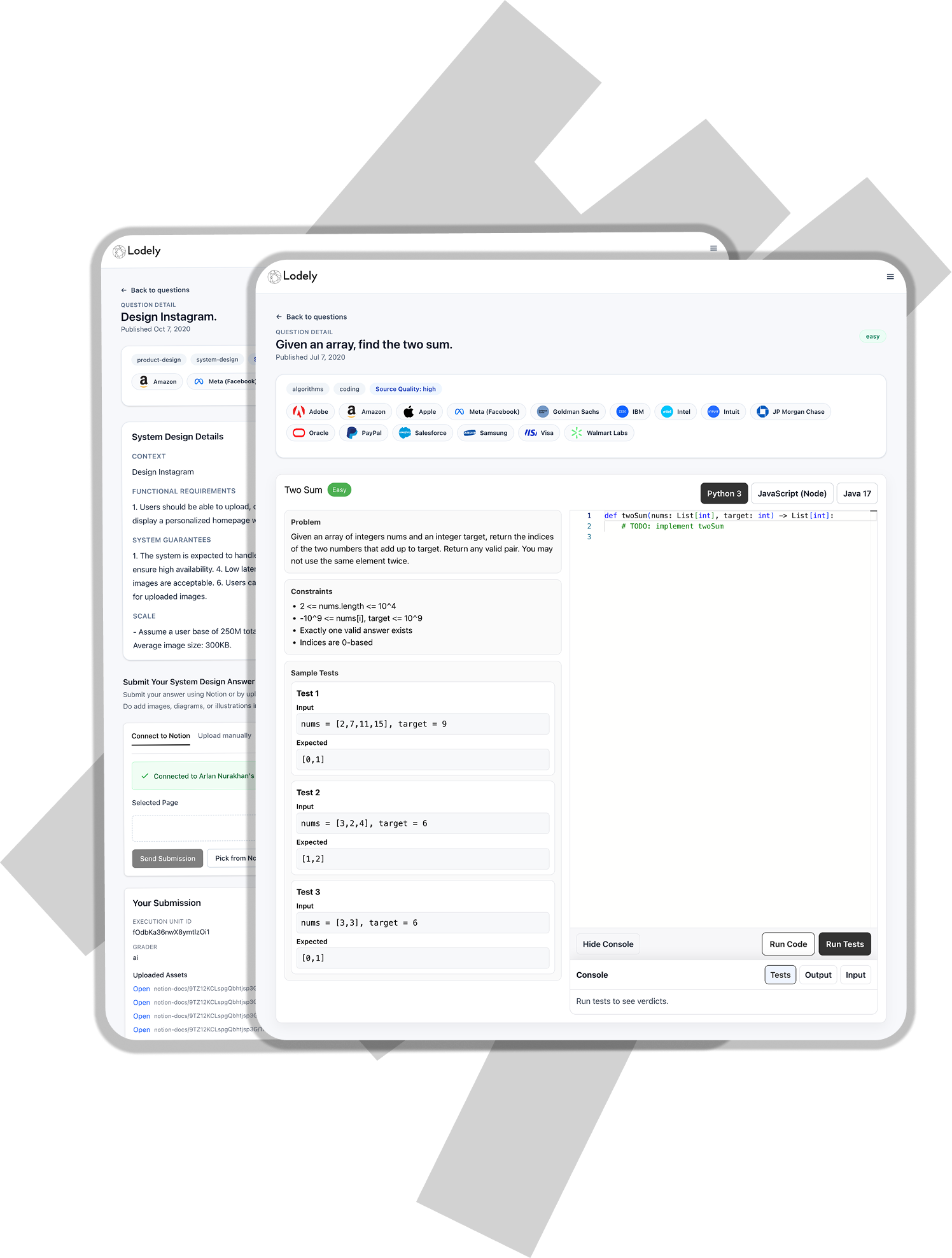
- Two Sum and Variants — type: Hash Map / Array
- Subarray Sum Equals K — type: Prefix Sum / Hashing
- Longest Substring with At Most K Distinct Characters — type: Sliding Window
- Top K Frequent Elements — type: Heap / Hash Map
- Accounts Merge — type: Union-Find / Graph
- Merge Intervals — type: Sorting / Intervals
- LRU Cache — type: Design / Doubly Linked List + Hash Map
- Design Hit Counter / Rate Limiter — type: Queue / Sliding Window
- Network Delay Time — type: Dijkstra / Graph
- Course Schedule — type: Graph / Cycle Detection
- Department Top Three Salaries — type: SQL / Window Functions
- Employees Earning More Than Their Managers — type: SQL / Self-Join
- Kth Smallest Element in a Sorted Matrix — type: Binary Search / Heap
- Valid Palindrome II — type: Two Pointers / String

How to Prepare and Pass the Capital One Online Assessment
Think of prep like training camp. You’re building speed, clarity, and judgment under time constraints.
1. Assess Your Starting Point (Week 1)
- Take a timed set of 2–3 medium LeetCode/CodeSignal problems.
- Note your slow topics (graphs, DP, SQL window functions).
- Write down what blocked you: unclear strategy, syntax, or complexity.
2. Pick a Structured Learning Path (Weeks 2-6)
- Self-study on LeetCode/HackerRank
- Best for disciplined learners; focus on arrays, hashing, sliding window, graphs, and common SQL.
- Mock assessments / proctored practice
- Simulate CodeSignal-style timers and pressure. Review reports for speed and accuracy.
- Mentor or coach
- A software engineer career coach can stress-test your approach and communication.
3. Practice With Realistic Problems (Weeks 3-8)
- Build a curated list of 40–60 Capital One–style questions (arrays, hashing, sliding window, graph traversal, SQL joins/window functions, simple design).
- Solve under time. Afterward, refactor for readability and robustness.
- Alternate coding with SQL practice. Aim for fluency with joins, GROUP BY, HAVING, and window functions.
4. Learn Capital One-Specific Patterns
Expect fintech-flavored twists:
- Ledger reconciliation and reversals (voids, chargebacks)
- Fraud detection heuristics (rolling windows, thresholds, top-K)
- Idempotent API behavior (deduplication by event keys)
- Event-stream processing patterns (Kafka/Kinesis semantics)
- PII handling and data partitioning by customer/account
- Rate limiting and backoff strategies for microservices
5. Simulate the OA Environment
- Use CodeSignal/HackerRank practice. Set 70–90 minutes for 2–4 questions.
- Turn off hints. No tab switching. Practice writing tests if the platform allows.
- Lock in your language of choice. Don’t switch languages right before the OA.
6. Get Feedback and Iterate
- Re-solve previously missed problems without looking at solutions.
- Share code with peers or a mentor. Ask for feedback on clarity, correctness, and complexity.
- Track patterns of mistakes (off-by-one, null handling, integer overflow) and write a checklist to run before submission.
Capital One Interview Question Breakdown
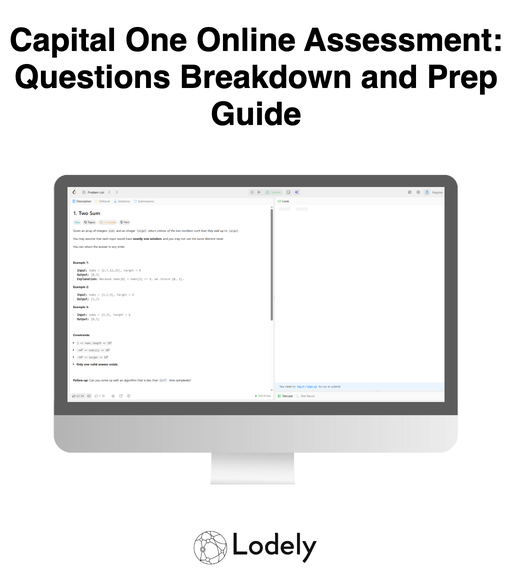
Here are featured sample problems inspired by Capital One’s OA style. Master the patterns, not just the answers.
1. Reconcile Ledger with Reversals
- Type: Hash Map / Prefix Sum / Parsing
- Prompt: Given a list of transactions (id, amount, type) and a list of reversals referencing prior transaction ids, compute the final balance and return the ids of unresolved mismatches.
- Trick: Use a map keyed by id to apply reversals idempotently; avoid double-subtracting. Consider multiple reversals and out-of-order events.
- What It Tests: Data integrity reasoning, idempotency, careful state tracking, and O(n) processing.
2. Sliding-Window Fraud Spike
- Type: Sliding Window / Heap or Deque
- Prompt: Given a stream of transaction amounts and a window size t (minutes), flag any user whose sum exceeds a threshold within any contiguous t window.
- Trick: Maintain a per-user deque of timestamps and a running sum. Evict stale events in O(1) amortized time.
- What It Tests: Streaming patterns, time-based eviction, and memory-conscious design.
3. Design a Simple Rate Limiter
- Type: Queue / Sliding Window / Design
- Prompt: Implement allow(userId, timestamp) that returns true if the user has fewer than R requests in the last W seconds.
- Trick: Store per-user queues; pop from the head while events are outside the window. Keep operations O(1) amortized.
- What It Tests: Practical microservice constraints, state management, and boundary conditions.
4. Accounts Merge by Contact Graph
- Type: Union-Find / Graph
- Prompt: Merge multiple accounts that share at least one email or phone. Return canonical records with deduplicated contacts.
- Trick: Build a graph of identifiers and union on edges; finally group by parent id. Sort deterministically for output.
- What It Tests: Graph modeling, disjoint set union correctness, and output hygiene.
5. Top Merchants by Dispute Rate (SQL)
- Type: SQL / Joins / Window Functions
- Prompt: Given transactions and disputes tables, find the top 3 merchants by dispute rate over the past 30 days (disputed_count / total_count), breaking ties by merchant id.
- Trick: Filter by date first, aggregate once, compute rates carefully (cast to decimal), and apply DENSE_RANK over rate desc, id asc.
- What It Tests: SQL fluency, window functions, careful denominator handling, and tie-breaking.
6. Shortest Path with Temporary Outages
- Type: Graph / Dijkstra
- Prompt: Given a service dependency graph with weighted edges and a set of temporarily down edges, compute the shortest path from source to all services ignoring down links.
- Trick: Pre-filter edges or check availability during relaxation. Use a priority queue; handle disconnected components.
- What It Tests: Graph algorithms under constraints, clean separation of concerns, and correctness on edge cases.
What Comes After the Online Assessment
Passing the Capital One OA opens the door; now you prove how you design, communicate, and collaborate.
1. Recruiter Debrief & Scheduling
Expect an email or call within a few business days. You’ll hear next steps and timelines. Ask about interview structure (coding vs. design vs. behavioral) and any role-specific focus areas (backend vs. data vs. cloud).
2. Live Technical Interviews
Usually 1–2 rounds on a shared editor or video call:
- Algorithmic coding similar to OA, but interactive
- Debugging or refactoring an existing snippet
- SQL (for data-focused roles): joins, windows, and careful filtering
Pro tip: Review your OA submissions. Interviewers may ask you to walk through your approach.
3. System Design / Architecture
For mid-level and senior roles:
- Design a transaction processing API, a ledger reconciliation pipeline, or a feature-flag service
- Discuss scale, consistency models, idempotency, retries, and monitoring
- Expect AWS-centric conversations (e.g., S3, Lambda, DynamoDB/RDS, Kinesis/Kafka)
They’re looking for trade-off thinking, not just buzzwords.
4. Behavioral & Values Alignment
Capital One emphasizes customer obsession, ownership, and doing the right thing. Expect prompts like:
- “Tell me about a time you handled sensitive data or mitigated risk.”
- “Describe a time you disagreed with a technical decision.”
Use STAR (Situation, Task, Action, Result) and be specific about impact.
5. Final Round / Power Day
A multi-interview block combining:
- Another coding round
- System design or data architecture
- Cross-functional or product collaboration discussion
Plan for context switches and keep answers crisp.
6. Offer & Negotiation
Comp often includes base, bonus, and equity. Research market ranges for your location and level. Be ready to discuss competing offers and priorities (scope, team, growth).
Conclusion
You don’t need to guess — you need a plan. The Capital One OA is rigorous but predictable. If you:
- Identify weak areas early,
- Drill the core patterns (hashing, sliding window, graphs, SQL) under timed conditions,
- Write clean, defensive code that handles edge cases,
you’ll turn the OA from a hurdle into your entry ticket. Fintech context helps, but disciplined problem-solving wins the day. Prepare with intention, and you’ll walk into each next stage with momentum.
For more practical insights and prep strategies, explore the Lodely Blog or start from Lodely’s homepage to find guides and career resources tailored to software engineers.
✉️ Get free faang interview cheat sheet and interview tips weekly
✉️ Get free faang interview cheat sheet and interview tips weekly


