


Coursera Interview Questions: 3 from Real Interviews

Coursera's software engineering process starts with a recruiter call, then moves to a technical screen and coding, system design, and behavioral interviews. Expect to write clean code, reason about scalability, and explain your interest in online learning.
What to Expect: Coursera Interview Process
After a 30-minute recruiter screen, candidates complete a data-structures interview or timed problem-solving challenge. The final stage may include back-to-back problem solving, system design, and a manager-led behavioral interview. The process length varies by experience level: entry-level loops may be shorter, while experienced candidates may receive deeper questions about architecture and past projects.
Coursera serves learners, universities, and business customers. Prepare to discuss reliability, content delivery, identity, progress tracking, and international scale across all three user groups.
How to Prepare and Pass Coursera Interviews
Plan four to six weeks. Use weeks one and two for implementation and testing. Use weeks three and four for education workflows such as enrollment, video delivery, recommendations, and course progress. In week five, prepare five short stories covering ownership, disagreements, failures, mentoring, and measurable impact.
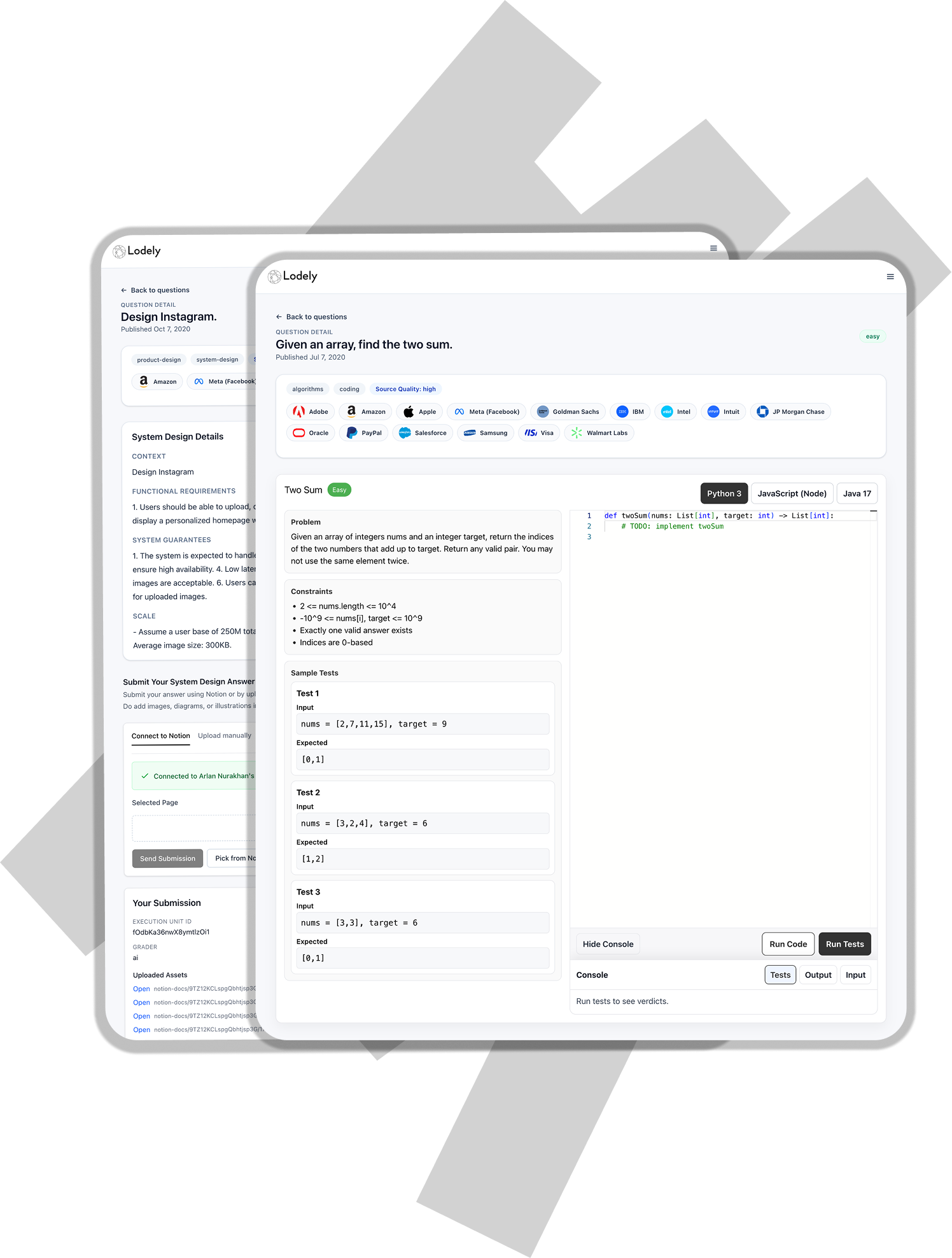
Use Lodely to practice coding alongside the rest of the loop. For Coursera, combine text-processing questions with a system-design mock and a walkthrough so you can switch formats smoothly.

Coursera Interview Breakdown
Team Voting - Popular Vote and Ranked Choice
Type: Data modeling and counting. The Trick: Define invalid ballots and tie-breaking rules before computing the result. What It Tests: Whether you can translate two election rules into deterministic code.
Formatting Text
Type: String parsing. The Trick: Separate tokenization from line construction so formatting errors do not obscure the parsing logic. What It Tests: Parsing, output formatting, and edge-case handling.
Design a Solution for Online Education
Type: System design. The Trick: Choose one workflow and define its requirements before covering content delivery, student progress, availability, and privacy. What It Tests: Requirements, data limits, and scale.
The three questions cover all the page requirements: two implementation problems and one product-architecture question. Explain your tests as you work. The product has several actors, so identify the actor behind each requirement.
What Comes After The Interview
Coursera decides level and fit before discussing an offer. Reported 2026 total compensation is $115K for Software Engineer I, $152K for Software Engineer II, $173K for Senior, and $230K for Staff. Location and equity mix can change those totals substantially.
Candidate Experiences
One recent engineer described a recruiter call, a data-structures coding screen delivered either as a test or live interview, and back-to-back problem-solving, architecture, and structured behavioral sessions with an engineering manager. The candidate did not receive an offer. They described the stages as clearly separated. Prepare to switch quickly among coding, design, and experience discussions.
Conclusion
Coursera looks for engineers who can implement software and reason about a multi-sided platform in a carefully designed environment. Practice explaining all three examples and their tradeoffs in plain English on Lodely.
✉️ Get free faang interview cheat sheet and interview tips weekly
✉️ Get free faang interview cheat sheet and interview tips weekly


